-
by sayum
28 August 2026 10:07 AM







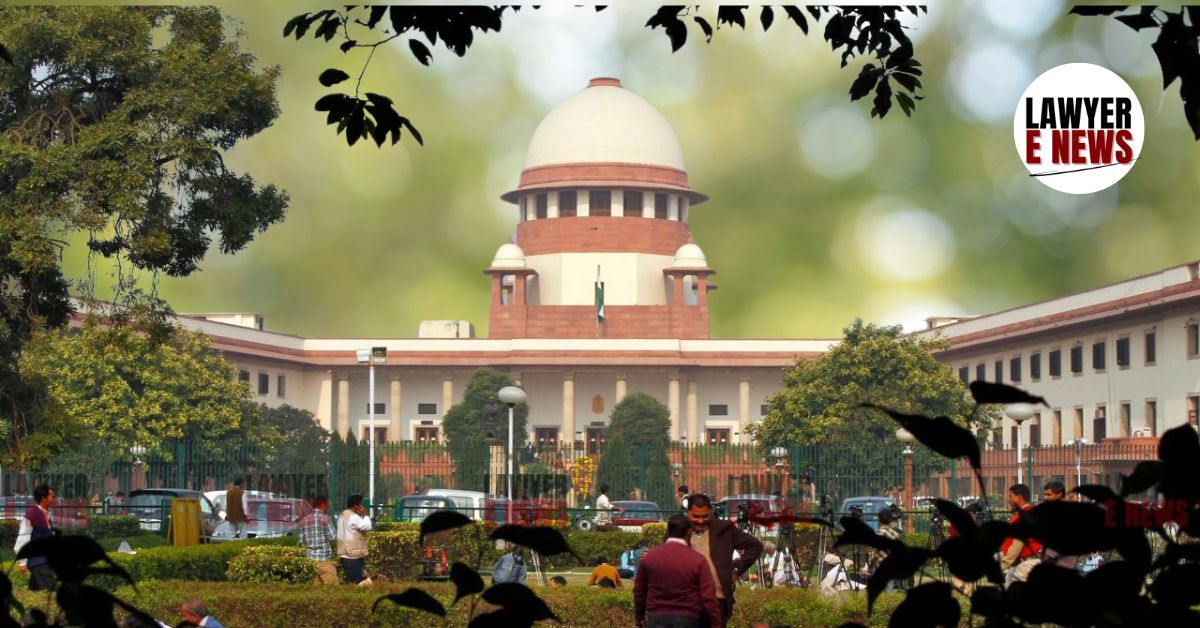
Supreme Court of India intervened under its extraordinary powers to order the transfer of a pending criminal trial in Delhi, citing the need to maintain public confidence in the fairness of judicial proceedings. While refusing to pass any judgment on the allegations made against the current Presiding Officer, the Court directed the reassignment of the trial to a different court of equivalent jurisdiction. The Bench comprising Justices Ahsanuddin Amanullah and S.V.N. Bhatti held that, “To ensure impartiality and protect the fairness of trial, transfer ordered without expressing any opinion on allegations.”
Invoking its powers under Section 406 of the Code of Criminal Procedure and Articles 136 and 142 of the Constitution, the Court ensured both procedural justice and the larger goal of public trust in the administration of justice.
“Trial Must End Within Three Months—Non-Cooperation Will Not Be Tolerated”: Supreme Court Lays Down Clear Timeline and Directions
The Supreme Court, while ordering the transfer of the case, also issued a stern directive mandating that the transferee court must conclude the trial “expeditiously and, latest within a period of three months from the date of such transfer.” In doing so, the Court warned that any delay caused by non-cooperation from either party would invite strict legal consequences. It emphasized that the concerned trial court “shall take appropriate steps in accordance with law to ensure that the trial is neither delayed nor suffers from any lacuna due to such non-cooperation.”
With the State assuring full cooperation in production of witnesses, the Court left no ambiguity regarding the responsibility of all stakeholders to adhere to the timeline, adding that the trial court “must manage its calendar accordingly so that the time frame fixed for final disposal is adhered to punctually.”
In a judgment that reflects both constitutional balance and judicial restraint, the Supreme Court of India on 4th September 2025 ordered the transfer of a criminal trial from its current court, following allegations by the petitioner of bias and lack of transparency by the sitting judge. The case, Rahul Sharma v. State NCT of Delhi & Others, arose after the Delhi High Court rejected the petitioner’s request for transfer. The Supreme Court, exercising its powers under Section 406 CrPC and Articles 136 and 142 of the Constitution, directed the Principal District and Sessions Judge, Shahdara, to either retain the matter himself or assign it to another court of equivalent jurisdiction. Importantly, the Court made it clear that it was not expressing any view on the allegations made, which were later unconditionally withdrawn by the petitioner.
Rahul Sharma, the petitioner, was facing a criminal trial in the Shahdara District of Delhi. Claiming that the conduct of the Presiding Officer raised serious concerns regarding transparency and fairness, he filed a petition before the Delhi High Court seeking transfer of the case. The High Court, however, dismissed the plea. Aggrieved by this rejection, the petitioner approached the Supreme Court under Article 136, invoking its special leave jurisdiction.
The core of the dispute was not the merits of the trial itself, but whether the continuation of the proceedings before the existing judicial officer would meet the constitutional threshold of a fair and impartial trial. During the hearing, the petitioner’s counsel submitted that the allegations made against the judicial officer would be withdrawn unconditionally.
The case revolved around two critical legal questions: First, whether the Supreme Court should exercise its power under Section 406 CrPC to transfer a criminal case merely on the basis of alleged bias, even when no concrete proof of prejudice has been established; and second, whether such power should be exercised when the petitioner is willing to withdraw all allegations unconditionally.
The Court struck a careful balance. While noting that it was “not expressing any opinion on the allegations”, it still found that justice would be best served by a change of forum. The Bench stated, “We are of the opinion that the ends of justice would be met if the case is assigned to a Court of equivalent jurisdiction by the concerned Principal District and Sessions Judge, Shahdara District.”
The Court clarified that it was intervening not because it found substance in the allegations, but to ensure that the fairness and impartiality of the proceedings were preserved in appearance and in fact. It added that the Principal District and Sessions Judge must reassign or retain the matter within one week from the date of the order.
In doing so, the Supreme Court reinforced the constitutional principle that justice must not only be done but must also be seen to be done—particularly in criminal trials where liberty is at stake.
The Supreme Court disposed of the Special Leave Petition with the following directions:
The case must be transferred or retained by the Principal District and Sessions Judge, Shahdara District, within one week. The transferee court must then proceed to complete the trial within three months. The Court was unequivocal in its direction that all parties must cooperate with the trial process, stating that “if there is non-cooperation from any side, the Court concerned shall take appropriate steps in accordance with law.” The State was specifically directed to ensure the presence of witnesses and to facilitate smooth scheduling of hearings.
In an important exchange during the proceedings, the Bench confronted the petitioner’s counsel about the accusations made against the Presiding Officer. The petitioner, through his Senior Counsel, withdrew all allegations unconditionally. This was recorded by the Court, which also noted the assurance that “in future no such insinuations would be made against any judicial officer or counsel representing the parties.”
By doing so, the Court not only avoided the need for a finding on judicial misconduct but also protected the integrity of the institution by ensuring that unfounded allegations do not become a means of forum-shopping.
The Court directed its Registry to immediately communicate the order to the Principal District and Sessions Judge and permitted the parties to bring the order to the Judge’s notice directly if required. All pending applications in the matter were also disposed of.
Date of Decision: 04 September 2025