-
by sayum
05 August 2026 3:07 PM







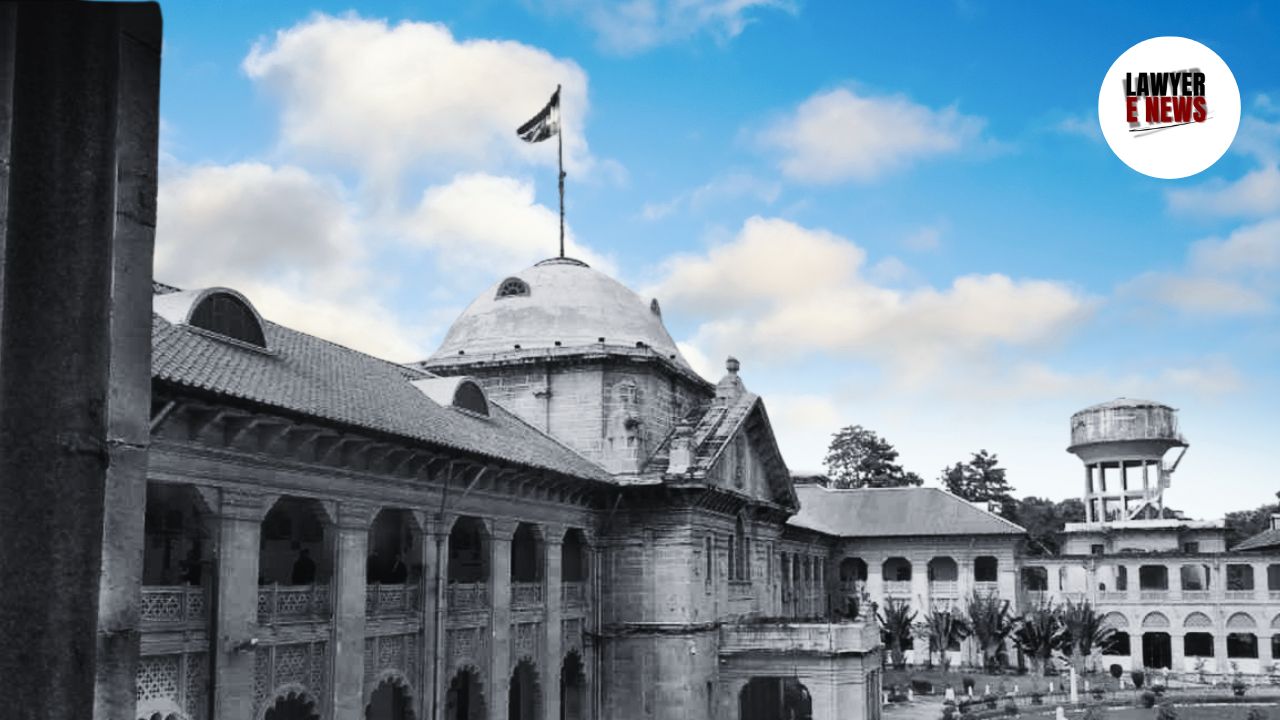
“Gratuity Act, 1972 Has No Application Where State Scheme Exists”, Allahabad High Court, in a reportable judgment delivered by Justice Ashwani Kumar Mishra and Justice Praveen Kumar Giri, dismissed the special appeal of a retired headmaster, Bindra Prasad Patel, who sought gratuity under the Payment of Gratuity Act, 1972. The Court upheld the view that teachers in basic institutions are governed by distinct State Government schemes, rendering the Gratuity Act inapplicable. Reiterating binding Supreme Court precedent, the Bench held, “A teacher of a basic institution holds a post under the State Government and is governed by separate gratuity schemes framed under executive authority, hence excluded under Section 2(e) of the Gratuity Act.”
This ruling decisively settles the debate on whether teachers of basic institutions can invoke central gratuity law, drawing a clear line of demarcation between State schemes and central legislation.
The appellant, a retired Headmaster, had superannuated at 64 years after availing an extension under the National Teachers’ Award scheme. He filed a writ petition seeking gratuity under the Payment of Gratuity Act, 1972, which was dismissed by the Single Judge. The appellant argued that as the institution employed more than 10 persons, it fell within the scope of the Gratuity Act post the 1997 notification issued by the Central Government.
The respondents, including the State of Uttar Pradesh and the Basic Education Board, countered that the appellant, as a teacher under the U.P. Basic Education Act, 1972, was not entitled to gratuity under the central legislation but only under the State’s specific gratuity scheme.
At the heart of the dispute lay the interpretation of Section 2(e) of the Payment of Gratuity Act, 1972, which excludes from its ambit “persons who hold posts under the State Government and are governed by any other Act or Rules providing for payment of gratuity.”
Justice Ashwani Kumar Mishra, authoring the judgment, framed two key questions:
Whether teachers in basic institutions hold posts under the State Government;
Whether such teachers are governed by separate gratuity rules or schemes.
On the first issue, the Court invoked the landmark decision in Biharilal Dobray v. Roshan Lal Dobray, (1984) 1 SCC 551, where the Supreme Court unequivocally held, “Every employee of the Basic Education Board holds his office under the Government.” The High Court echoed, “The true nature of employment under the State Government is writ large in the Act and Rules themselves.” [Para 24]
Gratuity Claim Under State Scheme Not Replaceable by Gratuity Act, 1972
On the second point, the Court meticulously traced the State’s gratuity schemes, beginning from the 1994 Government Order offering gratuity contingent upon voluntary retirement at 58 years, later extended to 60 years, with superannuation age increased to 62 years.
Addressing the applicability of Section 2(e), the Court observed: “The exclusion from Section 2(e) applies not only where gratuity is regulated by specific legislation but also where it is governed by valid executive instructions, issued under Article 162 of the Constitution.” [Para 28]
The Court emphasized that the legislative intent was not to override existing service-specific schemes and noted:
“The power of the State to frame gratuity schemes through executive orders co-exists with its legislative competence, and such schemes satisfy the exclusion contemplated in Section 2(e).” [Para 28]
Overriding Effect of Section 14 of the Gratuity Act Inapplicable
The appellant’s argument invoking Section 14, which grants overriding effect to the Gratuity Act, was categorically rejected. The Court clarified:
“Section 14 cannot operate in cases where exclusion under Section 2(e) applies. Once an employee falls outside the definition under Section 2(e), the overriding effect becomes irrelevant.” [Para 25]
Reliance on Private Sector Judgments Rejected
The Court differentiated between cases of private unaided schools, where gratuity under the Gratuity Act has been upheld (as in Independent Schools’ Federation of India v. Union of India), and basic institutions established under the U.P. Basic Education Act. The High Court observed:
“Unlike private schools, basic institutions operate under the direct administrative and financial control of the State, making their teachers public employees governed by State schemes.” [Para 29]
In unequivocal terms, the High Court held: “A teacher (including Headmaster) of a basic institution cannot be held to be an ‘employee’ under Section 2(e) of the Gratuity Act, 1972, and hence, is not entitled to claim gratuity under the central statute. The special appeal fails on all counts.” [Para 29-30]
This ruling reinforces the constitutional separation between centrally applicable labour welfare legislation and State-framed service benefit schemes, asserting the primacy of service-specific rules for public employees.
Date of Decision: 8th July 2025