-
by sayum
28 August 2026 8:44 AM







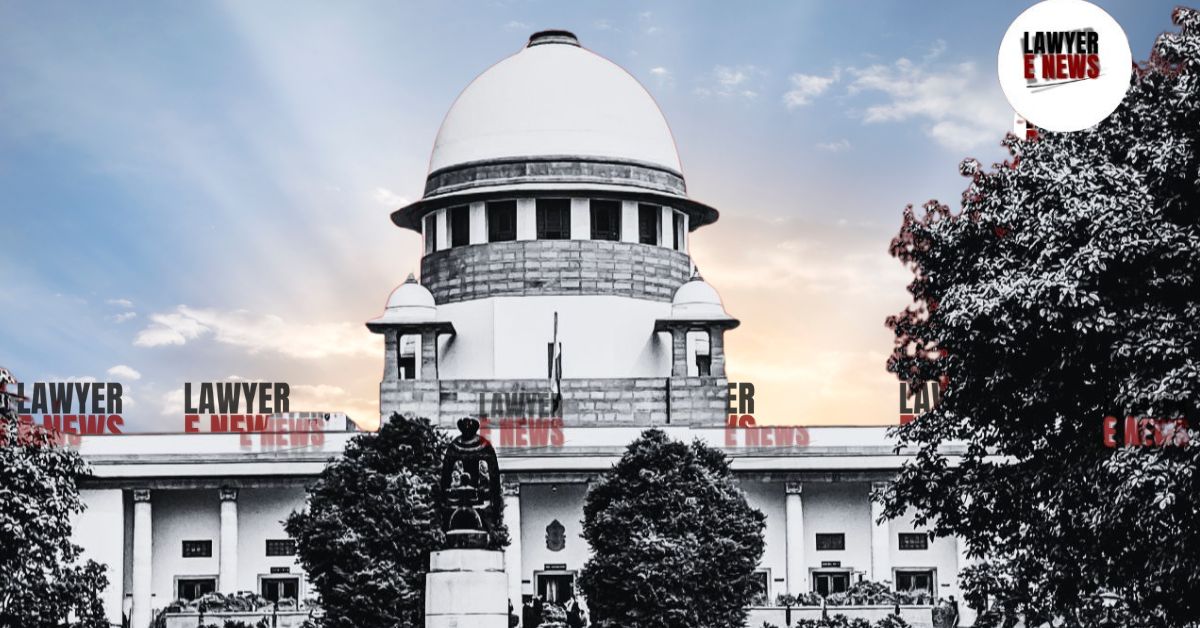
“A Generating Company and a Distribution Licensee Cannot, by Private Agreement, Execute a PPA or Stipulate Tariff Without the Commission’s Approval” — Supreme Court of India delivered a decisive ruling in the case of M/s. KKK Hydro Power Limited v. Himachal Pradesh State Electricity Board Limited & Ors., Civil Appeal No. 3005 of 2015. The judgment dismantles the private claim of a power developer seeking retrospective enhancement of tariff under an unapproved supplementary Power Purchase Agreement (PPA), and reinforces the supremacy of regulatory oversight in the Indian electricity sector. The Court categorically held that tariff fixation is not a private commercial negotiation but a statutory function, and dismissed the appeal filed by M/s. KKK Hydro Power Limited.
“Statutory Approval Is Not Optional – It Is the Soul of the Tariff”: Supreme Court Declares Enhanced Tariff Without Commission Approval Invalid
The appellant, M/s. KKK Hydro Power Limited, had entered into an Implementation Agreement on 30.03.2000 with the Government of Himachal Pradesh to establish a 3 MW hydroelectric project, followed by a PPA with the Himachal Pradesh State Electricity Board (HPSEB) on the same day. The agreed tariff was ₹2.50 per kWh, firm and fixed for 40 years. Subsequently, the capacity was augmented to 4.90 MW, and a fresh PPA dated 11.03.2008 was signed, again quoting ₹2.50 per kWh but “subject to the Himachal Pradesh Electricity Regulatory Commission (Power Procurement from Renewable Sources and Cogeneration by Distribution Licensee) Regulations, 2007.”
In 2010, following a revised tariff order issued by the HPERC increasing tariff to ₹2.95 per kWh, the appellant and HPSEB privately executed a supplementary PPA dated 10.09.2010, enhancing the tariff unilaterally without securing the mandatory approval of the Commission.
The Supreme Court held that this approach struck at the very foundation of statutory oversight under Section 86(1)(b) of the Electricity Act, 2003, which mandates that every PPA and its tariff must be reviewed and approved by the State Commission. The Court observed:
“Fixing of the price for the purchase of electricity is not a matter of private negotiation and agreement between a generating company and a distribution licensee... necessarily have to be reviewed and approved by the State Commission under this provision.”
“A Private PPA Cannot Trump the Law”: Supreme Court Rejects Unapproved Supplementary Agreement
The appellant claimed arrears based on the higher tariff of ₹2.95/kWh as stipulated in the 2010 supplementary PPA. However, the Supreme Court found that no draft of the amended agreement had ever been placed before the Commission, and thus it had no legal sanctity. The Court remarked:
“The supplementary PPA dated 10.09.2010 was executed independently and unilaterally by the parties... incorporating a tariff which was never subjected to the review and approval of the Commission.”
The Apex Court faulted the Appellate Tribunal for Electricity (APTEL) for having failed to give due weight to the statutory scheme when it directed implementation of the enhanced tariff for the entire project. It noted:
“The APTEL misguided itself on certain crucial aspects... The observation of the APTEL that no adverse inference could be drawn against the appellant... completely overlooked the binding mandate of Section 86(1)(b) of the Act of 2003.”
“Regulatory Approval Is Not a Ritual – It’s the Rule”: Apex Court Refuses Relief Despite Operational Reality
Despite finding the appellant's claim legally infirm, the Court, citing practical reasons, chose not to disturb the subsequently approved weighted average tariff of ₹2.60/kWh that had been operating pursuant to another supplementary PPA dated 03.11.2015, which the Commission approved. The Court reasoned:
“We choose not to interfere at this late stage... More so, as the HPSEB did not even choose to file an appeal against the impugned order.”
“Old PPAs Stand on Different Legal Footing”: Court Differentiates Between Pre- and Post-Regulatory Regime Projects
Another significant aspect of the ruling was the Court’s clear refusal to extend the enhanced tariff to the original 3 MW component, which had been commissioned prior to the 2007 Regulations and was governed by a PPA signed in 2000. The Court emphasized:
“The appellant cannot draw parity with power projects which entered into PPAs after establishment of the Commission... the very fact that its PPA was dated 30.03.2000 distinguishes it.”
Only the 1.90 MW capacity, added after 2007, could be considered under the revised regulatory regime — but even for that, the proper route was to seek Commission approval, not unilateral action.
“Where Policy Changes Hurt, Remedy Lies With The Commission”: Court Opens Door for Separate Royalty Review
On a tangential but important note, the appellant had also highlighted policy changes in royalty structure imposed by the Himachal Pradesh Government, impacting returns. While denying any immediate relief, the Court noted that the amended proviso to Regulation 6 of the 2007 Regulations could be invoked, if policy shifts affected viability. The Bench advised:
“It would, therefore, be open to the appellant to approach the Commission for appropriate relief under the amended proviso to Regulation 6 of the Regulations of 2007. We leave it at that.”
The Supreme Court dismissed the appeal filed by M/s. KKK Hydro Power Limited, affirming that tariff arrangements made without regulatory approval are unenforceable, and regulatory oversight is not just procedural but foundational to India's electricity governance.
The judgment sends a strong signal to both generators and distribution licensees: “compliance with regulatory procedure is not optional; it is the essence of lawful tariff determination.”
Date of Decision: August 29, 2025