-
by sayum
10 August 2026 1:57 PM







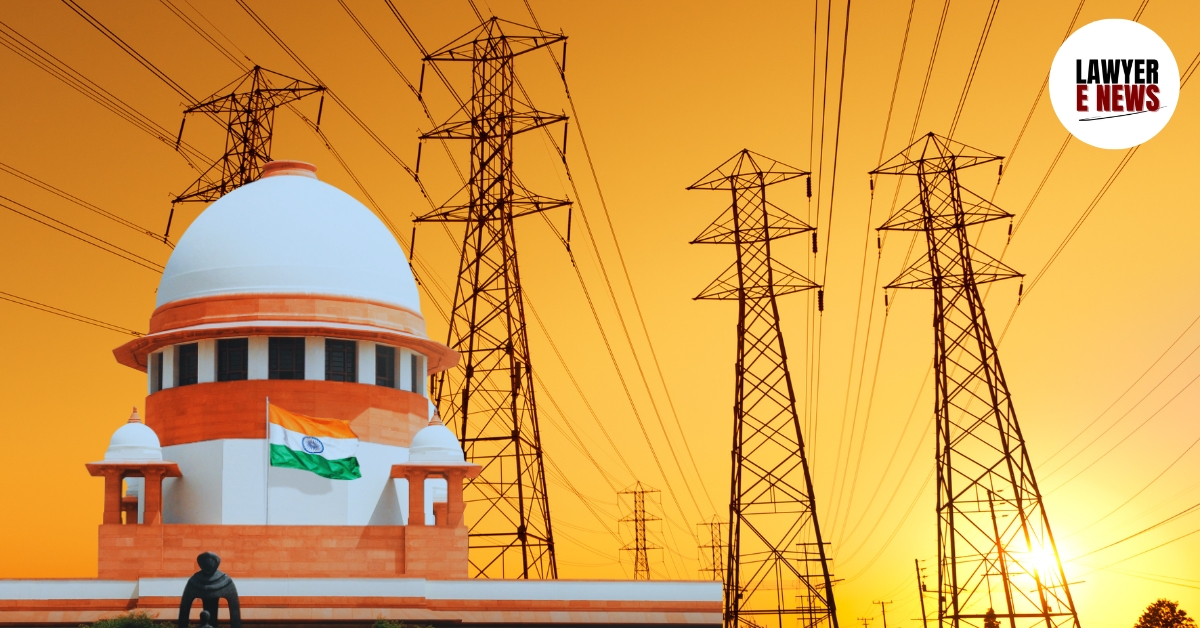
“Restitution Must Begin From the Date of Change, Not From Demand or Bill”, Supreme Court of India delivered a landmark judgment reaffirming the legal and contractual framework surrounding 'Change in Law' claims under Power Purchase Agreements (PPAs). The Court upheld Adani Power’s right to be compensated for Evacuation Facility Charges (EFC) imposed via a Coal India Ltd. notification, rejecting the challenge mounted by the Rajasthan DISCOMs. It ruled that compensation, along with Late Payment Surcharge (LPS) as carrying cost, was lawfully granted by the Appellate Tribunal for Electricity (APTEL).
The matter originated from a PPA signed in 2010 between Adani Power Rajasthan Ltd. (APRL) and three Rajasthan distribution companies for 1200 MW of power at Rs. 3.238/unit. In December 2017, Coal India Ltd. issued a notification levying EFC at Rs. 50/tonne. APRL promptly informed the DISCOMs that this constituted a 'Change in Law' under Article 10 of the PPA.
Following disputes and partial denial of relief by the Rajasthan Electricity Regulatory Commission (RERC), APRL appealed to APTEL, which accepted their claim for compensation and carrying costs.
At the heart of the appeal were two legal contentions: (1) whether the EFC notification was a valid ‘Change in Law’ event under Article 10 of the PPA, and (2) whether compensation was payable from the date of the notification, even in the absence of an initial supplementary bill.
The Supreme Court clarified that under Article 10.5.1(i), restitution starts from the date of the legal or regulatory change, not from the date of a claim or supplementary bill.
“As a matter of course, the adjustment in monthly tariff payment shall become effective from the date notified in the change in law,” the Court held, adding that “Article 10.5.1(ii)... is not applicable to the facts of the instant case since there is no change in law which has occasioned by way of an interpretation given by a Court or a Tribunal.”
Rejecting the DISCOMs’ insistence on the necessity of a supplementary bill before triggering liability, the Court explained:
“A supplementary bill has to be raised only after due adjudication by the competent forum,” affirming that procedural delays do not defer the accrual of rights.
The Court dismissed the DISCOMs’ arguments that Adani Power's delay in filing the appeal or in issuing the bill should deny it carrying cost:
“A different understanding would not result in a different interpretation of law, that would bar entitlement under Article 10.5.1(i) of the PPA.”
On carrying costs, the Court found no reason to diverge from GMR Warora Energy Ltd. v. CERC (2023), UHBVNL v. Adani Power Ltd. (2019), and MSEDCL v. MERC (2022), where compound interest on carrying costs was affirmed as restitutionary:
“Interest on carrying cost is nothing but time value for money… aimed at restituting a party adversely affected by a change in law event.”
It emphasized that Courts cannot rewrite contractual terms, nor deny compensation merely due to delayed enforcement:
“Unwarranted litigation… adds to the ultimate cost of electricity consumed by the end-consumer… the huge cost of litigation… adds to the cost of electricity that is supplied to the end-consumers.”
By affirming Adani Power’s entitlement to change in law compensation and carrying cost from the date of the CIL notification, the Supreme Court solidified the principle that economic restitution under PPAs begins from the legal change itself, not from subsequent procedural acts like billing. The appeal by the Rajasthan DISCOMs was dismissed.
Date of Decision: May 23, 2025