-
by sayum
08 August 2026 1:54 PM







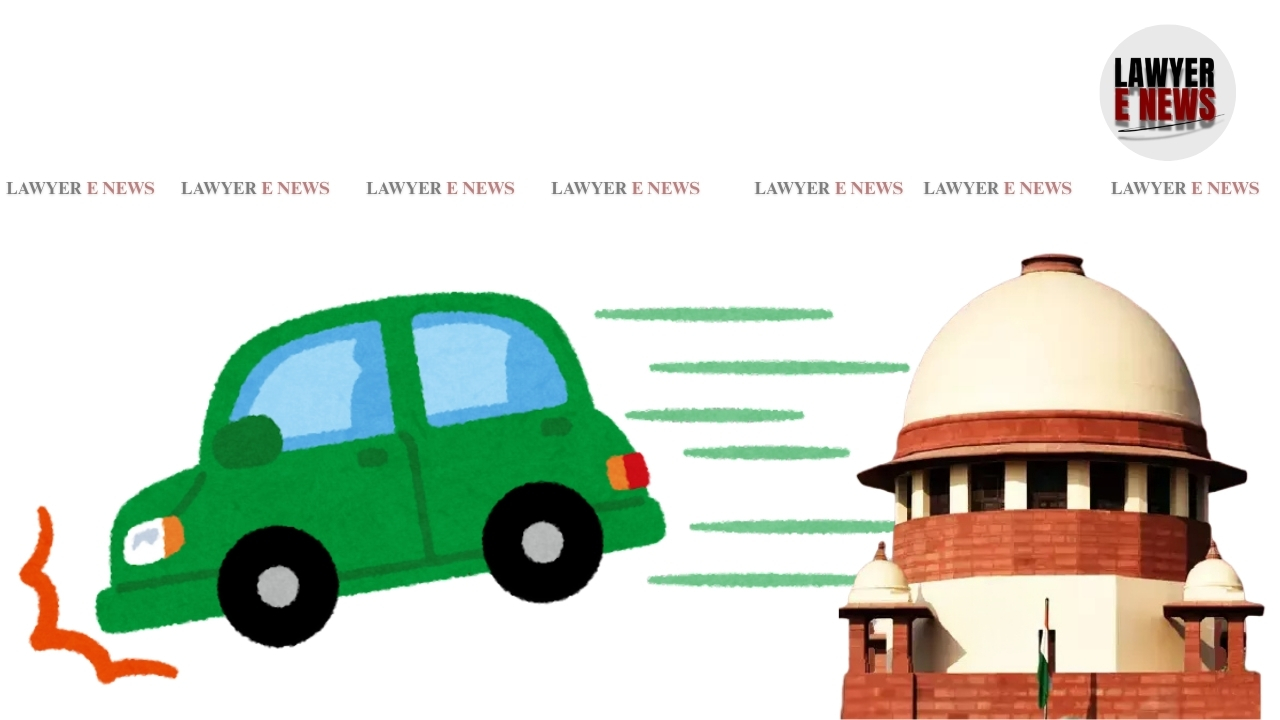
"A Student Engineer Has A Future, Not Just Minimum Wages", In a notable decision Supreme Court of India addressed the issue of contributory negligence and compensation in a motor accident involving a young engineering student who lost his leg. The Court held that the sudden braking by the car without warning on a highway amounted to primary negligence, and reapportioned the liability among the parties, ultimately enhancing the victim’s compensation to Rs. 91.39 lakhs, payable within four weeks with 7.5% interest.
The case arose from a tragic accident on 7th January 2017, when the appellant, S. Mohammed Hakkim, then a 20-year-old engineering student, was riding his motorcycle on a highway. A car ahead of him, driven by respondent no.2, suddenly applied brakes without any warning. As a result, the appellant collided into the rear of the car and fell on the road. Moments later, a bus following behind ran over him, resulting in the amputation of his left leg.
The Motor Accident Claims Tribunal initially held the bus driver 80% negligent and the appellant 20% contributory negligent, while exonerating the car driver. It awarded a total compensation of Rs. 91.62 lakhs, reduced to Rs. 73.29 lakhs after deducting for contributory negligence. The High Court, however, altered the finding: it held 30% negligence each on the appellant and the bus driver, and 40% on the car driver, while also reducing compensation to Rs. 58.53 lakhs.
Challenging the apportionment and the reduction, the appellant approached the Supreme Court.
The primary issues before the Court were: (1) apportionment of liability, particularly the validity of contributory negligence assigned to the appellant, and (2) assessment of just and fair compensation, especially in light of the appellant's status as a student with future earning potential.
The Supreme Court critically analyzed the findings of both the Tribunal and the High Court. It concurred that the “root cause” of the accident was the abrupt braking by the car and not solely the appellant’s failure to maintain distance.
As the Court observed:
“The explanation given by the car driver for suddenly stopping his car in the middle of a highway is not a reasonable explanation from any angle.”
Rejecting the justification that the driver stopped the vehicle due to his pregnant wife experiencing vomiting, the Court held:
“On a highway, high speed of vehicles is expected and if a driver intends to stop his vehicle, he has a responsibility to give a warning or signal to other vehicles moving behind on the road.”
While acknowledging the appellant's fault for not maintaining sufficient distance and riding without a valid license, the Court emphasized that his role was limited and secondary, and restored the Tribunal's earlier finding of 20% contributory negligence.
Accordingly, it reapportioned liability as:
20% on the appellant
50% on the car driver
30% on the bus driver
The Court’s ruling also carries landmark observations on the issue of assessing notional income for students. While the Tribunal and High Court had pegged the appellant’s monthly income at Rs. 15,000, the Supreme Court rejected that estimate, stating:
“In the present case, at the time of the accident, the appellant was a 3rd year engineering student who could have had a bright future.”
Relying on its earlier decision in Navjot Singh v. Harpreet Singh, the Court stated:
“We do not think that the notional income of a student undergoing a Degree course in Engineering from a premier institute should be taken to be equivalent to the minimum wages admissible to an unskilled worker.”
Accordingly, the Court fixed the notional income at Rs. 20,000 per month, added 40% future prospects, and applied a multiplier of 18 as per Sarla Verma v. DTC and Pranay Sethi. This resulted in a loss of income calculation of Rs. 60.48 lakhs.
The Court also took strong exception to the High Court’s reduction of attendant charges from Rs. 18 lakhs to Rs. 5 lakhs, remarking:
“We are unable to understand how the attendant charges of Rs.18 lakhs fixed by the Tribunal are unreasonable.”
Reiterating the gravity of the injury, the bench noted:
“The appellant has lost his entire left leg, which was amputated from the waist downwards, which means that he would require assistance throughout his life to perform the basic daily routine.”
On the issue of marital prospects, the Court further enhanced compensation from Rs. 2.5 lakhs to Rs. 5 lakhs, holding that the impact of 100% functional disability extends into the personal and emotional life of the victim.
The Supreme Court recalculated the entire compensation, head-wise, as follows:
Loss of Income: Rs. 60,48,000
Attendant Charges: Rs. 18,00,000
Pain & Sufferings: Rs. 2,00,000
Loss of Marital Prospects: Rs. 5,00,000
Discomfort: Rs. 1,00,000
Extra Nourishment: Rs. 50,000
Medical Bills: Rs. 22,03,066
Transportation: Rs. 20,000
Damage to Clothing: Rs. 3,000
Future Medical Expenses: Rs. 5,00,000
Total Compensation: Rs. 1,14,24,066
After deducting 20% for contributory negligence, the payable amount stands at Rs. 91,39,253, with interest at 7.5% per annum from the date of filing the claim.
The Court directed that the amount be paid within four weeks, and apportioned liability between the insurers of the car and bus in the ratio of 50:30, in accordance with the respective driver's share of fault.
The Supreme Court’s judgment in S. Mohammed Hakkim is a compelling reiteration of the principle of equitable compensation. By acknowledging that a young student’s future cannot be reduced to minimum wages, and by sharply scrutinizing negligent conduct on highways, the Court has further fortified the rights of accident victims.
As the Court observed:
“It cannot be ignored that the root cause of the accident is the sudden brakes applied by the car driver… There is nothing on record to suggest that the car driver had taken any precaution.”
This decision sets a precedent not only on just compensation, but also on proportional liability in multi-vehicle accidents, affirming that negligence must be viewed contextually, not mechanically.
Date of Decision: 29 July 2025