-
by sayum
23 August 2026 2:56 PM







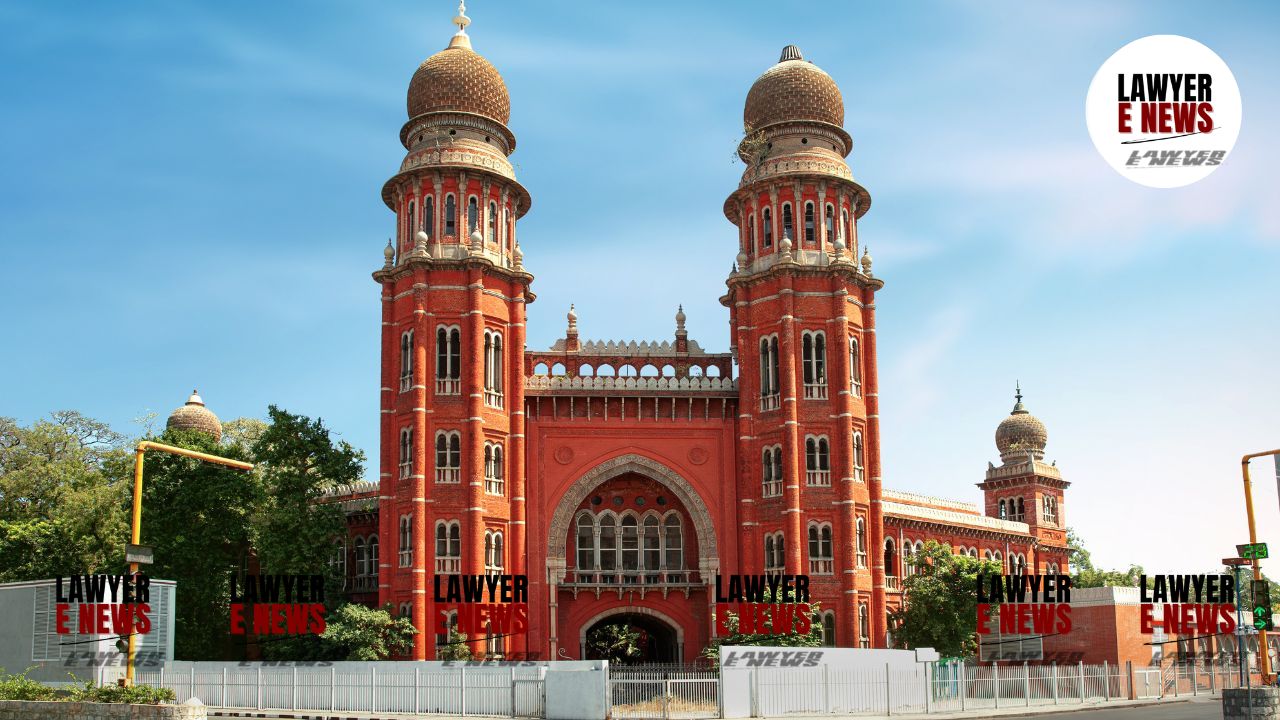
Madras High Court, in a landmark ruling exercised its powers under Article 227 of the Constitution to strike off a partition suit as not maintainable. The Court held that a fresh suit, filed on the same cause of action and involving identical factual and legal issues as an earlier partition suit which had already been dismissed and attained finality, was nothing but “a disguised re-litigation” and an “abuse of process of law.”
The judgment clarifies that when a female Hindu acquires property from her stridhan, such property becomes her absolute property under Section 14 of the Hindu Succession Act, and upon her intestate demise, the succession is governed not by Section 15(2)(a) but by Section 15(1)(a), entitling the husband to full inheritance.
“When the Husband Is the Only Surviving Heir, Entire Property Vests with Him”: Re-litigation Over Finalized Succession Rights Struck Down
The case arose when the plaintiff, R. Vasantha, filed a suit in O.S. No.36 of 2021 before the Principal Subordinate Court, Coimbatore, seeking partition of property originally purchased by her paternal relative Kamalammal in 1955. The plaintiff claimed that the property, being stridhan, should devolve upon Kamalammal’s paternal heirs after her intestate death in 2013. However, this very claim had already been raised and rejected in an earlier suit — O.S. No.1407 of 2015 — where the court held that Kamalammal's husband, being her sole surviving heir, had inherited the property.
Justice Balaji noted that the plaintiff in the present case had been arrayed as the 16th defendant in the earlier suit and therefore could not now circumvent the finality of the earlier ruling by initiating a fresh suit without first setting aside the earlier decree. “In both the suits, the specific case of the plaintiff… is that the property of Kamalammal was inherited by her father. The said plea was negatived by the Court, while allowing the rejection application in O.S. No.1407 of 2015. The said decree has admittedly become final,” the Court observed.
The Court rejected the plaintiff’s attempt to rely on Order VII Rule 13 CPC to justify the new suit. It ruled that the provision could not be used to revive a claim when the fundamental legal bar, which led to the earlier rejection, remained uncured. “It is not as if the defects for which the plaint was rejected in the earlier instance stand cured,” the judge noted. “The same legal and factual matrix has been re-invoked.”
“Filing a New Suit Without Curing Foundational Defects Is Not Fresh Litigation but Disguised Re-litigation”: High Court Slams Abuse of Court Process
The Court clarified the limited scope of Order VII Rule 13 CPC, which allows for a fresh suit after rejection of the plaint under Rule 11, only when the defects are remedied. “Mere re-filing without curing legal bar does not revive cause — no protection under Rule 13 available,” the Court held, adding that there was no scope for re-agitating the same issues without addressing the legal conclusions already reached in the earlier round of litigation.
On the question of succession, the Court delivered a categorical pronouncement on the nature of stridhan property under the Hindu Succession Act. It held:
“Sreedhana property being an absolute property of Kamalammal would be open for succession on her intestate demise in terms of Section 15(1)(a) of the Act only and when the husband is alive and in the absence of any children, it is the husband who would take the entire benefit.”
Rejecting the plaintiff’s contention that the property should revert to Kamalammal’s paternal heirs under Section 15(2)(a), the Court observed that such a reading was fundamentally flawed. “There is no question of applying Section 15(2)(a) to contend that the property was inherited by Kamalammal and therefore, it would revert back to only the heirs of the father. Sreedhana property is not to be treated as inherited property, but as absolute self-acquired property of the female Hindu.”
The judgment reinforces the principle that stridhan, once vested in a woman, cannot be subjected to a restricted estate unless explicitly stated, and upon her intestate death, her heirs are determined not by the origin of the property but by the general rules of succession laid down in Section 15(1). “The Will executed by the husband is valid, and the plaintiff’s claim as heir of Kamalammal’s father has no legal standing,” Justice Balaji held.
“Court Must Prevent Frivolous and Repetitive Litigation That Reopens Closed Legal Issues”: Article 227 Invoked to Strike Off Suit
While the respondent argued that alternate remedies existed and the High Court should refrain from invoking Article 227, the Court rejected this plea, holding:
“When there is an attempt at virtually re-litigating an issue that has already become final, it amounts to abuse of process. This Court can certainly exercise rights under Article 227 of Constitution of India, to nip the said futile exercise in the bud.”
The Court found that the second suit was filed without any plea to set aside the earlier rejection and that it merely reiterated the same rejected argument that Kamalammal’s property devolved upon her paternal heirs. “The present suit has no legs to stand,” the Court said, “and is an exercise in futility since the writing is on the wall for the plaintiff, who can never make a claim for partition, which is not available under law.”
This ruling is a strong reaffirmation of three core legal principles: firstly, that stridhan property becomes absolute property of a Hindu woman under Section 14; secondly, Section 15(1)(a) governs devolution on intestate death unless the property was inherited, not self-acquired; and thirdly, finality of litigation cannot be circumvented by initiating fresh proceedings based on the same legal foundation.
Justice Balaji's invocation of Article 227 to strike off the plaint marks a clear judicial stance against the misuse of process and a commitment to legal clarity in Hindu succession law.
Date of Decision: 22 August 2025