-
by sayum
05 August 2026 3:07 PM







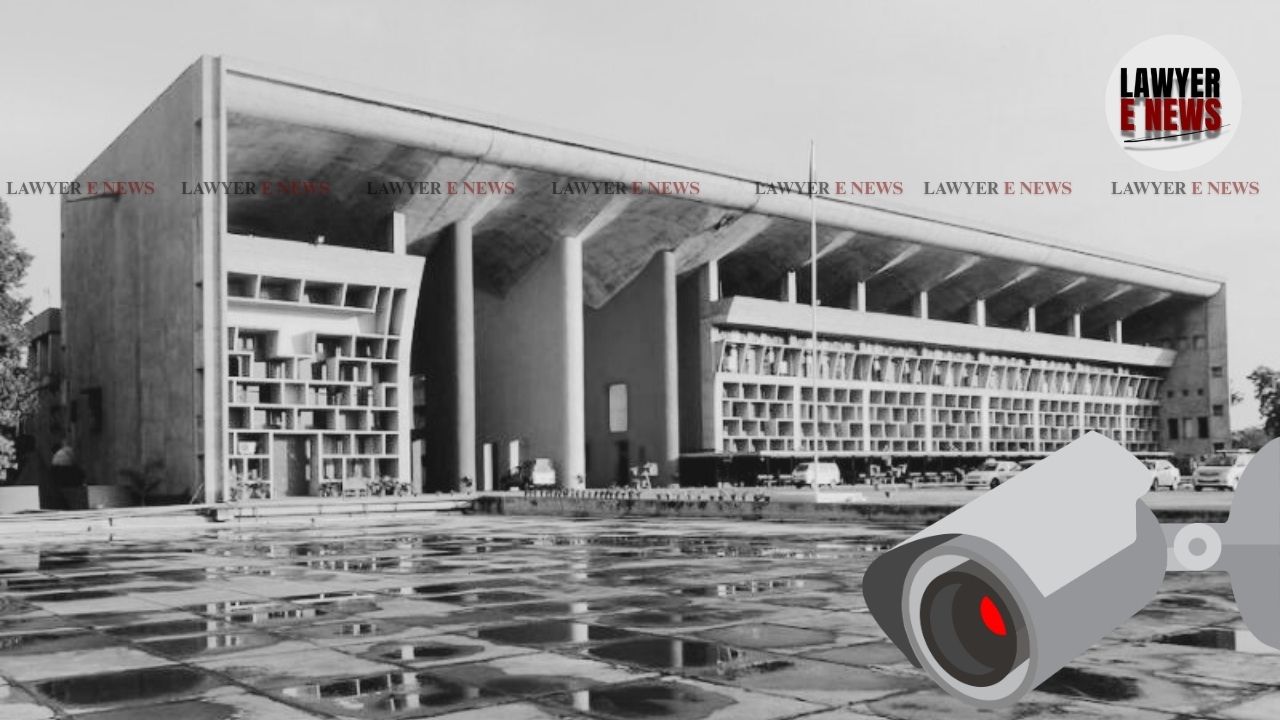
Liberty Cannot Be Sacrificed at the Altar of Administrative Convenience” – In a significant development Punjab and Haryana High Court clarified the procedural rights of individuals summoned by GST Intelligence authorities under Section 70 of the Central Goods and Services Tax Act, 2017 (CGST Act). The Court held that the recording of statements must be done during office hours, preferably under CCTV surveillance, and with the summoned person’s counsel present in visible range.
This part of the judgment, delivered by Justice Harpreet Singh Brar, provides critical safeguards against abuse of power during tax investigations and ensures that constitutional protections under Article 21 are not compromised in the name of investigation.
The petitioner, Barkha Bansal, approached the High Court with a habeas corpus plea, alleging that her husband, Bharat Lal Garg, was illegally detained by officers of the Directorate General of GST Intelligence (DGGI), Chandigarh Zonal Unit. He was summoned under Section 70 of the CGST Act on 04 June 2025, but was allegedly held overnight, without access to counsel or proper procedural safeguards, and was only produced before a Magistrate after more than 30 hours.
During the hearing, the Court examined the broader procedural framework governing the conduct of tax investigations, particularly focusing on how statements of summoned individuals are to be recorded.
Whether Investigations Under Section 70 Must Be Conducted With Safeguards Ensuring Presence of Counsel, Limited Hours, and Surveillance
The High Court emphasized that the power of summoning under Section 70 of the CGST Act, though ostensibly judicial in nature, cannot be exercised arbitrarily and must adhere to constitutional protections. While the DGGI claimed the statement of the detenue was voluntary and within their statutory right, the Court raised concerns about the timing, setting, and lack of transparency.
“The constitutional promise of liberty is not a hollow one; therefore, it is the duty of this Court to ensure that the rights of a citizen are not rendered merely theoretical.” [Para 18]
Statements Must Be Recorded During Office Hours
Referring to the Bombay High Court’s ruling in Mahesh Devchand Gala v. Union of India, Criminal W.P. No. 938 of 2024, the Court held:
“The statement of any person summoned by the DGGI must be recorded during office hours in view of the judgment… in Mahesh Devchand Gala.” [Para 31]
The Court denounced the practice of detaining persons overnight for interrogation, branding it a violation of liberty and dignity, regardless of whether the individual appears to consent.
Right to Counsel Within Visible Range (But Not Audible Range)
The Court reaffirmed the principles laid down by the Telangana High Court in Agarwal Foundries Pvt. Ltd. v. Union of India, 2020 SCC OnLine TS 1446:
“The person so summoned is well within his rights to record his statement in the presence of his counsel. The counsel may be present in the field of vision of the summoned person but not his hearing range.” [Para 31]
This strikes a balanced approach between ensuring procedural fairness and not impeding the investigative process.
Preference for CCTV Surveillance
In consonance with Supreme Court’s binding directions in Paramvir Singh Saini v. Baljit Singh, (2021) 1 SCC 184, the Court emphasized that statements must preferably be recorded under CCTV surveillance:
“Additionally, any person summoned to the DGGI may request his statement to be recorded under CCTV surveillance…” [Para 31]
The judgment recognizes that video recording serves as a protective mechanism both for the investigating agency and the summoned individual, ensuring transparency and fairness.
Court’s Final Direction on Investigations
Summarizing the safeguards to be followed, the High Court held:
Investigations must not extend beyond office hours;
Statements must be recorded preferably under CCTV;
Summoned individuals are entitled to have their counsel present within visible range during interrogation;
Consent obtained in coercive or psychologically restraining environments is not valid.
These directions standardize GST investigations with due process requirements, ensuring that the exercise of fiscal power does not transgress constitutional boundaries.
The High Court's decision in Barkha Bansal v. State of U.T., Chandigarh & Others goes beyond merely declaring the arrest illegal. It lays down enforceable safeguards to be followed in all future investigations under the CGST Act, thereby affirming that:
“Liberty is not a formality to be bypassed by bureaucratic convenience.”
This pronouncement aligns with the progressive jurisprudence laid down by the Supreme Court in Radhika Agarwal, Arvind Kejriwal, and Prabir Purkayastha, ensuring that tax administration functions within the boundaries of constitutionally guaranteed rights.
Date of Decision: 18 July 2025