-
by sayum
05 August 2026 3:07 PM







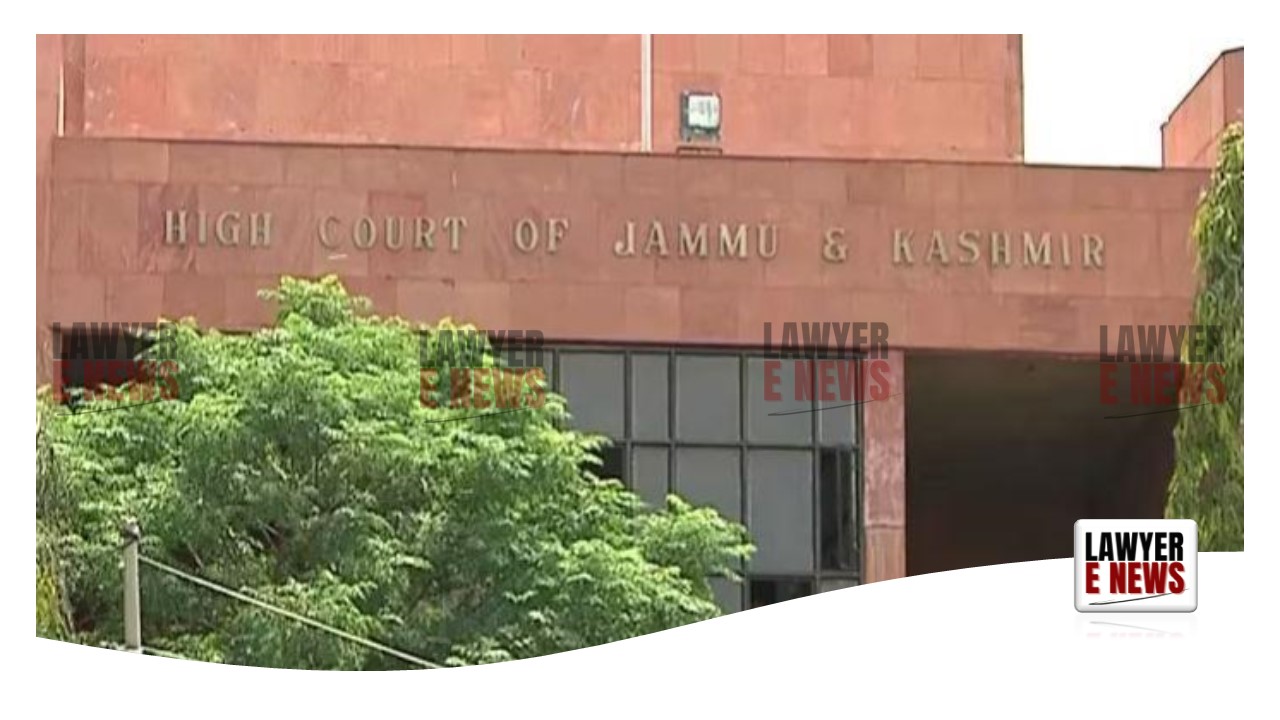
“Forcible Possession by State Without Acquisition Violates Article 300-A”: In a landmark judgment protecting constitutional and human rights, the High Court of Jammu & Kashmir and Ladakh on 11th July 2025 held that the State cannot retain private land without acquisition or compensation, even after the passage of decades. The Court declared the act of the State as violative of Article 300-A of the Constitution, and directed acquisition proceedings under the 2013 Land Acquisition Act.
A Division Bench comprising Justice Sanjeev Kumar and Justice Sanjay Parihar, while deciding LPA , set aside the dismissal of a writ petition by the Writ Court that had rejected the appellants’ claim for compensation merely on the ground of delay.
The Bench ruled: “So long as State remains in unauthorized possession of landed property of its citizens taken without following due process of law, the cause of action to seek restoration or compensation would arise every day.” [Para 14]
Land Taken in 1958 Without Acquisition — State Held Liable After 66 Years
The case involved 8 kanals and 13 marlas of land belonging to Mushtaq Ahmad Jan and others, originally owned by their predecessor Namdaar Jan, which was taken over in 1958-59 by the Rural Development Department for construction of a Block Development Office in Bandipora without initiating any acquisition proceedings or offering any compensation.
Though the revenue record continued to show the appellants as owners, the State never took steps to regularize its possession. The appellants first raised the issue in 2013, and filed a writ petition in 2022, which was dismissed by the Writ Court on the ground of delay and laches.
The High Court firmly overturned that reasoning, stating:
“The right to property, even after the 44th Amendment, continues as a constitutional right under Article 300-A and a human right in a welfare state. Its violation cannot be legitimized by lapse of time.” [Para 14]
“Donation Is a Specious Plea Without Evidence”: Court Rejects State's Justification
The State attempted to defend its possession by claiming that the land was voluntarily donated by the landowner in 1958. However, this assertion was made for the first time in a reply affidavit before the Writ Court, without any supporting record.
The Division Bench decisively rejected this, holding:
“A presumption cannot take the place of proof. We see no reason or justification to donate 8 kanals and 13 marlas of land to the State free of cost.” [Para 21]
“The plea of donation is unsupported by any contemporaneous record or credible evidence and deserves outright rejection.” [Para 20]
The Court found that various inter-departmental communications between 2017 and 2019 treated the land as private property of the appellants and sought release of funds for compensation—thus, negating the plea of donation.
“No Delay in Seeking Justice When the Wrong is Ongoing”: Continuing Cause of Action Recognized
Quoting extensively from the Supreme Court’s decision in Vidya Devi v. State of Himachal Pradesh (2020) 2 SCC 569, the Bench underscored that unauthorized occupation by the State is a continuing wrong, and as such, delay cannot extinguish the right to compensation.
“Delay and laches cannot be raised in a case of a continuing cause of action, or where the circumstances shock the judicial conscience of the Court.” [Para 12.12 – Vidya Devi, cited in Para 13 of the present judgment]
“The right to property may not be a fundamental right anymore, but it remains a basic constitutional and human right. It cannot be extinguished by the passage of time when State action is illegal.” [Para 16]
The Court relied on additional precedents including Tukaram Kana Joshi v. MIDC (2013) 1 SCC 353 and State of U.P. v. Manohar AIR 2005 SC 488, affirming the State’s constitutional obligation to acquire land lawfully and compensate the dispossessed.
Final Directions: Acquisition and Compensation Under 2013 Act
Allowing the Letters Patent Appeal, the Division Bench issued a mandatory direction:
“The respondents shall immediately and forthwith initiate the process of acquisition in accordance with ‘The Right to Fair Compensation and Transparency in Land Acquisition, Rehabilitation and Resettlement Act, 2013’ and determine compensation payable to the owners.” [Para 23]
The acquisition process must begin within four weeks of service of the judgment and be completed as per the statutory timeline under the 2013 Act.
Judgment Reaffirms That State Cannot Evade Its Constitutional Obligations
This ruling delivers a clear message: “In a constitutional democracy, the State is bound by law. It cannot dispossess citizens without authority, hide behind delay, or rely on presumed donations. Justice may be delayed, but cannot be denied when the wrong is ongoing.”
By recognizing the continuing violation of constitutional rights and rejecting the weaponization of delay, the High Court has reaffirmed that no lapse of time can validate illegal possession by the State.
Date of Decision: July 11, 2025