-
by sayum
26 August 2026 8:37 AM







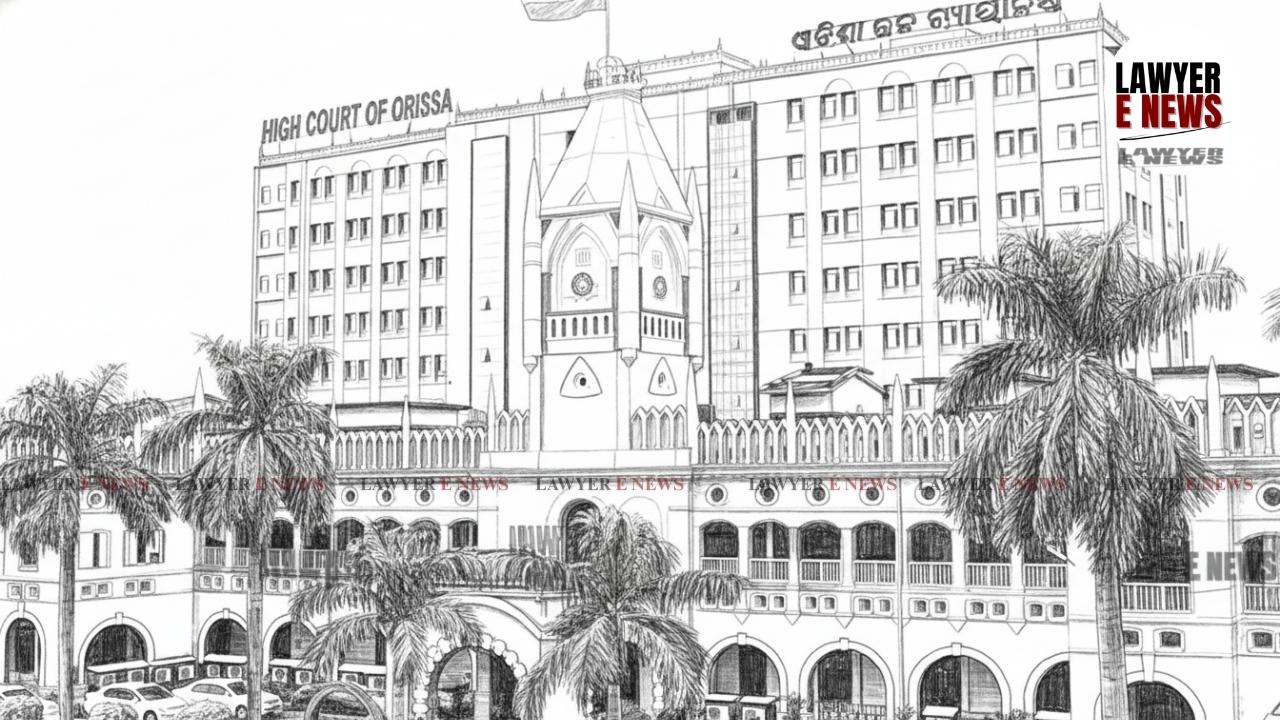
“High Court’s writ jurisdiction under Article 226 is not ousted—but must be exercised with discretion when a specialized forum like NGT is available”, In a significant decision reaffirming the constitutional balance between judicial review and specialized statutory remedies, the Orissa High Court declined to exercise its writ jurisdiction under Article 226 in a matter involving environmental pollution caused by unregulated dumping of fly ash during the construction of National Highway 49.
Division Bench comprising Chief Justice Harish Tandon and Justice Murahari Sri Raman held that, although the High Court’s powers remain intact under the Constitution, the petitioners must approach the National Green Tribunal (NGT), which is the expert forum statutorily established for such disputes.
The case presented a serious grievance involving alleged environmental degradation due to improper handling of fly ash during the construction of NH-49, affecting farmlands, water bodies, fish mortality, and ground water contamination.
“Jurisdiction remains, but discretion prevails”: High Court reiterates constitutional limits
Right at the threshold, the Bench questioned whether it would be appropriate to entertain a writ petition directly under Article 226 when a specialized tribunal like the NGT was available to adjudicate on complex environmental issues.
While recognizing that jurisdiction under Articles 226 and 227 cannot be ousted by legislation due to their status as part of the basic structure of the Constitution, the Court firmly reiterated the principle of judicial self-restraint.
“There is no absolute bar in entertaining writ petitions under Article 226… yet the writ Court may refuse to entertain such petitions and relegate the parties to exhaust the statutory remedy which is appropriate and effective by using its discretion,” the Court noted in paragraph 2.
“Environmental issues require scientific and technical expertise”: Court affirms NGT’s primacy in specialized adjudication
The Bench acknowledged the gravity of the environmental harm alleged in the petition — indiscriminate fly ash dumping during road construction, resulting in polluted air and water, crop damage, and groundwater contamination.
However, it found that these issues fall squarely within the technical domain envisaged for the NGT under Sections 14 and 22 of the National Green Tribunal Act, 2010. In paragraph 10, the Court observed:
“The issue relating to the pollution inflicted in ‘air’ and ‘water’ by indiscriminate use of fly ash… can be conveniently addressed by the National Green Tribunal and, therefore, we feel it prudent that the petitioners should be relegated to such statutory forum.”
The Court emphasized that environmental matters often involve scientific evaluations, necessitating expert adjudication beyond the conventional purview of writ courts.
“Jurisdiction of High Court under Article 226 remains untouched”: L. Chandra Kumar and NGT Act examined in depth
The Court meticulously examined the interplay between the NGT Act and constitutional powers of the High Court. Drawing upon the 7-judge Constitution Bench decision in L. Chandra Kumar v. Union of India [(1997) 3 SCC 261], the Bench reiterated that Articles 226 and 227 form part of the basic structure and cannot be diluted by statutory enactments.
In paragraph 6, the Court cited the recent Supreme Court decision in Madhya Pradesh High Court Advocates Bar Association v. Union of India [2022 SCC OnLine SC 639], affirming:
“The National Green Tribunal under Sections 14 & 22 of the NGT Act does not oust the High Court's jurisdiction under Article 226 & 227 as the same is a part of the basic structure of the Constitution.”
At the same time, the Court clarified that while the High Court’s jurisdiction is preserved, it should be exercised sparingly and not in a manner that undermines the functioning of specialized tribunals. The Court referred to the Whirlpool Corporation v. Registrar of Trade Marks [(1998) 8 SCC 1] decision to stress the doctrine of discretion.
"No leapfrog appeal to NGT": Court distinguishes between judicial review and statutory appeals
In supporting its conclusion, the Court addressed the scope of judicial review vis-à-vis the NGT’s jurisdiction, relying on the Supreme Court ruling in Tamil Nadu Pollution Control Board v. Sterlite Industries [(2019) 19 SCC 479]. It noted that the NGT does not possess the general power of judicial review akin to that vested in High Courts and therefore cannot act beyond its statutorily defined jurisdiction.
Yet, in the present case, where the grievance directly related to environmental degradation through actions during highway construction, the Court found that the NGT had clear jurisdiction under the NGT Act.
“The NGT is only conferred appellate jurisdiction from an order passed in exercise of first appeal. Where there is no such order, the NGT has no jurisdiction,” noted the Supreme Court in Sterlite, cited by the High Court in paragraph 8.
However, unlike Sterlite, where the issue concerned orders under Section 18 of the Water Act which were not appealable, the current case was well within the scope of NGT’s original jurisdiction under Section 14 of the NGT Act, thereby justifying relegation.
Rule of discretion, not of compulsion
Ultimately, the Orissa High Court declined to exercise its writ jurisdiction, not because it lacked the authority, but because of a principled judicial restraint in light of an effective and specialized alternative forum.
“The writ petition is, thus, disposed of,” the Bench held in paragraph 11, granting liberty to the petitioners to raise their grievances before the NGT, which is expected to “take into account the serious issues raised.”
This judgment serves as a textbook reaffirmation of the constitutional balance between fundamental judicial oversight and the efficient functioning of specialized tribunals, reinforcing that availability of alternative remedy does not oust jurisdiction—but does guide its exercise.
Date of Decision: 05 February 2026