-
by sayum
26 August 2026 9:49 AM







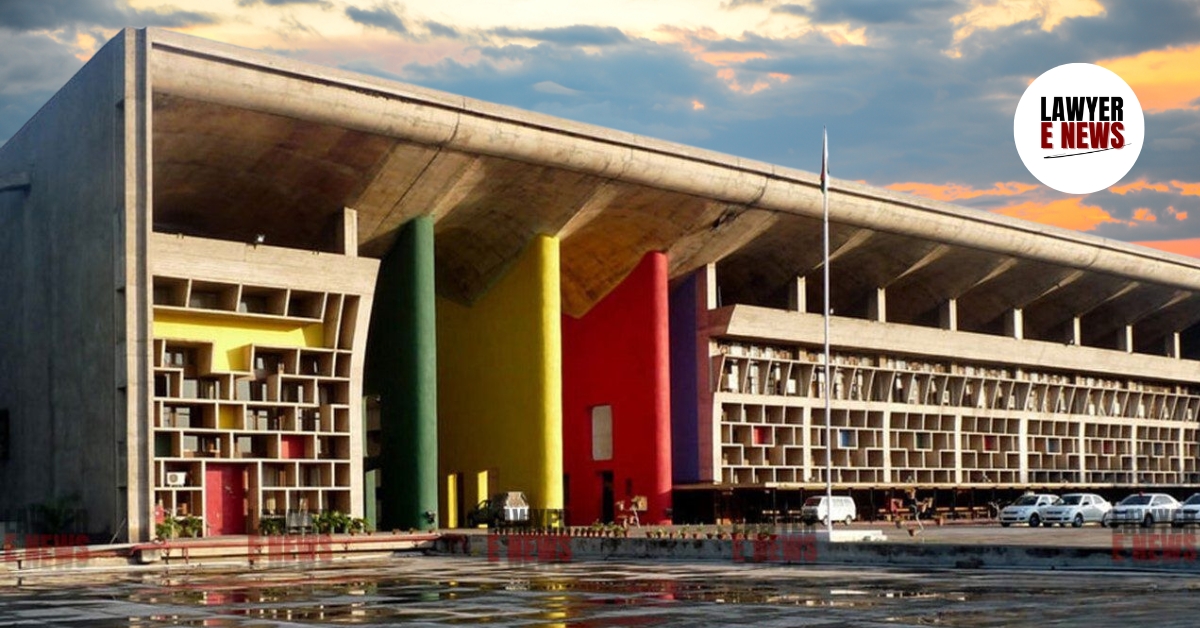
Punjab & Haryana High Court partly allowed the Insurance Company’s appeal, modifying the compensation awarded by the Motor Accident Claims Tribunal while firmly upholding the findings on negligence and involvement of the offending vehicle.
Justice Alka Sarin reduced the compensation from ₹26,12,000 to ₹22,69,200 by correcting the addition towards future prospects and recalibrating amounts under conventional heads in line with Pranay Sethi, Magma General Insurance, and N. Jayasree. However, the Court rejected the insurer’s plea that the case was fabricated and reaffirmed that “just compensation” must reflect realistic assessment.
“Criminal Acquittal Does Not Erase Civil Liability”: Involvement of Vehicle Upheld
The Insurance Company argued that the accident was a planted case because the FIR initially mentioned an unknown vehicle and the registration number and driver’s name were introduced after 21 days.
The Court found no merit in this submission. The eyewitness, PW2, consistently stated that the driver got down after the accident and fled. Though he could not note the complete registration number, he had seen the driver’s face. The challan corroborated this version.
The Court observed that minor discrepancies in cross-examination were not fatal and noted that the driver did not step into the witness box to rebut the allegations. Even though the accused was acquitted in the criminal case, all prosecution witnesses stood by their version and the claimants had challenged the acquittal.
The Court thus held that the involvement of the offending vehicle and rash and negligent driving stood proved. Criminal acquittal, it reiterated, is not determinative in motor accident claim proceedings, where the standard of proof is preponderance of probabilities.
“Some Guesswork Is Inevitable”: Income of ₹9,000 per Month Sustained
The deceased was 21 years old and left behind a 19-year-old widow and a child born after his death. The claimants had asserted higher income, but the Tribunal assessed it at ₹9,000 per month based on Deputy Commissioner rates for semi-skilled labour.
The Insurance Company contended that there was no documentary proof to justify this assessment.
Rejecting the contention, the High Court held that minimum wages serve as a guiding benchmark but cannot be treated as an inflexible rule. The Court relied on precedents such as Chandra @ Chandraram, Beant Kaur, Jakir Hussein, and Ramachandrappa, emphasizing that some degree of reasonable estimation is permissible where documentary proof is unavailable.
The Court observed that Deputy Commissioner rates at the relevant time in Haryana were ₹9,000 for semi-skilled and ₹10,000 for skilled labour. The Tribunal’s assessment, therefore, could not be termed excessive.
The judgment poignantly noted that while money cannot compensate for the loss of a young life, the law must ensure that the award mitigates the hardship of the surviving family.
“Future Prospects Must Follow Pranay Sethi”: 50% Reduced to 40%
The Tribunal had added 50% towards future prospects. The High Court corrected this, holding that as per National Insurance Co. Ltd. v. Pranay Sethi, the addition should be 40% for a deceased on fixed income aged below 40 years.
This recalibration significantly altered the final computation.
“Conventional Heads Cannot Travel Beyond Supreme Court Mandate”
The Tribunal had awarded ₹1,00,000 towards consortium and ₹3,00,000 towards love and affection, along with ₹25,000 for funeral and transportation.
The High Court held that such amounts were not in consonance with the settled law. Applying Pranay Sethi, Magma General Insurance, and N. Jayasree, the Court granted ₹18,000 towards loss of estate and ₹18,000 towards funeral expenses, reflecting the 20% enhancement recognized in subsequent jurisprudence.
Under the head of consortium, ₹48,000 each was awarded towards spousal, parental, and filial consortium, aggregating ₹1,92,000.
The Court made it clear that awards under conventional heads must strictly adhere to the Supreme Court’s framework and cannot be expanded on sympathetic considerations alone.
“Just Compensation Means Correct Compensation”: Final Recalculation
After reworking the figures, the Court recalculated the compensation as follows in substance: monthly income ₹9,000, annual income ₹1,08,000, deduction of one-fourth towards personal expenses, addition of 40% towards future prospects, multiplier of 18, and addition of conventional sums and consortium.
The total compensation was reduced to ₹22,69,200 with interest at 9% per annum from the date of filing of the claim petition.
The Court directed that the minor’s share be kept in a fixed deposit until attaining majority. Since the Insurance Company had already deposited the entire amount, the excess after recalculation was ordered to be returned.
“Balancing Legal Precision with Human Realities”
While modifying the award, the High Court preserved the Tribunal’s findings on negligence and involvement. The decision reflects a careful balance: adherence to Supreme Court guidelines on computation, combined with sensitivity to the realities of families who lose young earning members.
The appeal was thus partly allowed, not to deny compensation, but to align it with settled principles of law.
Decision Date: 05 February 2026