-
by sayum
08 August 2026 1:54 PM







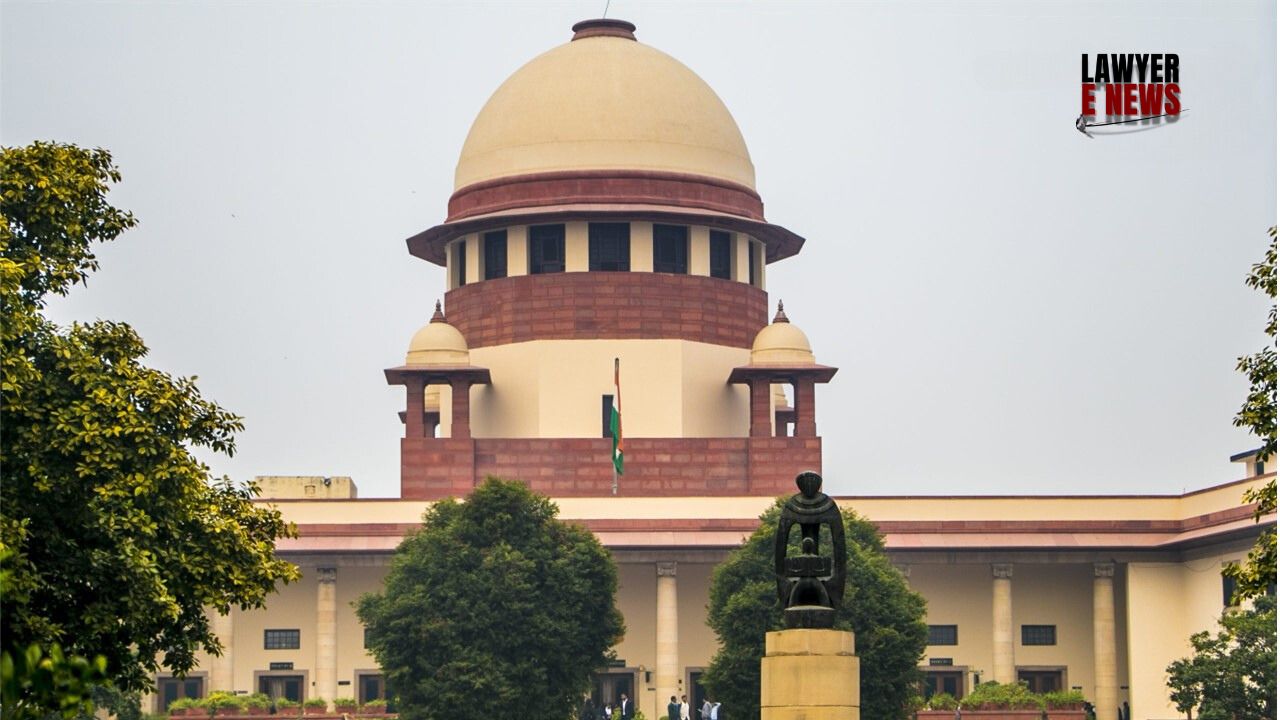
“We are unable to agree that a claim under Section 163A is restricted to third-party risks… The non-obstante clause overrides the Motor Vehicles Act, all other laws, and even insurance contracts,” In a significant order Supreme Court referred a pivotal legal issue for authoritative determination by a larger bench. The matter arose from a tragic accident in which both parents of a two-year-old minor child died, including the father who owned the vehicle. The minor, represented by her aunt, claimed compensation under Section 163A of the Motor Vehicles Act, 1988.
While earlier benches had held that Section 163A claims are confined to “third parties,” the present bench of Justices Sudhanshu Dhulia and K. Vinod Chandran questioned this approach, holding that the provision’s non-obstante clause indicates a much broader intent.
“A Claimant Cannot Be Denied Compensation Merely Because Her Deceased Father Was the Owner of the Vehicle” — Court Criticizes Narrow Reading of Section 163A
The petitioner, minor Wakia Afrin, lost both her parents in a road accident caused by a tyre burst when the family vehicle crashed into a building. She filed claims under Section 163A for the deaths of both parents.
While the Motor Accident Claims Tribunal (MACT), Cuttack, awarded ₹4.08 lakh for the mother and ₹4.53 lakh for the father’s death, the Orissa High Court dismissed both petitions on technical grounds—mainly that the father (owner) was wrongly impleaded though deceased, and more substantively, that no claim lies under Section 163A against the estate of the vehicle owner.
Can a Minor Claimant Seek Compensation for the Death of a Parent Who Was Also the Owner of the Vehicle?
The insurer contended that since the child succeeded to the estate of her father (vehicle owner), she effectively stood in the shoes of the person liable and hence could not claim compensation. The Court found this argument deeply problematic:
“A third-party claim for compensation would definitely survive since, on the death of the insured it would lie against his estate, which the insurer has an obligation to indemnify.”
And further: “The ground stated by the High Court definitely is not tenable.”
Does Section 163A Allow Claims Beyond Third-Party Risks?
The Court emphasized that Section 163A contains a sweeping non-obstante clause:
“Section 163A is a special provision brought in… which overrides not only the entire provisions of the Motor Vehicles Act but also any other law for the time being in force and any instrument having the force of law.”
The Court observed that: “When there is a valid policy issued in the name of the vehicle… a claim under Section 163A, as per the words employed in the provision, covers every claim and is not restricted to a third-party claim.”
The judgment criticized past decisions which limited Section 163A claims to third-party scenarios, particularly Ningamma, Jhuma Saha, and Rajni Devi, and held:
“With all the respect at our command, we are unable to agree with the dictum… that Section 163A is restricted to third-party risks.”
Why the Reference to a Larger Bench?
Acknowledging the inconsistency in prior rulings, the Court referred the issue to the Chief Justice of India for constitution of a larger bench:
“We have… doubted, with due respect, the decisions of co-ordinate benches of two Judges… We direct the Registry to place the matter before the Hon’ble the Chief Justice of India for appropriate orders.”
The Court found that earlier rulings under Section 166 requiring proof of negligence cannot be transplanted into the no-fault regime under Section 163A, which is social welfare legislation designed to ensure speedy relief.
The order is a profound development in motor accident jurisprudence. It signals the Court’s willingness to re-examine doctrinal limitations that have historically restricted the scope of victim compensation. By recognizing the intent of Parliament to create a no-fault, non-discriminatory compensation mechanism under Section 163A, the Court reinforces that “social security must not collapse under technicalities.”
Date of Decision: August 1, 2025