-
by sayum
30 August 2026 6:58 AM







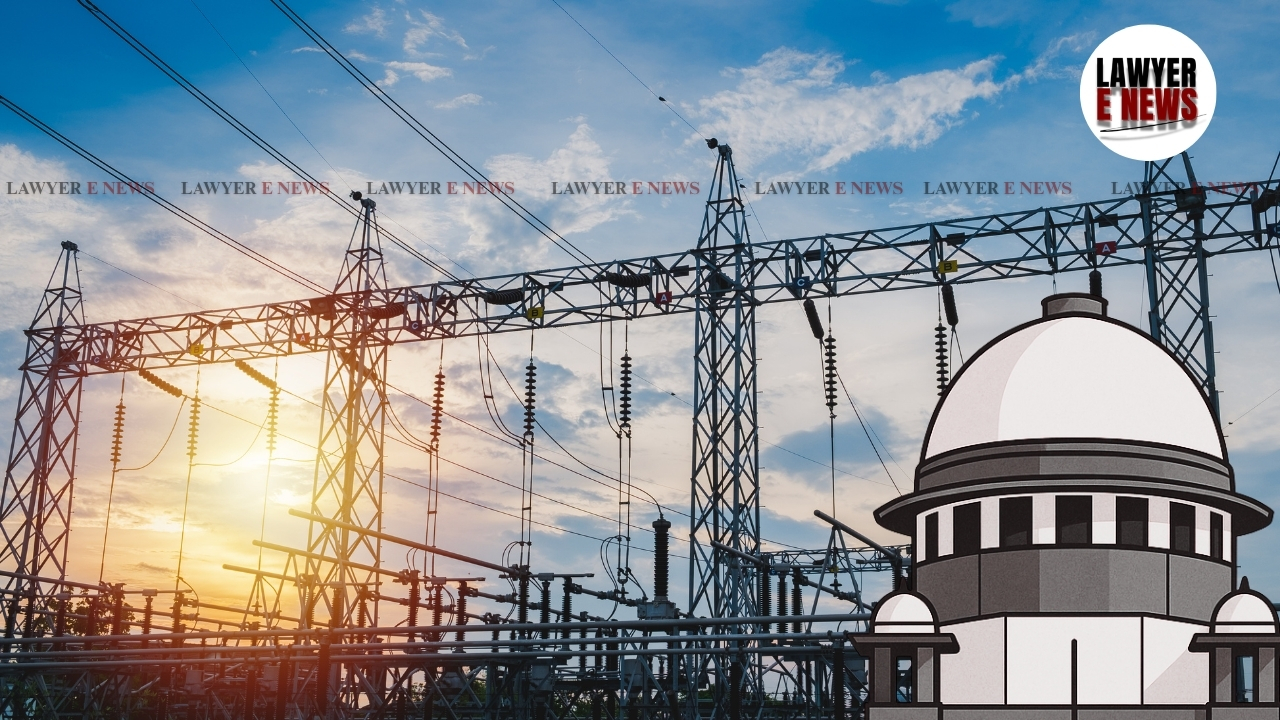
“Regulatory Failure Must Not Become Systemic”: Supreme Court Directs Liquidation Of ₹27,200 Crores In Regulatory Assets, Fixes 4-Year Deadline. Supreme Court of India, in a landmark decision laid down the legal boundaries for the creation, continuation, and liquidation of regulatory assets by electricity regulators. Holding that the Delhi Electricity Regulatory Commission (DERC) had failed in its statutory duty by indefinitely postponing the recovery of distribution costs, the Court declared the regulatory conduct as unjustified and unlawful, issuing binding directions to phase out the outstanding ₹27,200 crore regulatory asset within 4 years.
The two-judge Bench of Justice B.R. Gavai and Justice Sandeep Mehta clarified that:
“Creation of regulatory assets is permissible only in exceptional circumstances. They are not a regular feature of tariff planning. Their continued use without structured recovery mechanisms reflects regulatory failure.” [Para 67.3]
“Disproportionate increase and long-pending regulatory assets depict a regulatory failure”
The Court criticised DERC for letting regulatory assets pile up unchecked since 2004, stating that:
“DERC’s repeated creation and continuation of regulatory assets, in the absence of any structured amortisation plan, is contrary to the mandate of the Electricity Act, National Tariff Policies and its own regulations.” [Para 66.1]
The Court noted that as of 31.03.2024, regulatory assets including carrying costs had reached ₹12,993.53 crore for BRPL, ₹8,419.14 crore for BYPL, and ₹5,787.70 crore for TPDDL, totalling ₹27,200.37 crore, and found this unsustainable.
“Discoms cannot be burdened indefinitely by unrecovered dues… Regulatory Commissions must strike a balance between protecting consumers and ensuring financial health of distribution companies.” [Para 51]
“Regulatory asset is an accounting measure, not a legislative provision”
In defining the concept, the Court explained that: “A regulatory asset is not a statutory right—it is an accounting device… a recognition of costs incurred by the distribution company, deferred for recovery in future tariffs to avoid sudden tariff shocks to consumers.” [Para 8]
But such deferral cannot be indefinite: “Tariff must be cost-reflective. A regulatory asset cannot be used to mask the true cost of electricity supply or defer recovery indefinitely.” [Para 67.4]
The judgment emphasized that this practice not only damages the financial viability of private discoms but ultimately burdens consumers through accumulated interest and future tariff hikes.
“Rule 23 and Clause 8.2.2 of the Tariff Policy are binding guidelines, not optional suggestions”
The Court affirmed that the Electricity (Amendment) Rules, 2024, particularly Rule 23, along with Clause 8.2.2 of the National Tariff Policy (2006 & 2016), form the binding legal framework for the treatment of regulatory assets.
“Rule 23 must be treated as the normative principle to regulate creation and liquidation of regulatory assets… the principle formulated in Rule 23 is consistent with Clause 8.2.2 and the scheme of the Act.” [Para 67.3]
Under these provisions:
Regulatory assets should not exceed 3% of ARR
They must be liquidated within 3 years from the next financial year
Existing legacy assets must be cleared within 7 years
However, the Court further shortened this timeline in the current case, holding:
“The existing regulatory asset must be liquidated in a maximum of 4 years starting from 01.04.2024.” [Para 71(v)]
“Regulatory Commissions are not above scrutiny—Accountability is essential for good governance”
The Court pulled no punches in condemning what it called a regulatory vacuum:
“Ineffective and inefficient functioning of the Regulatory Commissions, coupled with acting under dictation, can lead to regulatory failure… They are accountable for their decisions.” [Para 70(VII)]
It stressed the need for transparency, responsibility, and enforceability in regulatory functioning:
“Accountability has three dimensions—responsibility, answerability, and enforceability… It enables action against officials or institutions for dereliction of duty.” [Para 68]
The Court highlighted that DERC had failed to comply with multiple binding directives of the APTEL, including those issued in O.P. Nos. 1/2011 and 1 & 2/2012, which mandated structured and time-bound recovery of regulatory assets.
“The APTEL is not just an appellate body—it is a watchdog with corrective powers”
Invoking Section 121 of the Electricity Act, the Court empowered the Appellate Tribunal for Electricity (APTEL) to act as a supervisory authority:
“Section 121 is intended to ensure that in the functioning of Regulatory Commissions, there is efficiency in administration, expertise through human resources, integrity through transparency, and accountability through review and assessment.” [Para 69.6]
The Court directed APTEL to initiate suo motu proceedings and:
“Issue such orders, instructions or directions as it may deem fit for performance of statutory duties with respect to regulatory assets.” [Para 71(viii)]
“The law is not silent—it’s just been ignored”
The Supreme Court underscored that the existing legal regime is complete and enforceable, but demands institutional will to implement:
“The regulatory regime under the Act is a complete code… The effectiveness of these laws will be reflected in the will to enforce them.” [Para 70(X)]
With this sweeping decision, the Supreme Court has not only drawn the legal limits on the use of regulatory assets but also restored the principle that electricity tariffs must reflect actual costs, not political convenience or regulatory inefficiency. The verdict serves as a warning to regulators across India that deferred recovery is not an escape from statutory responsibility, and that consumers cannot be burdened for past regulatory lapses.
“Ultimately, the burden is shifted on the consumer… It is an anathema to good governance of the Electricity Act.” [Para 67.3
Date of Decision: August 6, 2025