-
by sayum
05 August 2026 3:07 PM







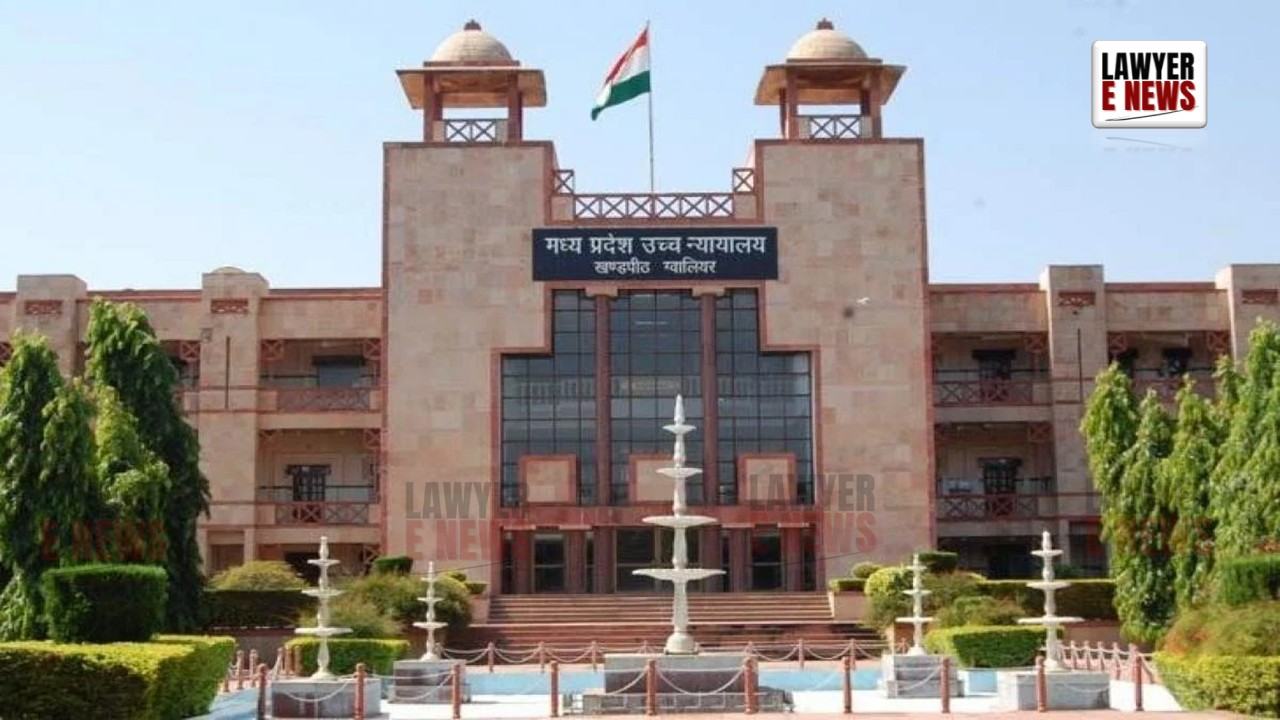
Signatures, Photograph, and Registration Are Clear Proof of Sale; Mortgage Claim Is an Afterthought”: in a detailed judgment the Madhya Pradesh High Court upheld the concurrent findings of the lower courts rejecting a suit for declaration of title and injunction over agricultural land. Justice G.S. Ahluwalia ruled that the sale deed in question, being a registered document executed before the Sub-Registrar and acknowledged by the appellant himself through signatures and photographs, carried a statutory presumption of validity. The Court held, “Where the execution of the sale deed is admitted, attempts to undermine it by raising the false plea of a loan cannot be entertained, especially after the lapse of the limitation period.”
The dispute arose over agricultural lands in Ganjbasoda, District Vidisha, where the appellant Raghunath Singh sought to annul a registered sale deed dated 30th April 2012, claiming it was executed under misrepresentation and without consideration. The appellant contended that the transaction was intended as a mortgage arrangement for a loan of ₹4,00,000 taken for his father’s treatment, and that he had never transferred ownership or possession to the first respondent, Meharwan Singh.
The defendant, however, defended the sale deed by asserting that it was executed after full consideration of ₹17,77,400 was paid, with possession delivered on the same day. Both the trial court and the first appellate court dismissed the suit, holding that the sale deed was valid, the plaintiff was not in possession, and the suit was time-barred. Raghunath Singh approached the High Court under Section 100 of the Civil Procedure Code, 1908.
Justice G.S. Ahluwalia focused on two critical legal issues: first, whether the sale deed was executed validly or obtained through misrepresentation; and second, whether the suit was barred by limitation and untenable without possession.
Quoting directly from the record, Justice Ahluwalia noted, “The plaintiff himself admitted his signatures and photograph on the registered sale deed. There is no plea or evidence of impersonation. This admission strikes at the root of his claim of non-execution.”
The Court emphasized the binding legal effect of Sections 32 and 34 of the Registration Act, 1908, observing: “The presumption of correctness attached to a registered document cannot be rebutted by mere oral allegations without substantial and credible evidence.”
Dismissing the plaintiff’s plea of a mortgage transaction disguised as a sale, the Court remarked, “No independent witness has corroborated the existence of a mortgage transaction. The claim that the sale deed was executed on court premises and not before the Sub-Registrar is contradicted by unimpeachable documentary evidence.”
On the issue of limitation, the Court pointed out that the challenge to the sale deed was raised more than three years after its execution. Justice Ahluwalia ruled, “The plea of discovery of fraud during mutation proceedings is an afterthought and lacks legal merit. Courts below rightly held the suit to be time-barred.”
Regarding possession, the Court reiterated the bar under Section 34 of the Specific Relief Act, 1963: “A suit for declaration of title without consequential relief of possession is not maintainable, particularly when the plaintiff is not in possession. This omission is fatal to the claim.”
Justice Ahluwalia extensively relied on authoritative Supreme Court rulings, particularly Dinesh Kumar v. Yusuf Ali (2010) 12 SCC 740, and reiterated the restricted scope of interference under Section 100 CPC. The Court stated:
“It is settled law that erroneous findings of fact cannot be reopened in second appeal unless perversity or gross misreading of evidence is established. Mere dissatisfaction with concurrent findings is insufficient.”
The Court dismissed all proposed substantial questions of law, holding they were either settled issues of fact or without legal significance. Justice Ahluwalia concluded: “This Court finds no perversity in the findings of the trial court and appellate court. No substantial question of law arises in this case.”
This judgment reaffirms the high threshold for interference in second appeals and the sanctity of registered sale deeds. The Madhya Pradesh High Court underscored that
“A registered sale deed, supported by signatures, photographs, and formal execution before the Sub-Registrar, carries a presumption of validity that cannot be lightly displaced by unsubstantiated allegations.”
The Court further clarified that “attempts to resurrect long-dormant property claims by alleging informal mortgage arrangements are legally unsustainable, especially when the challenge is barred by limitation and devoid of possession.”
With this ruling, the High Court ensured that registered property transactions remain secure against frivolous challenges aimed at unsettling settled property rights after a lapse of years.
Date of Decision: 8th July 2025