-
by sayum
30 August 2026 4:28 AM







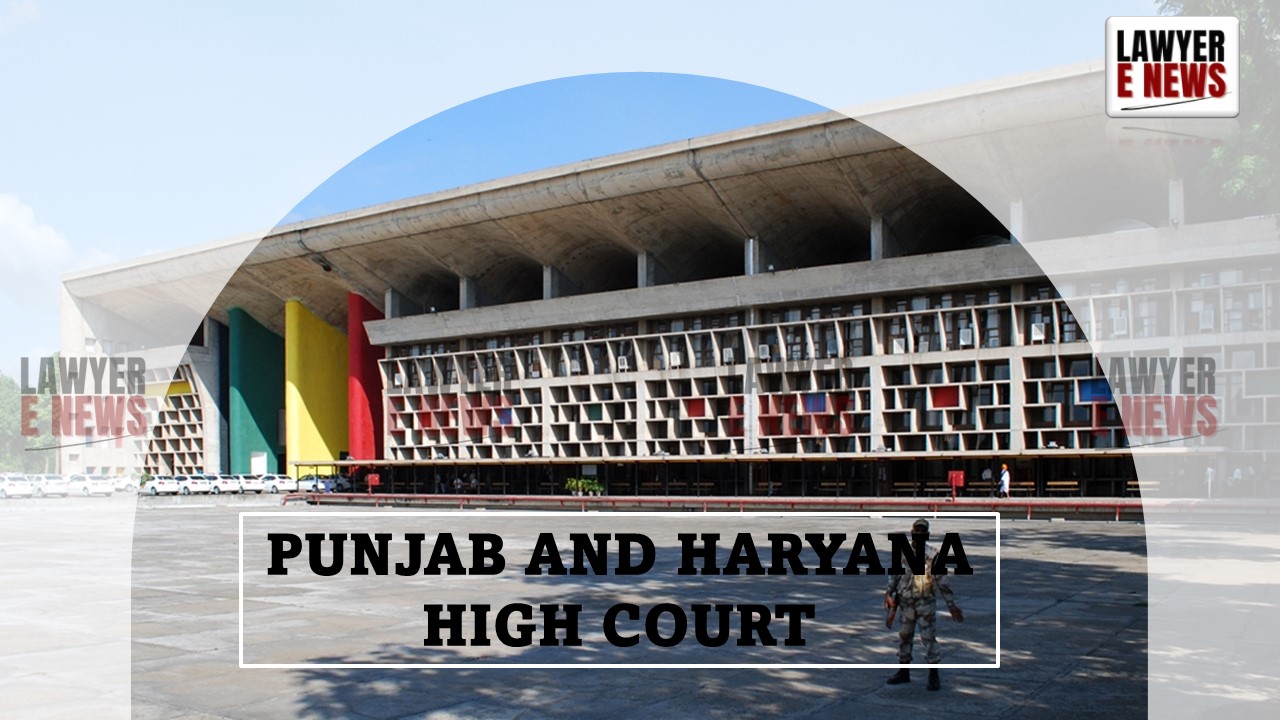
“Awarding Sentence Is Not a Mere Ritual; It Must Reflect the Possibility of Reform”— In a compassionate and reasoned judgment Punjab and Haryana High Court ruled that sentencing is “not a mere formality,” and reduced the sentence of a man convicted under Sections 452, 323, and 325 of the IPC to the period already undergone. While upholding the conviction, the Court emphasized the importance of individualized sentencing, observing that the accused had already spent six months and 21 days in custody, had shown no signs of recidivism, and was seeking to live a peaceful life.
Justice Harpreet Singh Brar, delivering the verdict in Rajinder Singh v. State of Punjab (CRR-1208-2025), observed:
“After assessing all relevant factors, proper sentence should be awarded bearing in mind the principle of proportionality, to ensure the sentence is neither excessively harsh nor does it come across as lenient.”
The High Court was considering a revision petition filed by Rajinder Singh, challenging only the quantum of his sentence, not the conviction itself. The petitioner had been convicted in 2017 and sentenced to two years rigorous imprisonment under Sections 452 and 325 IPC, and one year under Section 323 IPC, with all sentences to run concurrently. His appeal was dismissed earlier this year by the Additional Sessions Judge, Hoshiarpur.
However, before the High Court, the petitioner restricted his challenge to the sentence alone, contending that:
“He has already undergone six months and 21 days in custody and is not involved in any other criminal activity.”
The Court noted that the trial had dragged on for more than 11 years, and that the accused had now grown into a law-abiding citizen seeking a second chance.
Referring to the Supreme Court’s decision in Deo Narain Mandal v. State of U.P. (2004) 7 SCC 257, the Court reiterated:
“Awarding of sentence is not a mere formality. When a minimum and maximum term is prescribed by statute, a discretionary element is vested in the Court, to be exercised judiciously—not arbitrarily or whimsically.”
It further drew strength from Ravada Sasikala v. State of A.P., AIR 2017 SC 1166, which emphasizes that:
“Imposition of sentence also serves a social purpose, as it acts as a deterrent... but opportunities of reformation must be granted.”
After examining the custody certificate, the Court concluded that there was no justification to keep the petitioner incarcerated any further. It held:
“It would be in the interest of justice if the sentence awarded to the petitioner is reduced to the period already undergone by him.”
Affirming the conviction, the Court modified the sentence as follows:
“The sentence of rigorous imprisonment for a period of two years and fine, along with the default mechanism, is reduced to the period already undergone. The petitioner is directed to be released forthwith from jail, if not required in any other case.”
This judgment stands as a reaffirmation of the reformative spirit of criminal jurisprudence, sending a clear message that punishment must be tempered with mercy where warranted. The Court’s intervention underscores the belief that:
“Justice is not only about punishing wrongdoing—it is also about recognising redemption.”
Date of Decision: August 5, 2025