-
by sayum
27 August 2026 3:32 PM







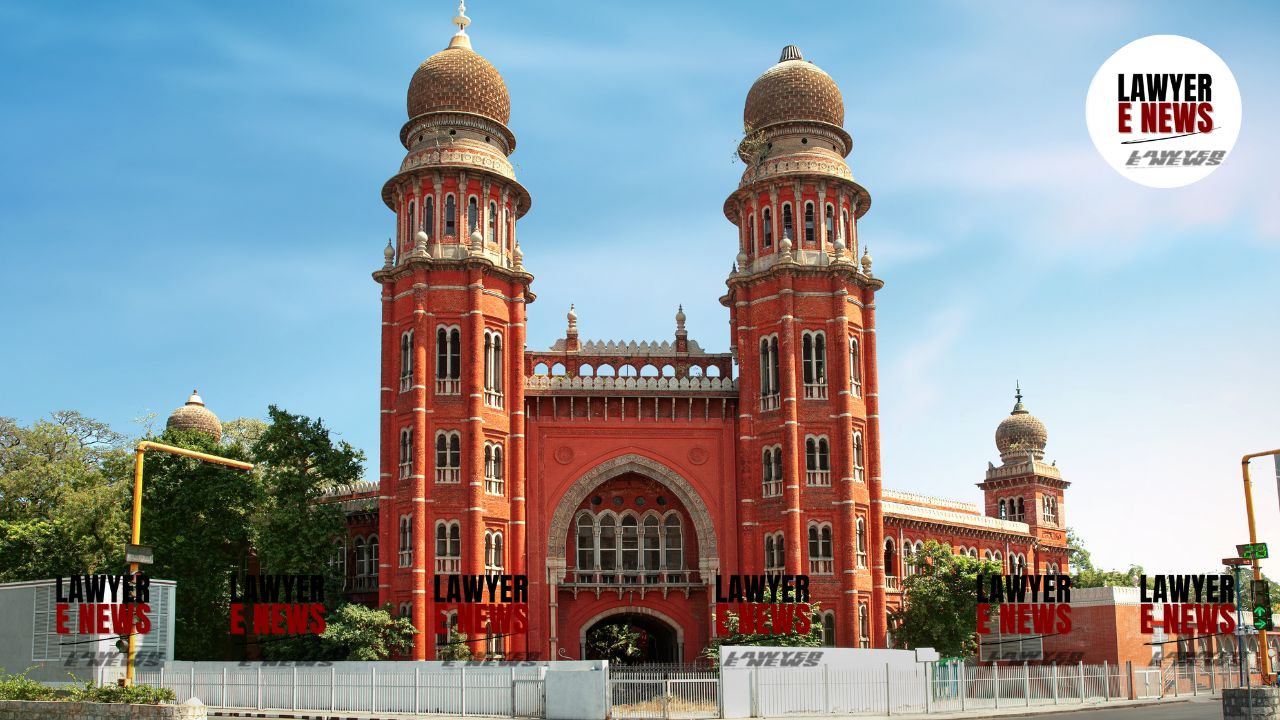
"It is crystal clear that the relief sought in this public interest litigation relates to service matter. The Apex Court has consistently held that a service dispute cannot be raised by way of a public interest litigation," Madras High Court, in a significant ruling dated April 27, 2026, held that a writ petition styled as a Public Interest Litigation (PIL) is not maintainable when the subject matter pertains to service disputes.
A bench comprising Chief Justice Sushrut Arvind Dharmadhikari and Justice G. Arul Murugan observed that challenges involving the removal or reinstatement of elected panchayat office-bearers fall within the realm of service matters, which cannot be litigated through the PIL route.
The petitioner, a ward member of the ThenMelpakkam Village Panchayat, filed a writ petition challenging a Government Order dated December 8, 2025. This order had allowed the appeals of the President and Vice-President of the Panchayat (Respondents 11 and 12), effectively setting aside the District Collector’s earlier direction for their removal from office. The petitioner sought the quashment of the Government’s reinstatement order through the present PIL.
The primary question before the court was whether a writ petition filed in the nature of a Public Interest Litigation is maintainable when it challenges orders relating to the appointment, removal, or service conditions of office-bearers. The court was also called upon to determine if a fresh PIL could be entertained when an earlier petition on similar facts was already pending.
PIL Not Maintainable in Service Jurisprudence
The Court, upon perusing the impugned order, noted that the core of the dispute involved the removal of respondent Nos. 11 and 12 from their posts as President and Vice-President. The bench emphasized that such disputes are essentially service matters in nature. Referring to the settled legal position, the Court noted that the Extraordinary Writ Jurisdiction under Article 226 of the Constitution of India cannot be invoked via PIL for service disputes.
"It is crystal clear that the relief sought in this public interest litigation relates to service matter," the Court observed.
Judicial Precedents Restricting PILs in Service Matters
The bench relied on a catena of Supreme Court decisions, including Dr. Duryodhan Sahu v. Jitendra Kumar, Neetu v. State of Punjab, and Vishal Ashok Thorat v. Rajesh Shripambapu Fate, which have consistently barred the entry of PILs into the service law domain. The Court underscored that High Courts must be vigilant in filtering out petitions that masquerade as public interest causes but are, in essence, private or service-related grievances.
Court's Duty to Weed Out Frivolous Litigations
Quoting the Apex Court's decision in Dattaraj Nathuji Thaware v. State of Maharashtra, the bench highlighted the necessity of weeding out petitions that misuse the PIL label. The Court noted that valuable judicial time is often wasted on such "so-called" public interest litigations, which should otherwise be utilized for genuine cases. The bench reiterated that the High Courts should "throw out" such petitions at the threshold based on established precedents.
"It would be desirable for the Courts to filter out the frivolous petitions and dismiss them with costs... so that the message goes in the right direction that petitions filed with oblique motive do not have the approval of the Courts," the bench quoted.
Impact of Pendency of Earlier Proceedings
The Court further observed that the petitioner had already filed a separate writ petition (W.P. No. 9473 of 2023) regarding allegations of misappropriation of funds by the same respondents. Since that petition was still pending and formed the basis for the initial action against the officials, the bench found no reason to entertain a fresh PIL arising from the subsequent service-related administrative orders.
"The scope of the earlier writ petition, which is also a public interest litigation, is regarding misappropriation of public funds. When that writ petition is still pending, we find no good ground to entertain a public interest litigation in service matter," the Court held.
The High Court concluded that the present petition was an impermissible attempt to litigate a service dispute under the guise of public interest. Consequently, the writ petition was dismissed as not maintainable. No orders were passed as to costs, and all connected interim applications were closed.
Date of Decision: 27 April 2026