-
by sayum
27 August 2026 3:32 PM







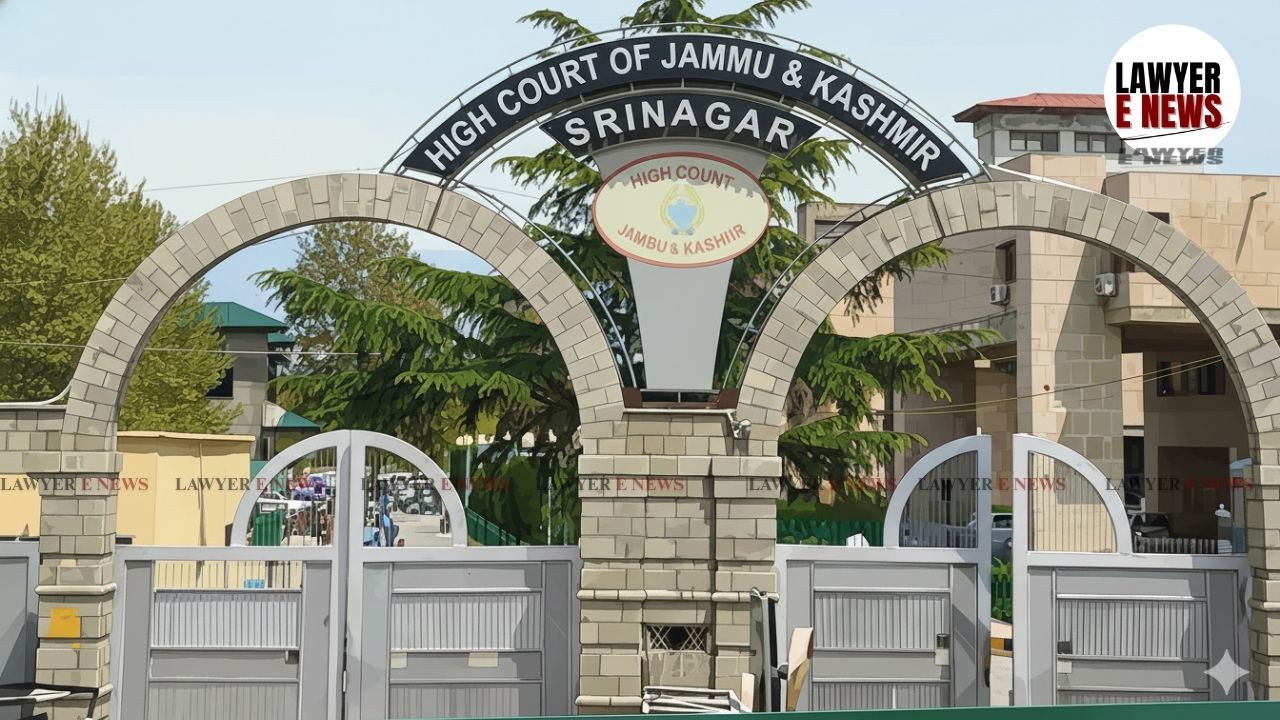
"Any annoyance or ill will expressed by public servants against the petitioner/detenu, in his capacity as the concerned MLA, cannot amount to public disorder," High Court of Jammu & Kashmir and Ladakh, in a significant ruling, quashed the preventive detention of an elected Member of the Legislative Assembly (MLA) under the J&K Public Safety Act, 1978.
A bench of Justice Mohd Yousuf Wani held that the alleged activities of the petitioner, involving protests against administrative decisions and social media criticism, amounted at best to infractions of normal criminal law and did not meet the threshold of "public disorder." The Court observed that "recourse to preventive detention, in respect of allegations of common law and order infraction is unwarranted and illegal."
The petitioner, Mehraj Din Malik, an elected MLA from Doda East, was detained by the District Magistrate, Doda, via an order dated September 8, 2025, to prevent him from acting in a manner prejudicial to the maintenance of public order. The detention was based on a police dossier citing 18 FIRs registered between 2014 and 2025 and 16 Daily Diary Reports (DDRs). The primary trigger for the detention was the petitioner's protest against the shifting of a local health center and his aggressive social media posts directed at the District Administration.
The primary question before the court was whether the alleged activities of the petitioner constituted "public disorder" as defined under Section 8(3)(b) of the PSA or were merely "law and order" situations. The court was also called upon to determine whether the non-supply of relied-upon materials, including social media videos, violated the petitioner's constitutional right to make an effective representation under Article 22(5). Finally, the court examined whether the detention was vitiated by staleness of material and a lack of live proximity between the alleged acts and the detention order.
Distinction Between ‘Law And Order’ And ‘Public Order’
The Court emphasized the fundamental distinction between "law and order" and "public order," noting that the latter is a much graver concept. Justice Wani observed that for "public order" to be disturbed, there must be a resulting "public disorder" that affects the community at large and tends to paralyze the day-to-day routine of society. The Court held that a mere disturbance of law and order is not necessarily sufficient for action under the PSA.
"Breach of ‘Public order’ must result in the ‘Public disorder’ and the ‘Public disorder’ needs to be understood as such a chaos and confusion which involves public at large having the tendency, to paralyze the day to day routine of the society."
Annoyance Of Public Servants Not A Ground For Detention
Addressing the allegations that the MLA had heckled officials and abused the District Magistrate on social media, the Court noted that these acts did not impact societal harmony. The bench remarked that the role of an elected representative often involves raising public grievances which may cause friction with the administration. The Court made it clear that personal annoyance of officials cannot be dressed up as a threat to public order.
"Any annoyance or ill will expressed by public servants against the petitioner/detenu, in his capacity as the concerned MLA, cannot amount to public disorder. There must be a direct impact of the alleged act on societal harmony before the same can be adjudged as an act disturbing social order."
Ordinary Criminal Law Is Sufficient Remedy
The Court found that the allegations against the petitioner, including theft of hospital equipment and obstructing public servants, were already covered by the Indian Penal Code (and now Bharatiya Nyaya Sanhita). The Court held that the invocation of the PSA was an unjustified exercise of power when ordinary law was sufficient to deal with the situation. Relying on the Supreme Court's ruling in Rekha v. State of Tamil Nadu, the Court noted that if ordinary law can deal with a situation, recourse to preventive detention is illegal.
"The alleged actions of the petitioner no doubt amount to infraction of normal criminal laws for which the legal mechanism in place was already pressed into service. The invocation of the provisions of the PSA to detain the petitioner rather than to pursue the prosecution against him appears to be an unjustified exercise."
Unverified DDR Entries Cannot Form Basis Of Detention
The bench scrutinized the 16 Daily Diary Reports (DDRs) relied upon by the Detaining Authority. The Court held that reports which have not been converted into formal FIRs for want of verification cannot be used to snatch the liberty of a person. It specifically noted that a DDR alleging communal incitement, upon examination, only showed the MLA criticizing the District Magistrate in his official capacity, which carries no communal undertone.
"The said DDRs which have not been registered in the form of formal FIRs for want of proper verifications and for being without formal information reports could not have been considered for ordering the preventive detention of the detenu."
Non-Supply Of Relied-Upon Videos Vitiates Detention
A critical procedural lapse identified by the Court was the failure to furnish the petitioner with copies of the videos and reports mentioned in the grounds of detention. While the respondents sought permission to play these videos in court during final arguments, the Court held that the failure to provide them to the detenu at the time of execution denied him the opportunity to make an effective representation under Article 22(5) of the Constitution of India.
"Non-supply of the said videos referred to and relied upon by the detaining authority denies the opportunity to the petitioner/detenue to make an effective representation and such lapse vitiates the detention order."
Staleness Of Material And Lack Of Proximity
The Court observed that many of the FIRs cited dated back to 2014, including violations of the Model Code of Conduct during past elections. The bench ruled that there was no "live link" or proximity between these stale incidents and the need for detention in 2025. Justice Wani noted that the Detaining Authority must satisfy itself of the imperative need to detain based on recent, relevant conduct.
"There appears to be no proximity or live link between the alleged incidents dating back from April 2014 and the passing of the impugned detention order dated 8th Sept. 2025."
Detenu Entitled To Raise New Grounds In Habeas Corpus
The Court rejected the respondents' argument that the petitioner could not raise new legal grounds during arguments that were not in his initial representation. Citing Mohinuddin v. District Magistrate Beed, the Court affirmed that in a Habeas Corpus petition, the burden lies entirely on the State to prove the legality of the detention, and the Court can examine the detention’s validity even without specific pleadings if the circumstances raise doubt.
"It is enough for the detenu to say that he is under wrongful detention, and the burden lies on the detaining authority to satisfy the Court that the detention is not illegal or wrongful."
The High Court allowed the petition, quashing the detention order issued by the District Magistrate, Doda. The Court concluded that the detention was a result of non-application of mind, as the activities alleged did not fall within the specific ambit of "public order" under the PSA. The respondents were directed to release the petitioner/detenu forthwith.
Date of Decision: 27 April 2026