-
by sayum
28 August 2026 12:24 PM







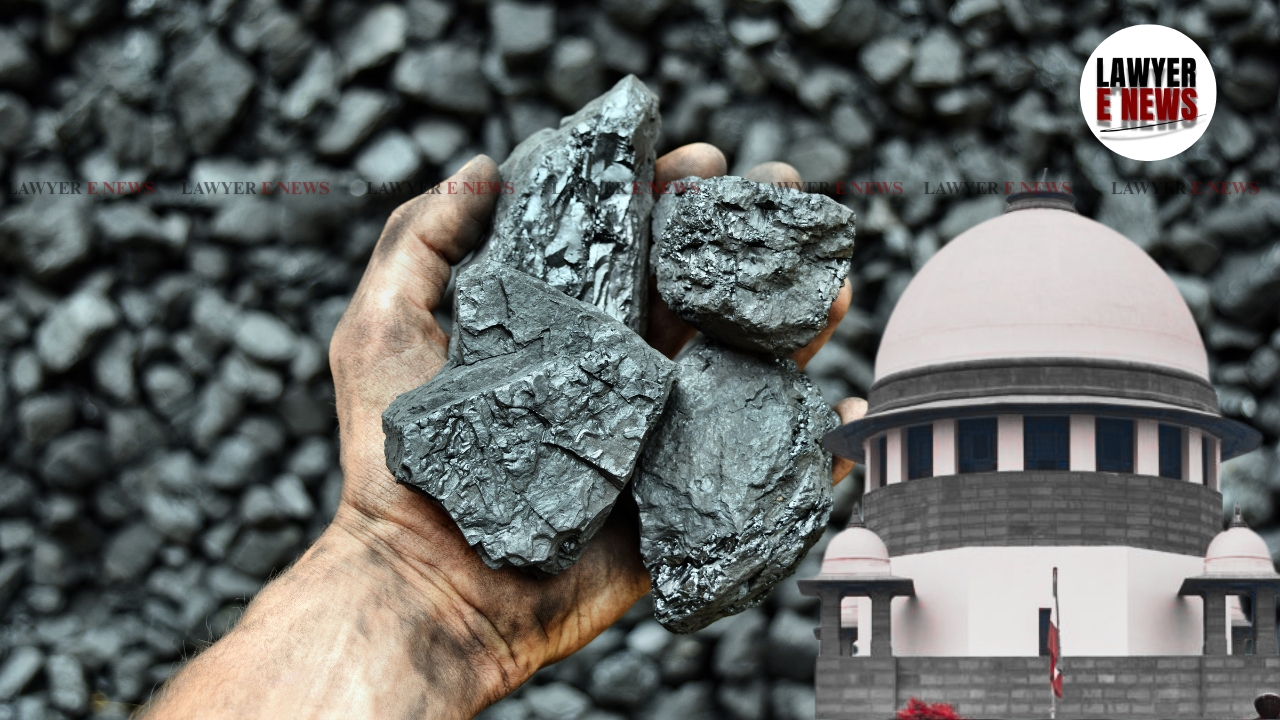
“Auction is not a constitutional mandate. Alienation of natural resources is a policy decision... Courts cannot second-guess economic policies unless they fall foul of Article 14.” – Supreme Court of India, in a significant pronouncement, upheld the validity of the Interim Coal Policy framed by Coal India Ltd. post the striking down of the e-auction mechanism. The policy, which imposed a 20% price hike for non-core sector linked consumers, was challenged as arbitrary and unconstitutional. Dismissing these contentions, the Court held that “price fixation is an executive function”, and the judiciary cannot substitute its wisdom over such economic choices unless the policy is “clearly arbitrary, irrational or violative of constitutional rights.”
Deciding the case of Coal India Ltd. & Ors. v. M/s Rahul Industries & Ors., the Bench comprising Justices J.B. Pardiwala and R. Mahadevan ruled that the Interim Coal Policy was a valid exercise of power under the Colliery Control Order, 2000, and found no breach of Article 14. It further held that the respondents’ claim for refund of the increased price was untenable in equity and law, as they failed to prove that they bore the burden of the cost themselves.
“Reasonable Profit in Pursuit of the Common Good Cannot Be Branded as Unconstitutional” – Court Dismisses Challenge to 20% Price Hike
At the heart of the dispute was the legality of the 20% price increase implemented after the Supreme Court’s decision in *Ashoka Smokeless Coal India Pvt Ltd. v. Union of India (2006), which had invalidated the coal e-auction system. In the aftermath of that verdict, and in the absence of a new pricing mechanism, Coal India Ltd. introduced the Interim Coal Policy on December 15, 2006, seeking to impose a marginal premium over the notified price for non-core sector consumers who had existing linkages.
The respondents, including various industrial users, argued that this hike was both unauthorised and discriminatory, alleging that it sought to recover past losses and that the linkage system entitled them to coal at notified prices.
Rejecting these submissions, the Supreme Court clarified that Coal India was never divested of its authority to notify prices under the Colliery Control Order. The Court observed:
“Nowhere in the Ashoka Smokeless judgment was any embargo created on CIL to notify prices. Such a proposition would be contrary to the separation of powers. Courts can neither legislate nor impose procedural mandates that curtail statutory power unless required by the Constitution.”
It further declared that the 20% increase was neither excessive nor profiteering, noting:
“A marginal hike which mitigates only 1.2% of operational losses, far from being profiteering, is merely an attempt to ensure sustainability. This cannot be held unconstitutional.”
“Article 14 Does Not Forbid Classification – Only Arbitrary Classification” – Rational Basis Found in Core vs Non-Core Distinction
A central constitutional challenge raised by the respondents was that the price differential between core and non-core sector linked consumers amounted to hostile discrimination in violation of Article 14. The Court, however, found that the classification was both intelligible and reasonable, aligned with legitimate public interest.
Citing the settled law in Pallavi Refractories v. Singareni Collieries Co. Ltd. and State of Gujarat v. Shri Ambica Mills, the Court observed:
“Every differentiation is not discrimination. A valid classification is permissible under Article 14 if it is based on intelligible differentia and bears a rational nexus to the object sought to be achieved. That test is fully satisfied in the present case.”
The Court reiterated that the linkage system is not a matter of constitutional entitlement and merely facilitates assured supply. It noted:
“There exists no absolute right to insist upon notified prices. The pricing mechanism must evolve with circumstances and operational sustainability.”
“Courts Are Ill-Equipped to Decide the Wisdom of Economic Policies” – Judicial Deference Reiterated
In strong words, the Bench emphasized the need for judicial restraint in economic matters, stating that policy framing is best left to the executive. It drew from precedents such as Balco Employees Union v. Union of India, Peerless General Finance v. RBI, and Kirloskar Ferrous Industries Ltd. v. Union of India, holding:
“The Court is not expected to become an appellate forum for economic decision-making. Unless a policy is shown to be manifestly arbitrary or in breach of constitutional norms, it is not subject to judicial correction.”
Answering the contention that a committee was yet to be formed following Ashoka Smokeless, the Court held that:
“Judicial directions for policy formation do not override statutory authority. The CCO, 2000 remains operative, and the power to notify prices under it remains unaffected.”
The Court declined to apply the proportionality test, noting that the challenge was not against individual rights but classification. Instead, it applied the rational nexus test, which was found fully satisfied.
Refund Denied: “Respondents Failed to Prove That They Bore the Burden” – No Refund Without Proof Under Mafatlal Doctrine
On the question of refund of the differential amount, the Court categorically held that such a claim could not succeed without proof that the buyers did not pass on the burden to their consumers. The Bench relied heavily on the Constitution Bench ruling in Mafatlal Industries v. Union of India, declaring:
“In matters of refund, the doctrine of unjust enrichment prohibits return of money unless it is shown that the claimant bore the burden. The respondents failed to meet this threshold.”
The Court found that the respondents had not produced evidence to demonstrate that the increased cost had not been passed on. In absence of such evidence, refund would result in a windfall, leading to unjust enrichment, which the law expressly prohibits.
Rejecting reliance on Maa Mundeshwari Carbon Pvt. Ltd. v. CCL, the Court observed:
“The decision in Maa Mundeshwari was rendered mechanically, without analyzing the principles under Articles 14 and 39(b). It cannot be treated as binding precedent.”
“Common Good Includes Sustainability – State Must Ensure Continued Access to Essential Commodities” – Article 39(b) Supports Policy
In a powerful reaffirmation of Directive Principles of State Policy, the Court invoked Article 39(b) to justify the policy’s objective of ensuring equitable and sustainable coal distribution. The Bench held:
“It is a fallacy to assume that a small price increase for non-core sectors undermines equity. On the contrary, ensuring the viability of coal supply serves the common good.”
The Court explained that where pricing policies are designed to safeguard public access to essential resources, reasonable pricing flexibility cannot be held unconstitutional.
“So long as the policy is aimed at furthering equitable access and sustainable development, Article 39(b) is subserved, not undermined.”
The Supreme Court’s judgment in Coal India Ltd. v. M/s Rahul Industries is a resounding affirmation of executive authority in economic policymaking, especially in sectors involving natural resources. The Court has clarified that not every price increase or administrative classification amounts to a constitutional violation. It has firmly held that judicial review cannot be used as a tool to micromanage economic decisions, particularly when no manifest arbitrariness is shown.
In upholding the 20% price hike, rejecting the refund claim, and reaffirming the policy's alignment with constitutional principles, the Court has set a precedent for judicial deference in matters of pricing and resource allocation, provided the executive action passes the basic tests of reasonableness and non-discrimination.
Date of Decision: 12 September 2025