-
by sayum
05 August 2026 9:31 AM







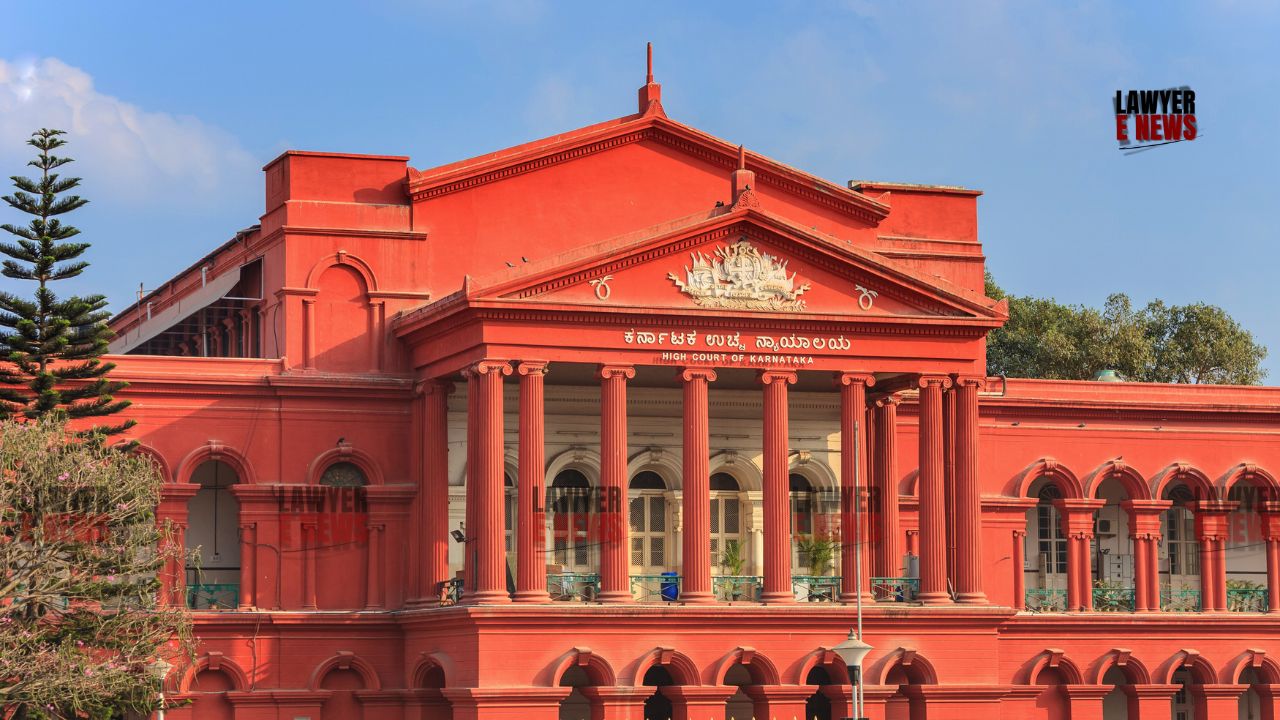
"Zoning Regulations Permit Places of Worship in Residential Zones — Cancellation of Building Licence Without Statutory Backing Is Without Jurisdiction", In a significant ruling, the Karnataka High Court, through Justice S. Sunil Dutt Yadav, held that a Community Hall intended to be used as a Prayer Hall cannot be termed illegal merely because it is situated in a residential zone, if such use is permitted under applicable zoning regulations. The Court declared that the cancellation of the Trust’s building licence by the City Municipality, Udupi, was void, as there was no misrepresentation or fraudulent conduct, which are the only statutory grounds available under Section 188 of the Karnataka Municipalities Act, 1964.
Terming the cancellation order as an action “without jurisdiction and in violation of zoning norms and statutory procedure”, the Court emphasized that “mere public objections, apprehensions of communal disharmony, or executive circulars cannot override valid statutory rights.”
The litigation arose out of two writ petitions, both concerning the construction of a Community/Prayer Hall by Chosen Generations Ministries, a registered public religious and charitable trust.
One petition (W.P. No. 21080 of 2023) was filed by a local councillor, Krishnarao Kodancha, challenging the refusal of the Udupi City Municipality to cancel the Trust’s building licence. The other petition (W.P. No. 7466 of 2024) was filed by the Trust, challenging the cancellation of its building licence on 15.02.2024, following pressure from local residents and instructions from the Urban Development Authority.
The Trust had originally obtained the building licence on 01.04.2023, for a Community Hall on converted residential land. Objections from local residents — primarily communal in nature — led to multiple complaints. However, the Civil Court in O.S. No. 328/2023 had granted injunction in favour of the Trust, holding that the licence was valid and that objections were deemed to have been considered.
Justice S. Sunil Dutt Yadav rejected the arguments made by the complainant and the Municipality, stating unequivocally:
“The use of the Community Hall as a Prayer Hall is squarely covered within the uses permitted under the Zoning Regulations... there is no violation of law.” [Para 28]
The Court relied on Annexure I to the Udupi-Malpe Zoning Regulation, 2021, and reiterated:
“As per Annexure I, 1(a) of this Zoning Regulation, uses permitted in residential zone includes the 'places of worship'. Therefore the argument that the plaintiff cannot use the residential building for public worship in residential area is not sustainable in the eyes of law.” [Para 19]
The central statutory issue concerned Sections 187 and 188 of the Karnataka Municipalities Act, 1964. The Court clarified that Section 188 allows cancellation of building licences only in cases of misrepresentation or fraud:
“Once a building licence is issued under Section 188 of the Act, it can be revoked only on the ground of material misrepresentation or fraudulent statement… There is no such allegation or evidence in the present case.” [Para 29]
In stark terms, the Court declared the cancellation order illegal: “The cancellation order refers to Section 187(9), which does not confer power to cancel building plans. If that were to be so, in the absence of such power, the order at Annexure-R is one without jurisdiction.” [Para 37]
Moreover, the Court dismissed the reliance placed by authorities on the 2009 Circular, observing:
“Any action taken on the basis of Circular dated 19.09.2009 would not confer power to cancel the licence… The validity of the said Circular has already been set aside in Udupi Youth Ministry v. Commissioner, Urban Development Authority.” [Para 39]
The Court was unequivocal in holding that mere public apprehensions cannot justify the denial of statutory rights:
“Mere objection of local citizens cannot defeat the right to enjoy the property for a use permissible under the Zoning Regulations.” [Para 40]
The Court held that the Civil Court’s injunction order dated 01.07.2023, passed in O.S. No. 328/2023, had attained finality and was binding. The City Municipality had earlier even withdrew its appeal against the injunction, citing that the Trust was acting in accordance with the sanctioned plan. The Municipality’s sudden reversal — cancelling the licence based on executive advice — was described by the Court as unjustified and lacking in statutory authority.
“The complainants as well as the City Municipality are parties in O.S. No. 328/2023 in which an order is passed on I.A. No. II protecting the Trust — which ought not to be ignored.” [Para 34]
The Court also reaffirmed that: “The Trust has neither misrepresented nor violated any of the statutory conditions under Section 188. The cancellation, therefore, is without the authority of law.” [Para 31]
The Karnataka High Court’s ruling not only reaffirms the legal sanctity of zoning permissions and sanctioned licences, but also serves as a strong rebuke to administrative overreach driven by non-legal concerns. By quashing the cancellation order and upholding the rights of a religious trust to build a prayer facility in a residential zone, the Court has clarified that religious use, if permitted by zoning law, cannot be denied based on public sentiment or executive whim.
“Where a statutory scheme occupies the field, an executive circular cannot override the law. There is no power to cancel the licence in absence of fraud or misrepresentation.” [Para 32]
In effect, the judgment sets a binding precedent on the limits of municipal and development authorities, ensuring that building licences, once validly granted, cannot be whimsically revoked.
Date of Decision: 03 July 2025