-
by sayum
29 August 2026 3:15 PM







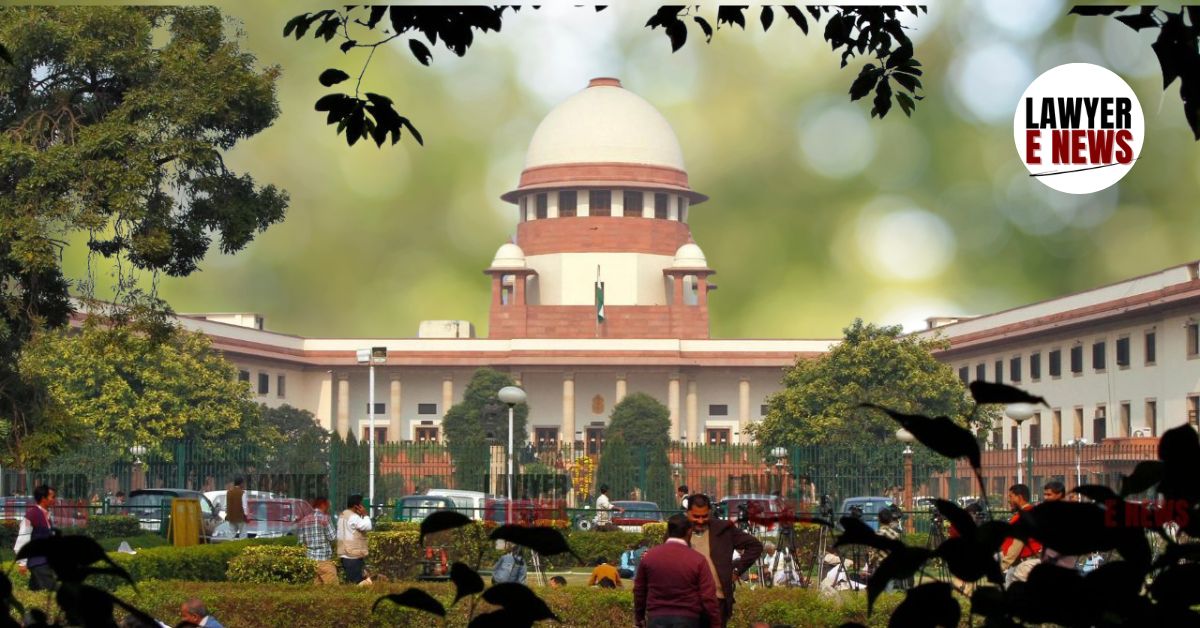
“Our regulations need to be one step ahead of times… inconsistencies and lack of clarity will only delay the process and generate unnecessary litigation” — Supreme Court of India, in a reportable judgment, allowed the appeals while issuing serious concerns over the fragmented and inconsistent legal framework governing environmental regulation following recent statutory amendments.
The bench comprising Justice Pamidighantam Sri Narasimha and Justice Manoj Misra not only resolved the appeals before them but also delivered a systemic critique of the environmental statutes, highlighting the contradictions emerging from the 2024 amendments to the Water and Air Acts.
“Amendments Have Created Legal Asymmetry; Urgent Legislative Redesign Needed”
While allowing the appeals filed by the Delhi Pollution Control Committee (DPCC), the Court took the opportunity to scrutinize the impact of recent amendments on the Water (Prevention and Control of Pollution) Act, 1974, the Air (Prevention and Control of Pollution) Act, 1981, and the Environment (Protection) Act, 1986.
The Court observed: “Certain amount of asymmetry in the governing statutes… has come to light. This asymmetry seems to have been aggravated with the advent of the amendments introduced in 2024 to the Water and Air Acts.”
The 2024 Water Act amendment, applicable only in Himachal Pradesh, Rajasthan, and Union Territories, and the Jan Vishwas (Amendment of Provisions) Act, 2023, which amended the Air and Environment Acts, have decriminalized many offences and introduced civil adjudication mechanisms, but not in a uniform manner across jurisdictions.
The appeals arose from enforcement actions by the DPCC against Lodhi Property Co. Ltd. and others under both the Water Act and Air Act, wherein statutory directions were challenged on grounds of procedural impropriety and legal validity.
The crux of the Supreme Court’s ruling lies in its broader examination of the statutory framework, not just the specific facts of the case.
The bench noted that: “Statutory framework lacks clarity… The Water Act, the Air Act, and the Environment (Protection) Act were legislated in 1974, 1981 and 1986 respectively, in a very different environment… there has been a persistent demand to amend these laws.”
The Court took judicial notice of how post-amendment disparities between the Water and Air Acts have created a regulatory and procedural minefield, particularly regarding penalties and appellate mechanisms.
Shift from Criminal to Civil Penalties, but with Limited Uniformity
The Court emphasized that: “A significant part of the amendments has been the substitution of imprisonment with fines… maximum penalty that may be imposed is fifteen lakh rupees.”
Yet, imprisonment is still retained for a few specific contraventions, such as failure to obtain consent or refusal to pay penalties.
No Nationwide Applicability of Amendments
The amended Water Act is not yet in force across all states, leading to a jurisdictional mosaic that undermines consistency:
“The amended Water Act has not come into effect in all the states.”
As a result, similar violations in different states may attract different punishments and procedures, potentially affecting both enforcement and adjudication.
Appeals Process Under the Water and Air Acts is Inconsistent
The Court noted: “There is no statutory appeal against directions issued by State Boards under Section 31A of the Air Act,”
whereas Section 33A of the Water Act provides for appeals to the National Green Tribunal (NGT) under Section 33B.
This inconsistency was earlier flagged in Tamil Nadu Pollution Control Board v. Sterlite Industries (India) Ltd. (2019) 19 SCC 479, which the Court quoted at length, stating:
“Directions issued under Section 33A of the Water Act are appealable to the NGT, [but] directions issued under Section 31A of the Air Act are not so appealable… This would drive a coach-and-four through the statutory scheme…”
The Court categorically rejected attempts to equate "orders" and "directions" under the Air Act, reiterating that such conflation undermines legislative intent.
“Environmental Law Must Keep Pace with Climate Reality”: Court Calls for Government Action
Calling the existing environmental legal architecture outdated and fragmented, the Court said:
“We need to augment and redesign our regulatory capacity… inconsistencies and lack of certainty… will not only delay the process but also generate unnecessary litigation.”
Acknowledging that climate change is not a future threat but a present reality, the Court underscored the urgent need for a coherent and unified legal framework.
In a significant move, the Court impleaded the Ministry of Environment, Forest and Climate Change (MoEFCC) and directed the Centre to respond on the broader legal framework.
“It is compelling to have an effective and efficient legal regime in place.”
The Court also appointed Ms. Shibani Ghosh and Mr. Ninad Laud, Advocates of the Supreme Court, as Amici Curiae to assist on the legal reform issues raised.
Judgment Allowed, Legal Reform Now on Notice
While allowing the appeals of the DPCC, the Court has clearly transformed a routine statutory matter into a starting point for systemic environmental law reform.
The matter has been posted for further hearing on 15 September 2025, with the Union of India directed to file its response.
Date of Decision: 4 August 2025