-
by sayum
05 August 2026 3:07 PM







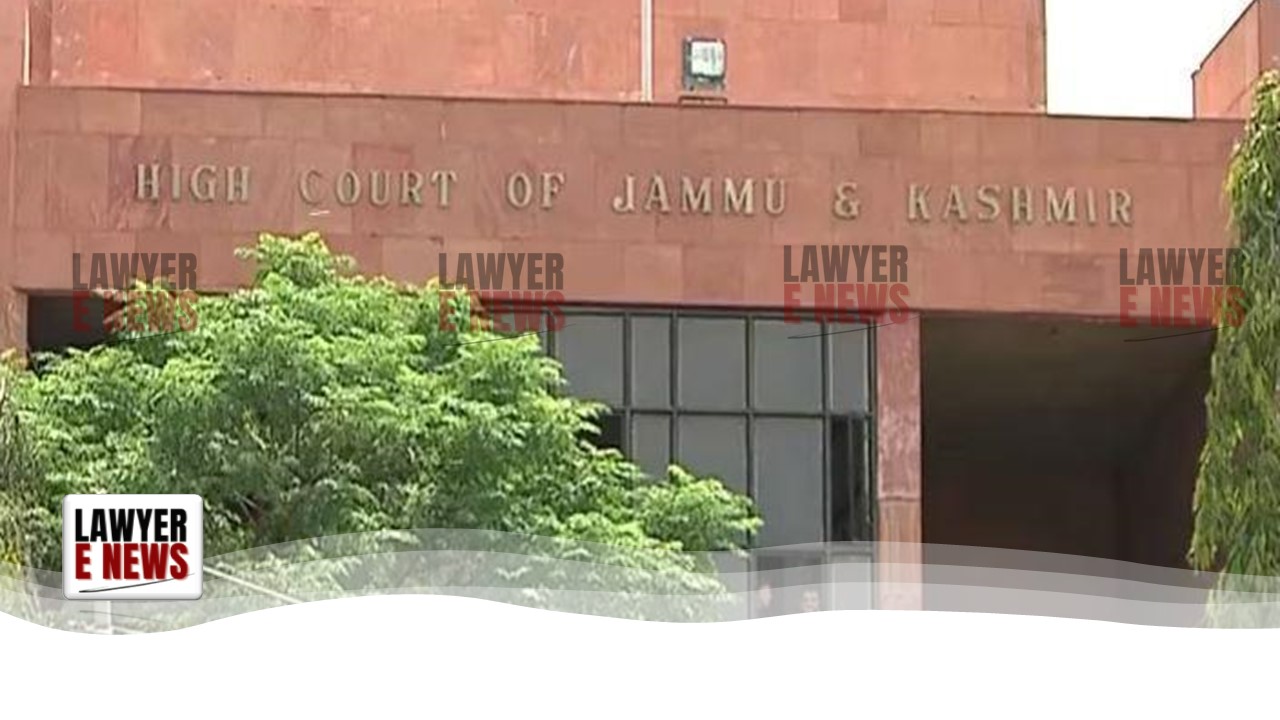
“Contradictions, Hostile Witnesses, and Lack of Civilian Presence Undermine Prosecution Case”: High Court of Jammu & Kashmir and Ladakh at Jammu dismissed the State’s appeal against acquittal in the 2005 arms and explosives recovery case, ruling that the trial court’s judgment was not perverse and based on plausible appreciation of evidence.
A Division Bench comprising Justice Shahzad Azeem and Justice Sindhu Sharma delivered a detailed judgment, arising from a challenge to the acquittal of Tajinder Singh and Ravinder Singh—accused of procuring and concealing AK-56 rifles, cartridges, and RDX, allegedly for subversive activities under the instructions of Pakistan-backed terror outfit K.Z.F.
The High Court affirmed the trial court’s judgment dated 02.01.2014, which had acquitted the accused under Sections 4 and 5 of the Explosive Substances Act, 7/25 of the Arms Act, and Section 120-B of the Ranbir Penal Code, citing severe contradictions in the prosecution’s evidence, non-examination of crucial witnesses, and procedural lapses.
“Once two views are possible and the trial court’s view is a plausible one, no interference is warranted even if the appellate court considers it erroneous,” the Bench ruled, quoting Tota Singh v. State of Punjab, AIR 1987 SC 1083.
“Police Witnesses Contradicted Each Other; Civilian Witnesses Were Never Examined Despite Availability”: High Court Slams Flawed Investigation
The case arose from an FIR registered on 24.08.2005, based on secret information that the accused were linked with the K.Z.F. terrorist outfit and had concealed arms and explosives at Sajadpur, near Nikki Tawi. Following their arrest at Satwari Chowk, the police claimed that disclosure statements led to the recovery of an AK-56 rifle, two magazines with 99 live cartridges, and 30 rolls of RDX.
However, the trial court had acquitted the accused after noting that the entire case rested on contradictory police testimonies, absence of independent witnesses, and hostile material witnesses. The High Court agreed, emphasizing that the prosecution failed to explain why independent civilians were not associated in arrest, disclosure, or recovery—despite their confirmed presence at all stages.
“Prosecution case, right from the time of arrest... and seizure and safe custody, is marred by contradictions, improbabilities, omissions, discrepancies... Witnesses, who were none other than police officers, lack credibility,” observed the Bench. [Para 49]
“Disclosure Statements Were Never Proven in Presence of Credible Witnesses”: Court Disbelieves Core of Prosecution Narrative
The High Court dissected the prosecution’s claim of voluntary disclosure, highlighting that key attesting witnesses—PW-1 Kulvinder Singh and PW-3 Gautam Sangra—either turned hostile or admitted absence during the disclosure.
PW-1 “was not present in the room where disclosure was allegedly made” and PW-3 “could not recall if any disclosure was made in his presence,” the Court noted. [Paras 30–31]
Similarly, PW-5 Daljeet Singh, also declared hostile, “categorically denied witnessing any disclosure or recovery.”
“The very foundation on which the edifice of the prosecution story rests... is badly shaken and renders the same unworthy of reliance,” the Bench concluded. [Para 48]
“Was the Recovery from the Bushes or Underground? Was It in the Dark? Was It Sealed at All?”: Bench Lists Inconsistencies and Gaps in Investigation
Noting inconsistent versions of how and where the arms were recovered—whether from bushes, underground, or handed over by the SHO—the Court highlighted the absence of a consistent chain of custody.
“If it was recovered in the dark, what was the source of light? No torch or source was seized or shown in court. Neither the sealing nor resealing of recovered materials was proved by the Magistrate. The investigation lacked integrity and failed legal standards.” [Paras 39–42]
The failure to prove sealing, custody, and transport of the arms and explosives, and the non-examination of the Magistrate who sealed the evidence, were held to be fatal to the prosecution case.
“Law Does Not Permit Conviction Merely on Suspicion, However Grave the Allegation”: High Court Reiterates Scope of Appellate Review
Relying on Ballu @ Balmukund v. State of M.P., AIR 2024 SC 1678, the Division Bench reminded that an appellate court cannot reverse an acquittal unless the trial court’s findings are perverse or legally impossible.
“Even if two views are possible, and the trial Judge found the other view to be more probable, interference would not have been warranted,” the Bench quoted from the precedent. [Para 46]
Thus, while the State argued that the case involved national security, the Court clarified:
“Gravitas of the offence cannot substitute for credible proof. Procedural safeguards and evidentiary thresholds remain applicable even in cases touching national integrity.”
Appeal Dismissed, Acquittal Affirmed
Holding that the trial court’s view was not only plausible but supported by a clear record of contradictions, the High Court refused to interfere:
“We do not find the impugned judgment suffers from any perversity or impossibility... Resultantly, the appeal is dismissed.” [Para 50]
This judgment underscores the constitutional and evidentiary safeguards applicable even in high-stakes prosecutions and reiterates that “justice must be done within the framework of law—not outside it.”
Date of Decision: July 18, 2025