-
by sayum
29 August 2026 3:15 PM







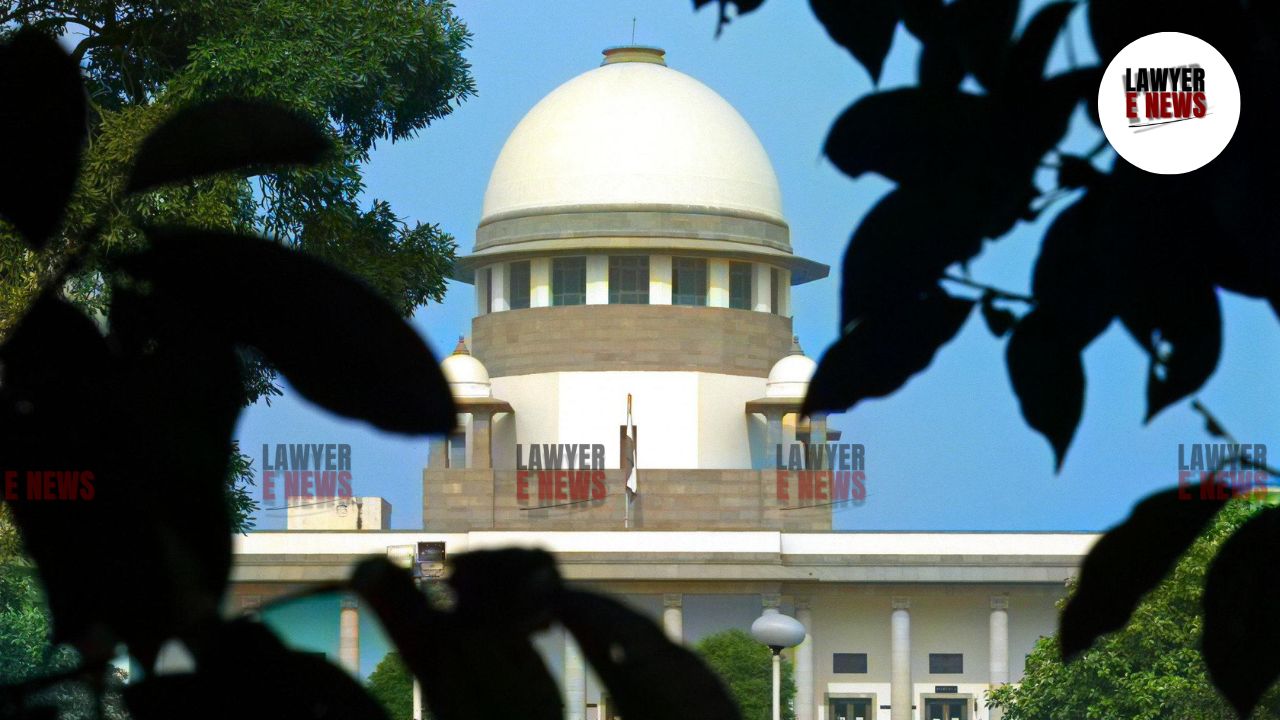
“Ordinarily an order of injunction may not be granted ex parte… Both the provisions are mandatory.” - Supreme Court of India declined to interfere with an Allahabad High Court order that had set aside an ex parte injunction, while powerfully reiterating the mandatory safeguards of Order 39 Rule 3 CPC for granting injunctions without notice. The Court directed the Trial Court—which is scheduled to hear both sides on August 12, 2025—to decide the injunction application on its own merits and in accordance with law, uninfluenced by the High Court’s observations.
The Trial Court (Civil Judge, Senior Division, Barabanki) had on May 9, 2025 granted an ex parte status-quo injunction over specified parcels of land in Village Kurouli, Tehsil Nawabganj, District Barabanki, noting a prima facie case and appointing a Local Commissioner/Amin to file an inspection report. The order also restrained alienation till the next date.
“Parties are directed to maintain status quo on the title and possession… and not to sell the suit property/land till the next date of hearing.”
Aggrieved, the defendants invoked Article 227 before the Allahabad High Court (Lucknow Bench). By order dated July 24, 2025, the High Court set aside the ex parte injunction, faulting the Trial Court for a cursory approach and for not recording the three sine qua non for interim relief, while transferring the suit to another Court and directing a fresh decision on the injunction within 15 days.
“The trial Court has not… recorded any existence of a prima-facie case, the balance of convenience or irreparable hardship… the three sine qua non for grant of… injunction.”
At the heart of the SLP lay the scope of ex parte injunctions and strict compliance with Order 39 Rule 3 CPC. The Supreme Court reproduced Rule 3 and underscored that while notice is the norm, the no-notice exception is hedged with mandatory duties: the Court must record reasons why delay would defeat the injunction’s object, and the applicant must promptly serve papers and file an affidavit of service.
“Ordinarily an order of injunction may not be granted ex parte… Both the provisions are mandatory.”
Relying on Shiv Kumar Chadha v. MCD, (1993) 3 SCC 161, the Bench emphasized that recording reasons is not a mere formality and that Parliament’s procedure for exceptional ex parte restraint must be scrupulously observed.
“If a statute requires a thing to be done in a particular manner it should be done in that manner or not at all.”
The Court clarified the consequence of non-compliance with Rule 3’s proviso: where the applicant fails to meet the mandatory obligations attached to an ex parte order, the Court that granted such indulgence may simply vacate the ex parte injunction—without commenting on merits—so that the matter proceeds bipartite.
“On being… satisfied [of] non-compliance… it would simply vacate the ex parte order… without expressing any opinion on the merits… leaving it open… for a bipartite hearing.”
Turning to the case at hand, the Supreme Court noted that the injunction application is listed for hearing on August 12, 2025, and therefore declined to interfere with the High Court’s order. It directed the Trial Court to decide the injunction afresh on merits, in accordance with law, and uninfluenced by any High Court observations in the impugned order.
“We need not interfere… The Trial Court shall hear the plaintiff and defendants… and decide… without being influenced… by the High Court.”
Finally, the SLP was disposed of, along with all pending applications. The Bench comprised Justice J.B. Pardiwala and Justice R. Mahadevan, sitting at New Delhi.
The judgment is a sharp reminder that ex parte injunctions are exceptional and procedurally exacting. By reaffirming the mandatory rigour of Order XXXIX Rule 3 and the limited appellate intervention when a prompt, full hearing is imminent, the Supreme Court has reset the focus to trial-level adjudication on merits—with due process, not shortcuts, as the governing norm.
“Recording reasons… cannot be held to be a mere formality.”
Date of Decision: August 11, 2025