-
by sayum
30 August 2026 4:28 AM







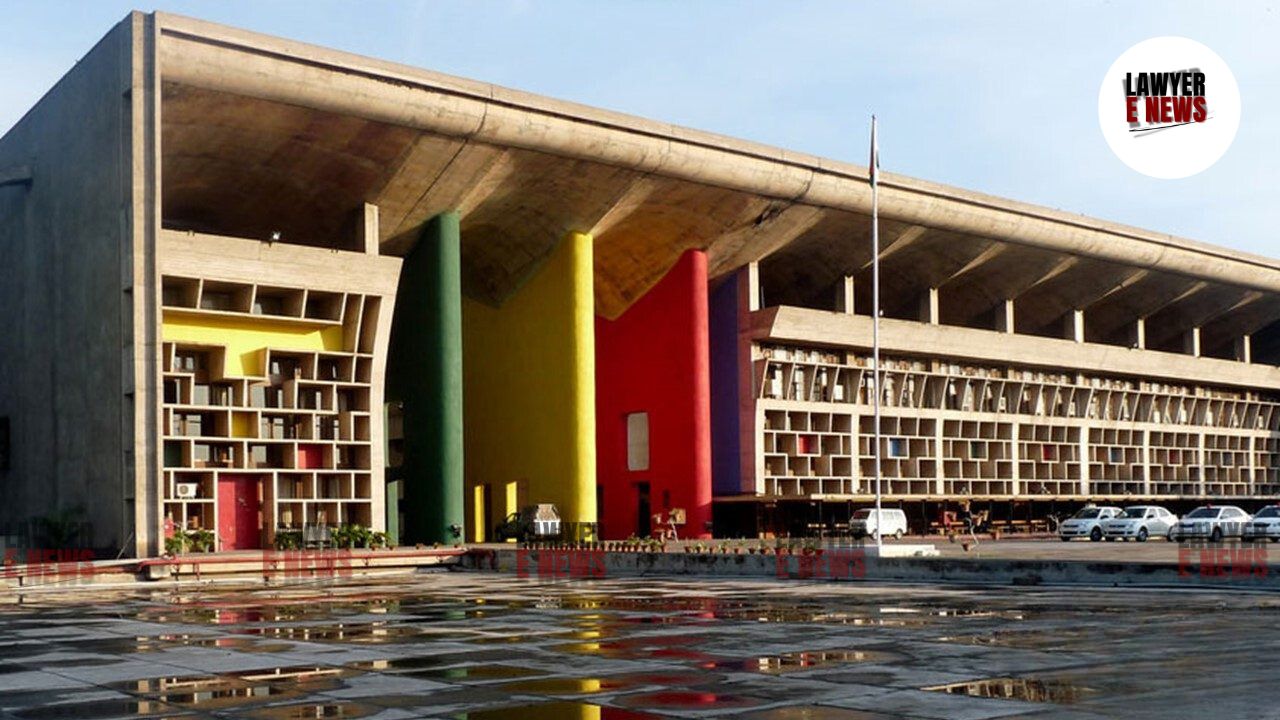
“License Deed Cannot Be Termed Forged Without Cogent Evidence”, Punjab and Haryana High Court, in a noteworthy ruling, upheld concurrent judgments passed by the Trial Court and the First Appellate Court, emphasizing that mere allegations that signatures were obtained on blank papers do not suffice unless supported by strong and cogent evidence. The Court firmly established that in matters involving disputed agreements or compromise deeds, the burden heavily rests upon the person denying authenticity to prove otherwise conclusively.
The appellant-defendant Dara Singh approached the Punjab and Haryana High Court through a Regular Second Appeal challenging the concurrent judgments by the Trial Court (dated 09.08.2022) and the First Appellate Court (dated 11.12.2023).
The core dispute pertained to a property owned by the plaintiff-respondent, Shalinder Pal, who filed a suit seeking mandatory injunction directing Dara Singh to vacate the premises and sought mesne profits of ₹2500 per month. The plaintiff contended that Dara Singh was inducted merely as a licensee via a license deed dated 06.08.2014, paying ₹1800 per month, which Dara Singh denied, alleging tenancy rights and fraud regarding the license deed.
Despite agreeing in a compromise dated 07.11.2017 to vacate by 31.12.2019 and pay increased compensation of ₹2500 monthly, Dara Singh failed to vacate, resulting in the initiation of the suit by the respondent.
“Admitted Signatures on Documents Place Heavy Onus on Signatory to Prove Fraud”
The central legal issue examined was whether mere claims of signatures being fraudulently procured on blank papers were sufficient to dispute a license deed and compromise agreement.
Justice Alka Sarin, addressing the appellant’s arguments, firmly stated:
"Once the signatures were admitted, the onus lay heavy on the defendant-appellant to prove that the same were taken on a blank piece of paper."
The Court highlighted that Dara Singh admitted his signatures but failed utterly to substantiate his allegations of signatures obtained deceitfully. The Court noted explicitly:
"The defendant-appellant woefully failed to prove by leading cogent evidence."
“A License Deed Executed and Signed Cannot Be Casually Termed Forged Without Substantial Proof”
The Court decisively rejected Dara Singh’s argument that he was a tenant and not a licensee:
"Both Courts concurrently found that Ex.P3 was in the nature of a license deed executed on 06.08.2014 bearing signatures of the defendant-appellant. He took the stand that signatures were taken on blank papers but failed to lead any cogent evidence."
Moreover, the Court reaffirmed the authenticity of the compromise deed (Ex.P4), underscoring that merely alleging misconduct by authorities or vague coercion does not establish forgery or fabrication without substantive and clear evidence:
"A compromise was entered into (Ex.P4) in which defendant-appellant undertook to pay ₹2,500 monthly. He admitted signatures but alleged they were obtained with Police help on blank papers. Yet again, the onus lay on him to prove this allegation, which he failed to do."
Justice Alka Sarin, after reviewing the judgments by lower courts and considering arguments advanced by the appellant, concluded unequivocally that the appellant-defendant had not provided adequate evidence to substantiate claims of fraud, coercion, or forgery.
Notably, the High Court found the lower courts’ findings factually and legally sound, observing explicitly:
"No fault can be found with the judgments and decrees passed by both the Courts. No question of law, much less any substantial question of law, arises in the present case."
Thus, the second appeal was dismissed for lack of merit.
Date of decision: 04/08/2025