-
by sayum
29 August 2026 3:15 PM







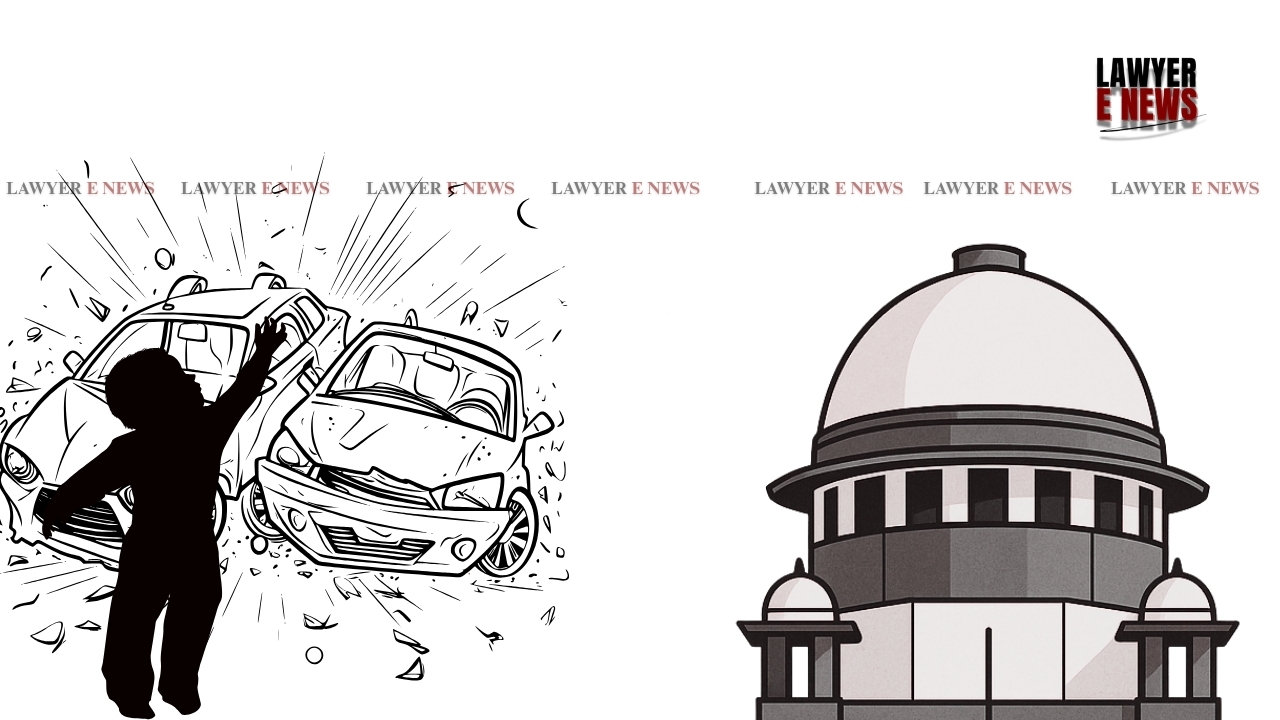
Supreme Court of India delivered a poignant ruling in a case involving the tragic death of a 10-year-old boy in a road accident. The Court set aside the Madras High Court’s reduction of compensation and restored the award granted by the Motor Accident Claims Tribunal (MACT), holding that “there is no straight jacket formula as to the income to be adopted in the case of children when they suffer injuries or succumb to death in a motor vehicle accident.”
The appellants, grieving parents, had lost their young son when he was cycling to school and was struck by a bus owned by the Tamil Nadu State Transport Corporation. The Tribunal, finding the bus driver negligent, had assessed the child’s notional income at ₹5,000 per month, applied a multiplier of 18, and after deducting one-third for personal expenses, arrived at a compensation of ₹8,55,000, which included amounts for “loss of love and affection,” funeral costs, transportation, and damage to belongings.
The Madurai Bench of the Madras High Court, however, slashed the award to ₹5,80,000. It applied the figure of ₹30,000 annual income from Schedule II of the Motor Vehicles Act, 1988, fixed the multiplier at 15 based on the mother’s age, reduced funeral expenses, deleted compensation for transportation and damaged belongings, and added ₹15,000 for loss of estate. This reduction prompted the parents to approach the Supreme Court.
The central legal question before the Supreme Court was whether the High Court was justified in applying Schedule II – which is relevant for claims under Section 163A (no-fault liability) – to a case under Section 166, where negligence of the driver had already been established.
Justice K. Vinod Chandran, writing for the Bench also comprising Justice N.V. Anjaria, was categorical:
“Schedule II is applied in cases where the claim is made under Section 163A of the Act… In the present case a claim under Section 166 of the Act was preferred and there was negligence found on the driver of the offending vehicle.”
The Court faulted the High Court for departing from a Division Bench precedent that had already accepted ₹5,000 per month as a reasonable notional income for a 9-year-old, noting that “the High Court does not give any reasoning to deviate from the said monthly income adopted by a Division Bench and merely adopts the income as per Schedule II.”
The Supreme Court held that the Tribunal’s adoption of ₹5,000 monthly income was “perfectly in order.” It further clarified that “there is no question of any deduction for personal expenses” in the case of a deceased child. Even applying the High Court’s multiplier of 15 due to the mother’s age of 36 years, the Court found the loss of dependency would be ₹7,50,000 — ₹30,000 higher than the Tribunal’s award.
While noting that the Constitution Bench in Pranay Sethi limits filial consortium to ₹40,000 per parent and funeral expenses to ₹15,000, the Court reinstated the sums for transportation and damaged belongings, observing “we find no rationale for the High Court to have deleted the transportation expenses and loss of dress, ornaments and cycle.”
In its own calculation, the Supreme Court determined that just compensation would amount to ₹8,70,000, but since the parents had not filed an appeal on the quantum, the Court restored the Tribunal’s award of ₹8,55,000 in full. The respondent corporation was directed to pay the amount, deducting any sums already deposited, within one month, with interest as earlier ordered.
By restoring the Tribunal’s award, the Supreme Court reinforced that the determination of a child’s income in motor accident claims cannot be reduced to a mechanical application of statutory schedules meant for other contexts. As the Court reminded, “there is no straight jacket formula” — the assessment must be sensitive to the facts and precedents, ensuring that bereaved families receive compensation that is fair, reasonable, and grounded in justice rather than rigid calculation.
Date of Decision: August 8, 2025