-
by sayum
29 August 2026 3:15 PM







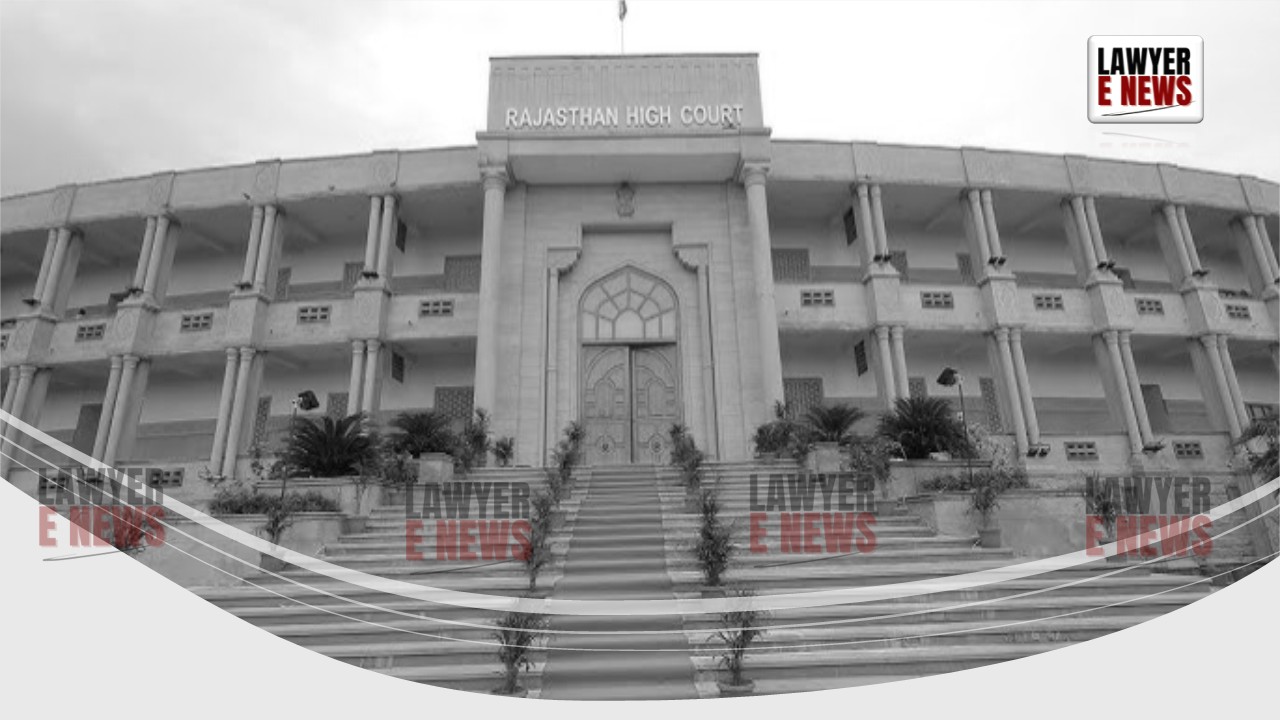
“Mere Absence of Hindu Succession Act Notification Cannot Extinguish Equality — Custom Must Be Proved to Exclude Women”, Rajasthan High Court set aside a Board of Revenue order that had rejected a Scheduled Tribe woman’s revenue suit for declaration of khatedari rights in her ancestral property at the threshold under Order 7 Rule 11 CPC, solely on the basis of Section 2(2) of the Hindu Succession Act, 1956.
Justice Anoop Kumar Dhand, relying on the recent Supreme Court rulings in Tirth Kumar v. Dadu Ram (2024) and Ram Charan v. Sukhram (2025), held that denying a daughter of the Scheduled Tribe category her right in ancestral property without proof of an exclusionary custom violates Articles 14 and 15 of the Constitution, and that the suit must proceed on merits.
Manni Devi, sole daughter of a Meena ST father, challenged a 2018 gift deed executed by her father in favour of her stepmother (respondent no. 2). When the civil court dismissed her gift cancellation suit for want of a prior revenue declaration, she approached the SDO for khatedari rights.
During the revenue proceedings, the respondents sought rejection of the plaint under O7 R11 CPC, citing Section 2(2) HSA and arguing that ST women cannot inherit absent a Central Government notification. The SDO rejected this objection, but on revision, the Board of Revenue accepted it, holding that the petitioner “did not possess any right of succession in the ancestral property” as an ST daughter.
Applicability of Section 2(2) HSA to Scheduled Tribes
The High Court acknowledged that Section 2(2) expressly excludes Scheduled Tribes from the HSA’s ambit unless notified, but stressed — quoting the Supreme Court in Tirth Kumar — that:
“For the application of a custom to be shown, it has to be proved… Courts cannot proceed with an assumption of an exclusionary custom where daughters are denied inheritance.”
Justice Dhand underlined that in the present case, no proof of a custom excluding female succession was led, and absent such proof, the equality guarantee controls.
Equality and Non-Discrimination
Relying on Ram Charan, the Court reproduced the Supreme Court’s reminder:
“Denying the female heir a right in the property only exacerbates gender division and discrimination, which the law should ensure to weed out.”
The Court found that Gulam v. Board of Revenue (AIR 2006 Raj 162) and Kamla Neti (2023) could no longer be applied to reject claims at the threshold after the SC’s more recent pronouncements.
Procedural Impropriety of Order 7 Rule 11
Justice Dhand reiterated that O7 R11 CPC cannot be used to foreclose a claim involving debatable legal issues and disputed facts:
“Rejection of a plaint at the threshold on such grounds amounts to deciding complex legal questions without trial… The suit must be adjudicated on evidence.”
Constitutional Observations – A Way Forward
In a detailed discussion, the Court linked the issue to Articles 14, 15(1), 15(3), 16, 21 and 51-A of the Constitution, observing:
“When daughters belonging to non-Scheduled Tribe communities are entitled to equal share in their father’s property, there is no reason & justification for denying the same right to the daughters of Scheduled Tribe community.”
Echoing Kamla Neti, the Court urged the Union Government to revisit Section 2(2) HSA to remove the barrier and ensure parity for female tribals in intestate succession.
The High Court quashed the Board of Revenue’s 09.06.2025 order, restored the SDO’s 24.07.2023 rejection of the O7 R11 application, and directed that Manni Devi’s 2018 revenue suit be decided on merits within two years, uninfluenced by any observations on the merits of her claim.
Date of Decision: 22 July 2025