-
by sayum
28 August 2026 8:44 AM







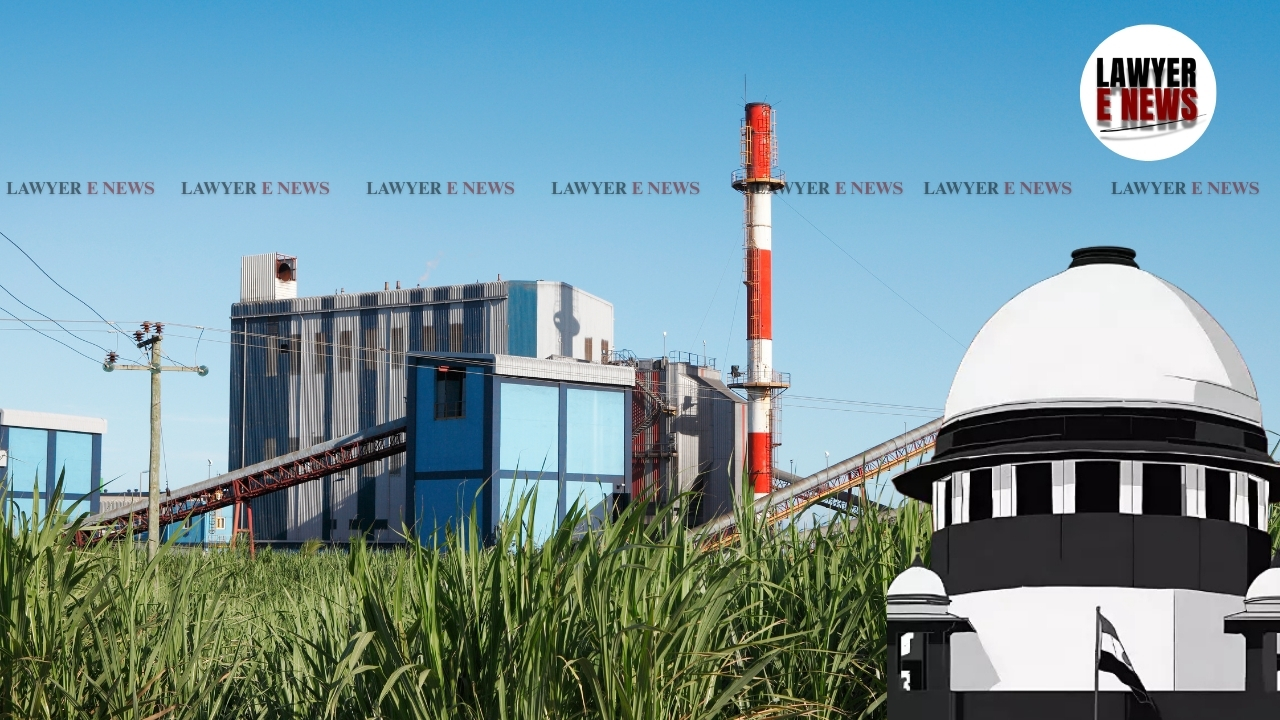
“Even if the NGT Acts Suo Motu, It Must Hear the Party Before Issuing Any Adverse Directions Against It” — Supreme Court of India delivered a significant judgment, where it held that even in environmental matters, the right to a fair hearing cannot be bypassed in the name of public interest.” The Court quashed two orders of the National Green Tribunal (dated February 15 and September 16, 2022), which had imposed a ₹18 crore penalty on the company for alleged violations of environmental norms, observing that the entire proceedings had been conducted “in blatant violation of the principles of natural justice.”
The apex court made it clear that “even when the cause is noble, the procedure must be just.” The judgment reasserts the timeless maxim that “no person shall be condemned unheard.”
How A Sugar Mill Was Fined Without Being Heard
The case revolved around a sugar manufacturing unit operated by M/s. Triveni Engineering and Industries Ltd. in Khatauli, Muzaffarnagar, Uttar Pradesh. In March 2021, a complaint was filed before the NGT by a private individual, alleging that the sugar mill had contaminated groundwater by discharging untreated effluents.
Acting on this complaint, the NGT constituted a joint committee comprising the Central Pollution Control Board, Uttar Pradesh Pollution Control Board, and the District Magistrate of Muzaffarnagar. The committee submitted reports alleging illegal disposal of untreated industrial waste, dilution of effluents with fresh water to disguise pollution, and non-maintenance of treatment logs.
Based solely on these reports, the NGT, without issuing notice or hearing the mill, passed two scathing orders. The first, on February 15, 2022, held the company guilty of violations; the second, on September 16, 2022, directed the company to pay ₹18 crores as environmental compensation within a month. The Supreme Court intervened and stayed these orders, and later delivered its final judgment setting them aside in entirety.
Can A Tribunal Impose A Punitive Fine Without Even Hearing The Accused?
The Supreme Court identified a disturbing procedural lapse. “No notice was issued to the appellant. No copy of the joint committee report was shared. No opportunity of hearing was granted. And yet, the appellant was condemned.” The Court emphasized that under Section 19 of the National Green Tribunal Act, 2010, even though the NGT is not bound by the Code of Civil Procedure, it is “expressly required to be guided by the principles of natural justice.”
The judgment declared, “NGT acted contrary to its own founding statute.” The tribunal imposed civil liability and financial burden based on one-sided material, turning what should have been a contested inquiry into an ex parte condemnation.
Referring to A.K. Kraipak v. Union of India, the Court underscored that “rules of natural justice supplement the law, they do not supplant it.” A judicial or quasi-judicial body cannot proceed to impose penalties without providing the affected party with an opportunity to respond.
No Due Process, No Fairness
The Court dissected the methodology of the Joint Committee and found it legally unsustainable. It held that the report did not conform to the mandatory procedure prescribed under Sections 21 and 22 of the Water (Prevention and Control of Pollution) Act, 1974. The Court observed:
“The inspection team neither issued notice to the appellant, nor sealed the collected samples in the presence of the occupier, nor offered any part of the sample for independent testing by the company.”
Such procedural lapses were not trivial. Under environmental law, the reliability of laboratory analysis is contingent upon strict adherence to statutory protocols. As the Court put it: “If the foundation is infirm, the superstructure must fall.”
Moreover, the Court observed that the NGT failed to treat the expert report for what it was: “a piece of material, not a binding finding.” The tribunal accepted the committee’s report as gospel, without ever allowing the sugar mill to rebut or question it. The Supreme Court held: “A report prepared behind the back of a party cannot become the basis for a ₹18 crore penalty.”
The Court’s Emphatic Stand: Natural Justice Is Not A Luxury, It Is The Bedrock Of Law
The Court quoted from its earlier decisions, including S.N. Mukherjee v. Union of India, T. Takano v. SEBI, and State Bank of India v. Rajesh Agarwal, to reiterate that “recording reasons, disclosing materials, and giving a fair hearing are not optional.” These are “substantive obligations that flow from Article 14 and 21 of the Constitution.”
“Even a decision made in the name of environmental protection must not trample procedural fairness,” the Court warned, reminding judicial and quasi-judicial forums of their duty to balance environmental protection with individual rights.
In perhaps the most telling remark of the judgment, the Court observed:
“Environmental justice is meaningless if delivered at the cost of elementary procedural justice.”
Final Verdict: ₹18 Crore Fine Quashed, Case Remanded Back
Having found the NGT’s orders fatally flawed, the Court quashed them entirely. It directed that the matter be remanded back to the NGT for fresh consideration. However, it emphasized that any further proceedings must strictly comply with principles of natural justice, including notice to the appellant and an opportunity to contest all adverse findings.
Thus, the Court restored not just procedural fairness in this case but also laid down an authoritative reaffirmation of how quasi-judicial tribunals must function when imposing civil liability in environmental matters.
Justice Must Not Only Be Done, But Be Seen to Be Done
“NGT’s failure to implead the company as a party, its reliance on unilateral reports, and imposition of compensation without any hearing is a textbook case of violation of natural justice,” the Court held.
And in reaffirming the foundational procedural safeguard that “no person shall be condemned unheard,” the Supreme Court has, once again, drawn the line between environmental governance and constitutional overreach.
Date of Decision: September 1, 2025