-
by sayum
29 August 2026 3:15 PM







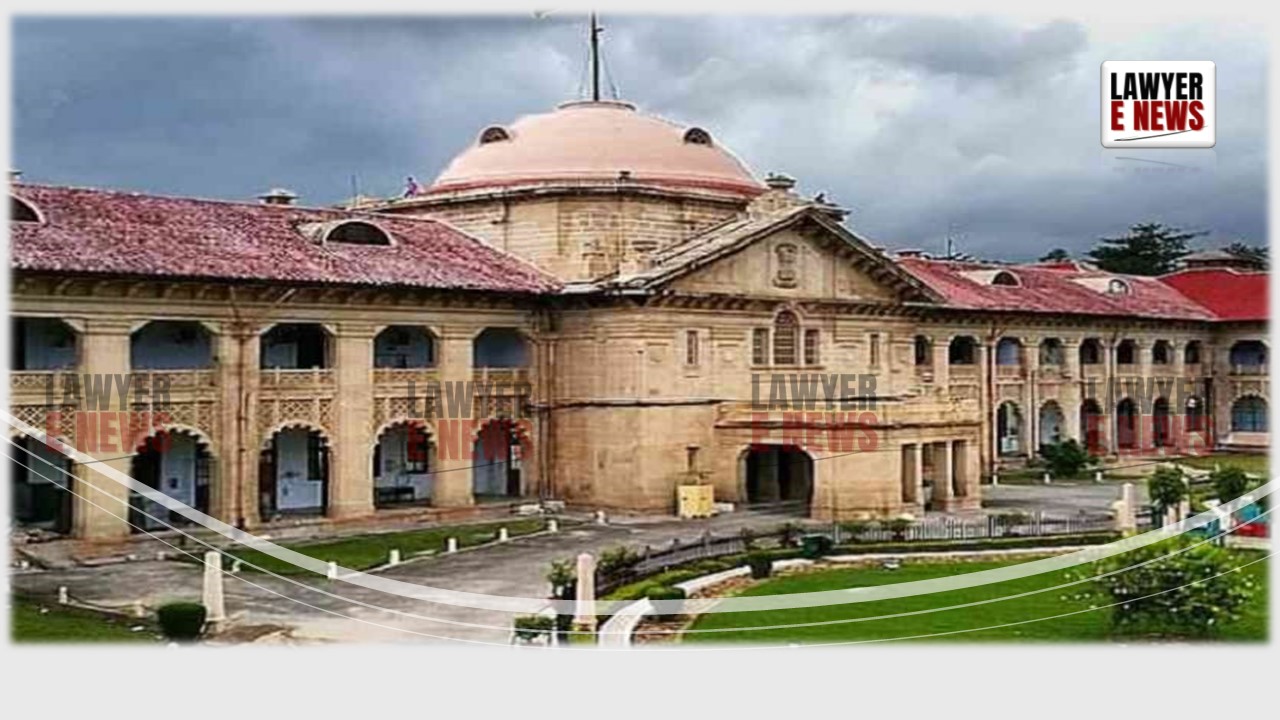
“Assets Funded by Consumers or Local Bodies Cannot Be Considered for Book Value or Depreciation Under Section 7-A(2)(i)” – On 11th August 2025, the Allahabad High Court (Justices Ashutosh Srivastava and Mahesh Chandra Tripathi) delivered a reportable judgment in The U.P. State Electricity Board v. The Special Officer (Electricity) & M/s Agra Electricity Supply Company Ltd., Writ Petition (Civil) No. 11731 of 1982, upholding the Award dated 12.07.1982 passed under Section 7-A of the Indian Electricity Act, 1910. The Court dismissed UPSEB's challenge to specific components of the Award, reaffirming that assets not funded by the licensee (e.g., consumer/local body-funded works) cannot be included in the book value for the purposes of compensation or depreciation.
The dispute arose from the acquisition of the Agra Electric Supply Undertaking by the U.P. State Electricity Board (UPSEB) on 17/18.12.1973, following the expiry of the license period under the 1923 license issued to the Agra Electricity Supply Company (Ex-Licensee).
Following the takeover, a Special Officer (Electricity) was appointed under Section 7-A(6) (as amended by the U.P. Amendment and Validation Act, 1975) to determine the net amount payable to the Ex-Licensee.
The Award, passed on 12.07.1982, fixed the payable amount at ₹63,41,886.26 with interest, which UPSEB partially paid but contested several components through the present writ petition.
The Court dealt with seven specific objections raised by UPSEB against the computation of compensation. These related to depreciation, valuation of stores, advance revenue collections, consumer advances, employee dues, and development reserves.
“Only Self-Funded Works by Licensee Are Eligible for Depreciation Deduction”: Rejection of ₹20.98 Lakhs Claim
Depreciation on Consumer/Local Body Funded Works
UPSEB contended that it was entitled to ₹20,98,226/- as depreciation on works constructed at the cost of consumers or local bodies. The Special Officer disallowed this, holding such assets excluded from both book value and depreciation.
Relying on the Supreme Court's landmark decision in Pilibhit Electric Supply Co. v. Special Officer (Electricity), (1996) 2 SCC 288, the Court noted:
“If for calculating the book value of such assets the works paid for by the consumers are to be excluded, they necessarily cannot be included for the purpose of ascertaining deductible depreciation on such assets.”
The Court affirmed that Section 7-A(2)(i) deals only with self-financed assets, and any reference to Paragraph XII of the Sixth Schedule for depreciation on consumer-funded assets was misplaced.
“This would on the face of it be very anomalous and unfair... The Special Officer was patently in error... paragraph XII was wrongly pressed into service.” — Pilibhit Electric Supply Co.
The Court upheld the reasoning that only depreciation on licensee-funded assets is permissible, and that the ₹20.98 lakh depreciation claim on consumer-funded assets was rightly rejected.
“No Double Deduction or Unsupported Liabilities Can Be Allowed”: HC Affirms Special Officer’s Findings on Other Heads
Stores and Spare Parts – ₹83,243
UPSEB alleged double inclusion, but the Special Officer had relied on physical verification and store records. The Court found no evidence to refute the finding and upheld the inclusion under Section 7-A(2)(iii).
“The conclusion drawn by the Special Officer is factually correct and calls for no interference.”
Advance Collections – ₹2.5 Lakhs
UPSEB claimed this was an advance, but the Special Officer held it was revenue collected on behalf of the Ex-Licensee, and not a deductible advance under Section 7-A(5)(a). The Court agreed, rejecting the claim.
“The amount collected was on behalf of the Ex-Licensee and therefore outside the ambit of deductible advances.”
Railway Siding Charges – ₹31,595.69
The petitioner did not press this issue. The Court upheld the Special Officer’s finding without further analysis.
Consumer Advances – ₹8,75,393.59
UPSEB argued that consumer advances were not refunded. The Special Officer found these amounts were already reflected as consumer contributions and excluded from the book value.
“The Special Officer has recorded findings of fact in this regard which call for no interference.”
Employee Dues – ₹14.5 Lakhs
This claim included gratuity, leave encashment, Supreme Court awards, etc. The Special Officer disallowed it for lack of actual disbursement or proof. The Court upheld the decision, citing:
Saduruddin v. Union of India, AIR 1981 SC 1257 – continuity of service post-transfer doesn’t automatically generate immediate gratuity liability.
Anand Behari v. RSRTC, (1991) 1 SCC 731 – gratuity arises only upon cessation of service.
“The situation for payment of gratuity... would arise only on the retirement, resignation, death or disablement.”
Development Reserve – ₹19,95,398
UPSEB sought to deduct the Development Reserve amount. The Special Officer, after verifying records, found that the entire amount had been utilized in creating fixed assets that were transferred to UPSEB.
“No amount is deductible on account of Development Reserve from the gross amount payable to the ex-licensee.”
The Court cited Tinsukhia Electric Supply Co. Ltd. v. State of Assam, AIR 1990 SC 123 and U.P. State Electricity Board v. Upper Jamuna Valley Electric Supply Co. Ltd., AIR 2000 SC 2736, affirming that only unutilized reserves can be deducted.
After a detailed review of each head of claim and the legal principles governing acquisition and compensation under Section 7-A of the Indian Electricity Act, 1910, the High Court concluded:
The Special Officer’s Award was well-reasoned.
There was no illegality or misapplication of law.
The limited challenge by UPSEB failed on all counts.
“The writ petition is devoid of merits and is, accordingly, dismissed.”
Additionally, noting that principal amount was deposited in 1991 before the Calcutta High Court and released, the High Court directed:
“...the petitioner to pay the amount of interest due thereon, as provided under the Indian Electricity Act, 1910, within a period of 6 months from the date of production of a certified copy of the order before the authority concerned.”
This judgment reinforces the long-standing principle that compensation under Section 7-A of the Indian Electricity Act, 1910, must strictly adhere to assets financed by the licensee alone. Any claim for depreciation or deduction must be substantiated by actual disbursement or legal entitlement, failing which, such claims are rightly disallowed.
The ruling also underscores judicial fidelity to binding Supreme Court precedents, especially in complex financial adjudications under electricity law, and highlights the robust standard of accounting scrutiny required during public utility acquisitions.
Date of Decision: 11 August 2025