-
by sayum
29 August 2026 3:15 PM







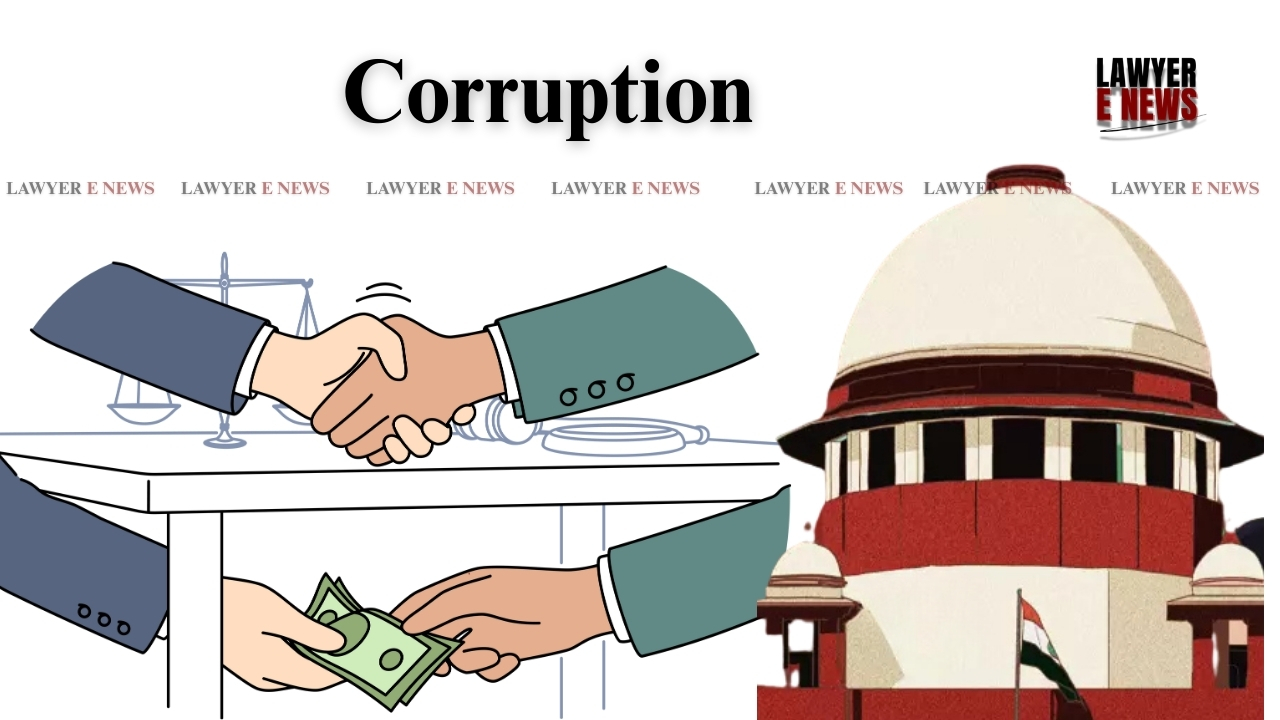
“Demand and acceptance of illegal gratification is a sine qua non.” - Supreme Court delivered a crisp primer on corruption law, drawing a bright line between mere recovery and proof of “demand” under the Prevention of Corruption Act, 1988. Setting aside the conviction of a Village Assistant (A-2) for a ₹500 bribe trap while affirming the guilt of the Village Administrative Officer (A-1), the Court held that there can be no conviction under Sections 7 and 13 without establishing demand and acceptance — and that a third person who simply takes the money on someone else’s say-so cannot be convicted absent a clear abetment charge.
The case arose from a 2004 trap where a complainant seeking a community certificate alleged that the VAO demanded ₹500 to process his papers. During the trap, the VAO reiterated the demand and asked the Village Assistant to collect the money; phenolphthalein turned the Assistant’s hands pink. A Special Court in 2011 convicted both men under Sections 7 and 13(1)(d) read with 13(2), sentencing the VAO to rigorous imprisonment of three years (plus two years on Section 7) and the Assistant to one-and-a-half years (plus one year on Section 7). The High Court in 2018 affirmed both convictions.
The Supreme Court split the fates. As to A-2, it invoked Neeraj Datta v. State (NCT of Delhi) to reiterate that “for recording a conviction under Section 7 and Sections 13(1)(d)(i) and (ii)… demand and acceptance of illegal gratification is a sine qua non.” The Bench underscored that there was no evidence A-2 ever demanded a bribe, or that he was present when the original demand was made, or that he acted in concert with A-1. The Court stressed that he “accepted the money on the direction of A-1 only,” and, in the absence of a specific abetment charge or proof of connivance, his conviction could not stand. The judgment leaned on Mahendra Singh Chotelal Bhargad v. State of Maharashtra, where acceptance “on behalf of another” may amount to abetment — but cannot found a conviction without an abetment charge.
The VAO stood on different ground. The Court found the complainant and official witnesses consistent enough that “both the ingredients of demand and receipt stand duly proved against A-1,” noting that minor contradictions did not dent the core case. Conviction, therefore, was affirmed.
On sentence, the Bench recalibrated punishment with statutory restraint rather than extra-statutory sympathy. Acknowledging the “small amount of ₹500,” the offence’s vintage (2004), and the long pendency through trial and appeals, the Court reduced A-1’s imprisonment to the statutory minimum: one year each under Section 7 and Section 13(2), clarifying that “the reduction of sentence is within the scope of the statute which provides for a minimum sentence of one year.” The Court rejected the notion that such reduction was impermissible clemency, explaining it was neither an override of deterrence nor an Article 142 indulgence beyond the Act, but a measured application of the minimum mandated by Parliament.
In practical terms, the ruling is a pointed reminder to trial courts: recovery and phenolphthalein are not enough. Prosecutors must prove demand; where money changes hands through an intermediary, they must also lay the foundation for abetment if they wish to ensnare the go-between. For defence counsel, the decision arms arguments against dragnet convictions where “demand” is unproven and abetment is uncharged. For sentencing, it signals that, in old, low-value traps, courts can lawfully sit at the statutory floor without dulling the law’s edge.
Date of Decision: 12 August 2025