-
by sayum
24 August 2026 3:22 PM







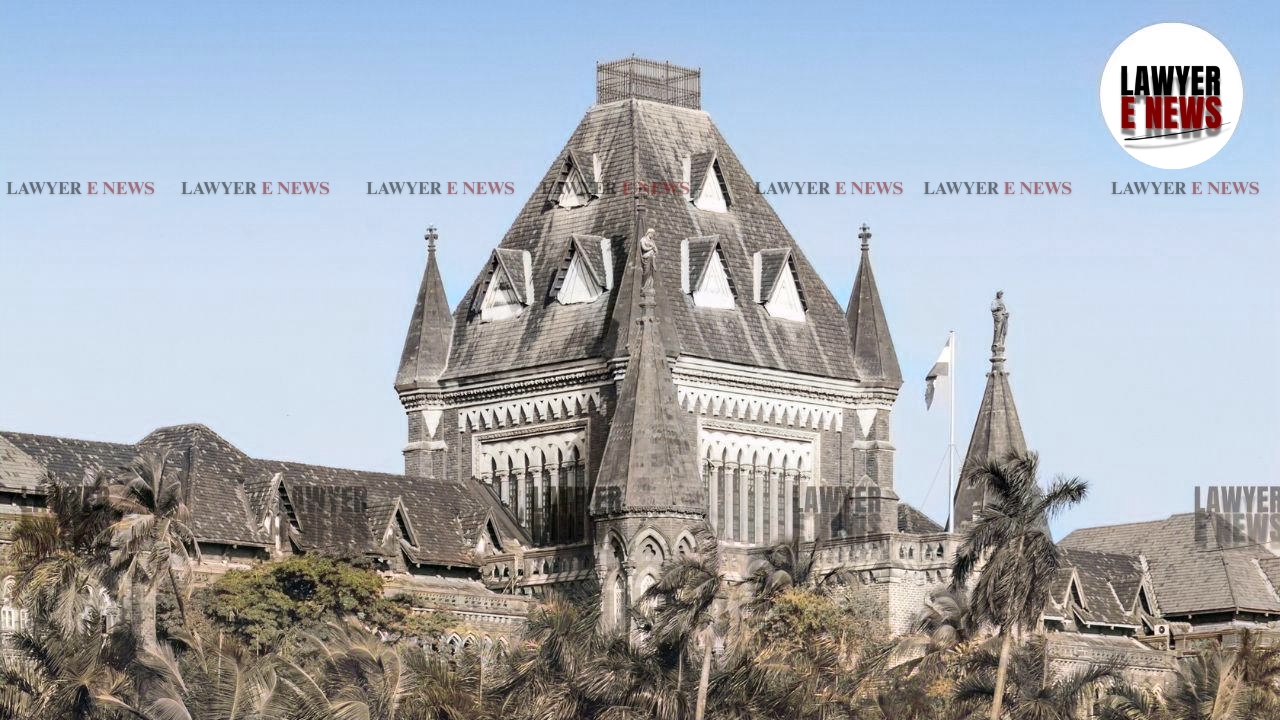
“Negligence findings based on evidence can’t be undone by speculative contradictions” —In a firm reiteration of settled principles governing motor accident compensation, the Bombay High Court dismissed an appeal filed by HDFC Ergo General Insurance Co. Ltd. challenging the findings of the Motor Accident Claims Tribunal that had awarded ₹2.97 crore in compensation to an accident victim who suffered 100% permanent disability. The Court imposed ₹2 lakh as costs on the insurer for filing what it deemed a frivolous appeal limited to a challenge on the question of negligence — a finding which the Tribunal had already substantiated through cogent evidence.
Bench comprising Chief Justice Shree Chandrashekhar and Justice Gautam A. Ankhad upheld the Tribunal's award passed on 4 March 2025, and made strong observations about the limited scope of appellate interference in motor accident compensation matters, particularly when no perversity or legal error is demonstrated.
“Findings of Fact Can’t Be Overturned Unless Perverse” – Reaffirms Scope of Section 173 MV Act
The central issue before the High Court was the insurer’s limited challenge to the Tribunal’s finding of negligence. While the quantum of compensation — a substantial sum of ₹2.97 crore with 7% interest — was left untouched, the insurer attempted to overturn the decision solely on the basis of alleged inconsistencies in the victim’s testimony as to whether the impact came from the front or rear.
But the Court refused to re-evaluate factual findings, holding:
“The decision rendered by the Tribunal on appreciation of the materials on record cannot be overturned on a minor mistake, even if committed by the Tribunal… Adequacy or sufficiency of evidence led on a point cannot be agitated in appellate jurisdiction.”
The Court relied on the Supreme Court’s seminal ruling in Syed Yakoob v. K.S. Radhakrishnan, (1963 SCC OnLine SC 24), which restricts judicial interference with findings of fact unless they are based on no evidence, or if material evidence was erroneously excluded or wrongly admitted.
“Summary Nature of Motor Accident Claims Demands a Holistic and Probabilistic Approach”
Reinforcing the purpose of Section 166 and 168 of the Motor Vehicles Act, 1988, the High Court emphasised that motor accident claims are not bound by strict rules of pleading and proof. The Tribunal is required to determine “just compensation” based on the preponderance of probability, not criminal law standards.
The Court observed:
“The Tribunal is not bound by pleadings of the parties… Victims and their dependents should not suffer merely because of some doubts here or obscurity there. The function of the Tribunal is to take a holistic view of the matter.”
Further, relying on the principles laid down in Sarla Verma v. DTC (2009) 6 SCC 121 and Manikandan v. Palani (2014) 10 SCC 547, the Court noted that strict proof of income or mathematical precision in sequence of events is not required when determining entitlement to compensation.
“Contradiction About Front or Rear Impact Doesn’t Shake the Foundation of the Case”
The only ground urged by Mr. Surel Shah, Senior Advocate for the insurer, was a minor contradiction in the testimony of the victim regarding whether the accident occurred due to a front or rear impact.
But the Court found such discrepancies immaterial:
“Some inconsistency or contradiction in the statement of a witness shall not attain materiality unless it shakes the very foundation of the judgment.”
The Court also noted that the claimant’s version was fully corroborated by police records, including FIR, spot panchanama, charge-sheet, and RTO documents. Even in extensive cross-examination, nothing substantial was elicited to discredit the core version.
“Disability Fully Proven – Tribunal’s Award Based on Cogent Medical and Occupational Evidence”
The victim, Adil Lutfi Peters, was a 53-year-old cabin crew member at Air India earning ₹2,00,000 per month, who suffered total permanent disability in the accident on 18 November 2014. His testimony was corroborated by Dr. Sameer (AW-6), who issued and proved the Disability Certificate (Exh. 74). The Tribunal recorded that the cross-examination of Dr. Sameer yielded nothing that could discredit the medical findings.
Importantly, the insurer did not challenge the amount of compensation, interest, or method of calculation, nor did it raise any argument based on guidelines in Sarla Verma, which were duly applied by the Tribunal.
Frivolous Appeal Results in Costs – Court Imposes ₹2 Lakh Penalty on Insurer
Coming down heavily on the insurer for pursuing a meritless appeal, the High Court not only dismissed the appeal but also imposed ₹2,00,000 as litigation costs, payable directly to the victim, in addition to the decretal amount.
The Court directed:
“The amount deposited in the Court by the appellant-Insurance Company shall be permitted to be withdrawn by the victim-applicant or any other person authorized by him.”
No Stay – No Substantial Question of Law Involved, Says High Court
Rejecting a plea by the insurer for a four-week stay, the Bench held:
“No substantial question of law arises for consideration in this appeal… The prayer for stay is declined.”
As a result, all interim applications including IA Nos. 11383/2025 and 13587/2025 were disposed of as infructuous.
Court Reaffirms Limits of Appellate Review – Victims’ Rights Must Not Be Undermined by Tactical Litigation
The judgment is a clear message to insurers and litigants that motor accident compensation proceedings are not arenas for hyper-technical nitpicking, and that the rights of injured victims must not be diluted through groundless appeals aimed at delay or frustration of awards.
“Unless findings are perverse or unsupported by evidence, appellate courts will not interfere. Frivolous litigation will not be entertained — and may attract costs.”
In an era where insurance companies often resist payouts even in cases of undisputed injury, this ruling not only upholds the integrity of the Tribunal process, but also serves as a warning that delaying justice for accident victims will carry financial and reputational consequences.
Date of Decision: 6 January 2026