-
by sayum
05 August 2026 9:31 AM







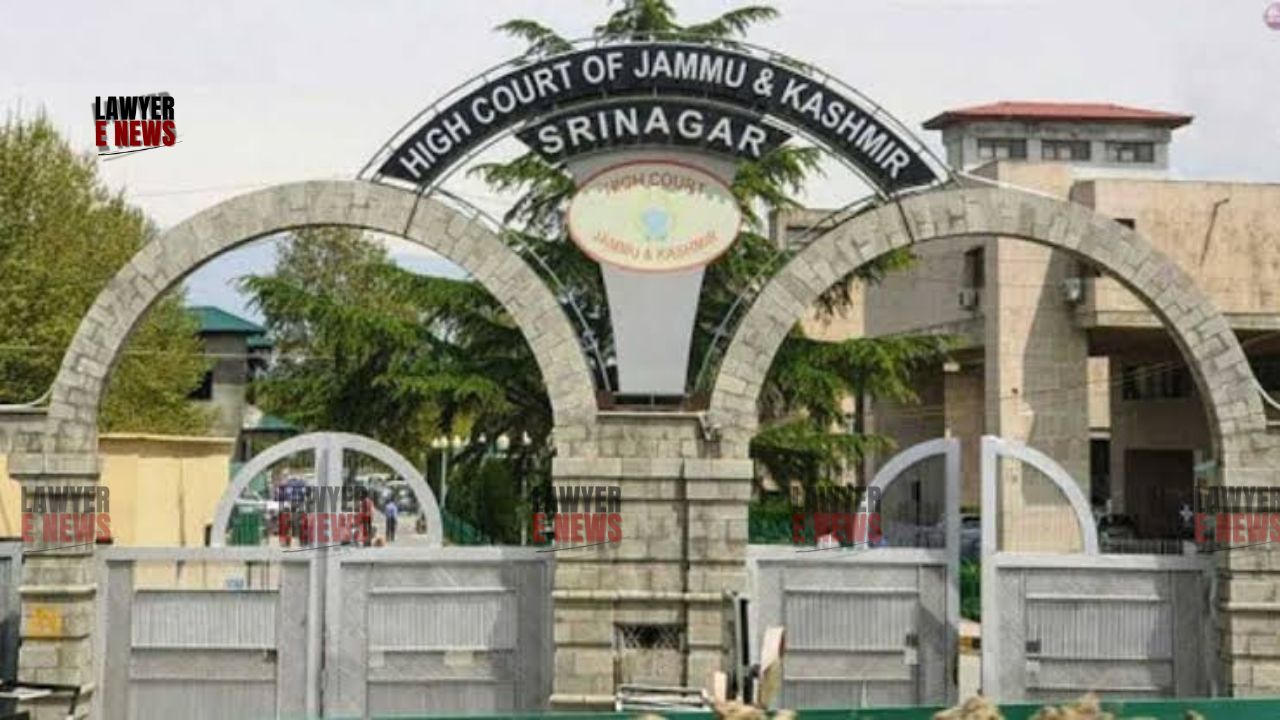
“Court Cannot Act as a Post Office for Prosecution; Kidnapping Requires Enticement, Not Mere Lift” — In a powerful reaffirmation of legal standards governing the framing of criminal charges, the High Court of Jammu & Kashmir and Ladakh at Srinagar, presided by Justice Sanjay Dhar, has quashed charges of kidnapping and rape under Sections 363, 376 of IPC and Section 4 of the POCSO Act, against petitioner Basit Bashir. Delivering the verdict on 6th June 2025, the Court observed that “the trial court failed to apply its mind and mechanically framed charges despite a complete absence of material indicating even a grave suspicion against the petitioner.”
The Court categorically ruled that “a medical report indicating prior sexual intercourse cannot by itself sustain a charge of rape in the absence of any statement from the victims or forensic evidence linking the accused.”
The ruling came in the criminal revision titled Basit Bashir v. Union Territory of J&K, where the petitioner challenged the order of the Special Judge (POCSO Cases), Srinagar, dated 09.03.2022, which had framed the charges.
“Offering Lift is Not Kidnapping Without Inducement or Coercion” — Court on Section 363 IPC
Justice Sanjay Dhar minced no words in holding that the trial court had mechanically framed the charge under Section 363 IPC without applying the settled legal test of kidnapping.
The Court declared in emphatic terms that “there is absolutely no material to indicate that the petitioner had either enticed or induced the minor girls to accompany him. The victim girls themselves, in their voluntary statements recorded under Section 164 CrPC, have clearly stated that they boarded the petitioner’s vehicle willingly when no other transport was available.”
The Court further reinforced that “merely offering a lift, in the absence of any promise, inducement, or deceit, does not satisfy the ingredients of kidnapping under Section 363 IPC.”
“Rape Charge Cannot Stand on Medical Opinion Alone When Victims Do Not Allege Assault” — Court on Section 376 IPC & POCSO
In what could be described as the fulcrum of the judgment, the Court ruled that the charge of rape under Section 376 IPC and penetrative sexual assault under Section 4 of the POCSO Act cannot survive purely on the basis of a medical report.
Justice Sanjay Dhar observed, “None of the two minor girls has stated even in the faintest terms that the petitioner subjected them to sexual assault. The entire prosecution case is glaringly devoid of any such allegation from the victims themselves.”
The Court rejected the prosecution’s reliance on medical opinion stating that “while the doctor noted signs suggestive of recent sexual intercourse, there is no material whatsoever linking the petitioner to it. A medical finding, unaccompanied by testimonial or forensic evidence connecting the accused, cannot form the sole basis for framing charges of rape.”
“Framing of Charges Requires Judicial Application of Mind, Not Blind Acceptance of the Chargesheet” — Court Cautions Trial Judges
The High Court strongly reprimanded the approach of the trial court, stating that “the learned Special Judge acted as a mere post office for the prosecution rather than exercising the judicial discretion mandated under Sections 227 and 228 of CrPC.”
Quoting the Supreme Court’s dictum in Sajjan Kumar v. CBI (2010) 9 SCC 368, the Court reminded that “at the stage of framing of charges, the Judge is required to sift and weigh the material to ascertain whether the evidence discloses grave suspicion warranting a trial. The Judge cannot act as a mechanical mouthpiece of the prosecution.”
The Court reiterated that “if the statements of the witnesses, taken at their face value, do not disclose the basic ingredients of the offence, then the court is under no compulsion to frame a charge merely because a chargesheet has been filed.”
“Even Grave Suspicion Must Be Based on Some Evidence, Not Speculation” — On Application of POCSO
Addressing the invocation of the POCSO Act, the Court emphatically stated that “the prosecution failed to establish any material indicating sexual assault on the minor victims by the petitioner. The girls, in fact, narrated that the petitioner arranged a hotel stay for them when it got late and he slept in a separate room.”
Justice Sanjay Dhar stated, “The prosecution’s narrative collapses under its own weight when neither the alleged victims support it, nor is there any circumstantial, scientific, or forensic evidence to prop it up.”
Court’s Final Verdict: “Material Does Not Raise Even a Grave Suspicion”
In unequivocal terms, the Court ruled, “There is absolutely no evidence on record to show that the petitioner either kidnapped the minor girls or committed sexual assault upon them. Even if the material collected remains unrebutted, it does not raise even grave suspicion of the petitioner’s involvement.”
Terming the trial court’s approach as “unsustainable in law”, the High Court set aside the order dated 09.03.2022, discharged the petitioner from all charges, and ordered that the challan against him shall stand dismissed.
Date of Decision: 06 June 2025