-
by sayum
29 August 2026 3:15 PM







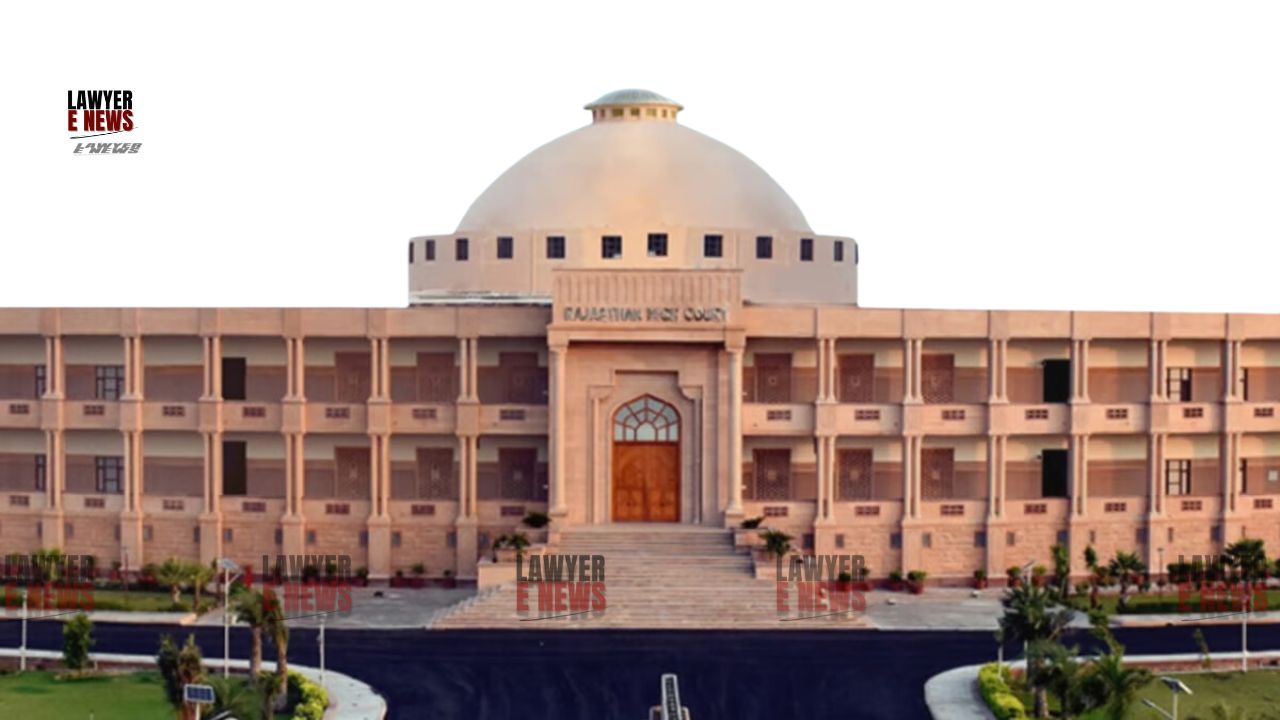
“Even if the entire evidence is accepted at its face value, there is no act of instigation, cruelty or intentional aid by the accused to push the deceased into committing suicide” — In a significant ruling Rajasthan High Court at Jodhpur quashed charges framed under Sections 498A and 306 IPC, observing that strained marital relations and vague allegations of humiliation during litigation proceedings do not satisfy the legal ingredients for abetment of suicide or cruelty.
Justice Sandeep Shah categorically held that the prosecution’s evidence, including the dying declaration of the deceased and the statements of witnesses, lacked the requisite elements of mens rea, direct instigation, or willful cruelty, and that proceeding with a criminal trial would amount to a “miscarriage of justice and abuse of court process.”
“Mental Distress from Failed Marriage Alone Does Not Establish Criminal Abetment under IPC Sections 306 or 498A”
“There is no evidence to show that the accused had meted out the deceased with cruelty… or to instigate or abet the deceased to commit suicide” — Court’s Observation
Geeta Devi, a constable in the Rajasthan Armed Constabulary, attempted self-immolation on 7 September 2018, allegedly due to mental harassment by her estranged husband Haribhajan Ram. She succumbed to burn injuries on 20 September 2018. In her parcha bayan and subsequent dying declaration, she alleged that Haribhajan, from whom she had been separated since 2006, had remarried, insulted her during court dates, and constantly harassed her whenever they crossed paths.
Based on these claims, an FIR was initially registered under Section 498A IPC. Subsequently, following directions from the Commissioner of Police, the case was escalated with charges under Section 306 IPC as well. The Trial Court framed charges on 8 August 2023, which was later challenged before the High Court through a revision petition.
“No Act, No Words, No Evidence of Abetment — A Trial Cannot Be Founded on Emotions and Broken Relationships”
The High Court delved deeply into the legal standards necessary to invoke Section 306 IPC for abetment of suicide and Section 498A IPC for cruelty. The Court reiterated the principle that:
“A person is said to abet the doing of a thing who instigates any person to do that thing… or intentionally aids by an act or illegal omission.”
Citing the Supreme Court’s landmark rulings in Ramesh Kumar v. State of Chhattisgarh and M. Mohan v. State, the Court held that:
“The accused must have played an active role by an act of instigation or doing certain acts to facilitate the commission of suicide.”
Justice Sandeep Shah emphasised that in this case, even the dying declaration of Geeta Devi focused largely on past abandonment, courtroom discomfort, and long-standing marital estrangement, none of which constituted abetment or cruelty under the law.
“There is no iota of evidence showing any act of abetment or cruelty… not even a single specific instance or word was cited that would amount to instigation.”
“Trial Court Cannot Be a Post Office for the Prosecution — Judicial Mind Must Be Applied Before Framing Charges”
The judgment strongly criticised the Trial Court’s approach of mechanically framing charges without conducting even a limited sifting of the material on record. Citing the principles laid down in Sajjan Kumar v. CBI and P. Vijayan v. State of Kerala, the Court reminded that:
“The Court cannot act merely as a post office or a mouthpiece of the prosecution. It has to apply its judicial mind to the record and see whether the basic ingredients of the offence exist.”
The High Court clarified that even at the stage of framing of charge, there must be a “grave suspicion” based on facts and evidence — not just allegations or emotions.
“Where the materials disclose mere suspicion or strained relationship, without more, the court must discharge the accused.”
It further observed that all witnesses, including the deceased’s brother, parents, and even her son, had stated that she felt “humiliated in court,” but none had described any act of cruelty or instigation directly committed by Haribhajan Ram. Interestingly, the deceased’s own counsel admitted there was no altercation or exchange between the accused and deceased on the relevant court date.
“Ongoing Separation and Remarriage Do Not Per Se Constitute Cruelty or Instigation for Suicide”
The Court placed particular emphasis on the 12-year marital separation between the deceased and the accused. It noted that the two had not been cohabiting since 2006, and that she had even declared herself a “divorcee” when applying for government employment in 2009. The fact that she later lived with another man, Manphool, further supported the conclusion that the husband had not been involved in her life in any proximate sense to trigger the suicide.
“The deceased was living independently, and no act of the accused has been proved to have created a situation where she was left with no option but to end her life.”
“Emotionally Driven Prosecutions Must Not Be Allowed to Proceed When the Law Demands Proof of Intention and Action”
The Court cautioned against prosecuting individuals merely because of emotional narratives or the tragedy of a death, when the law imposes high standards for attributing criminal responsibility.
“The prosecution case, even if accepted in full, fails to bring home the charge of abetment or cruelty. The continuation of criminal proceedings would be a grave injustice.”
Justice Shah stressed that criminal liability cannot rest on feelings of grief, humiliation, or personal history alone. There must be proof of action, intention, and connection between the accused and the suicide.
The High Court, finding no justification to frame charges, allowed the criminal revision, quashed the Trial Court's order dated 08.08.2023, and discharged Haribhajan Ram from all accusations under Sections 498A and 306 IPC.
“To compel the accused to face a trial in such circumstances would result in grave miscarriage of justice and would be an abuse of court process.”
Date of Decision: 28 August 2025