-
by sayum
08 August 2026 1:54 PM







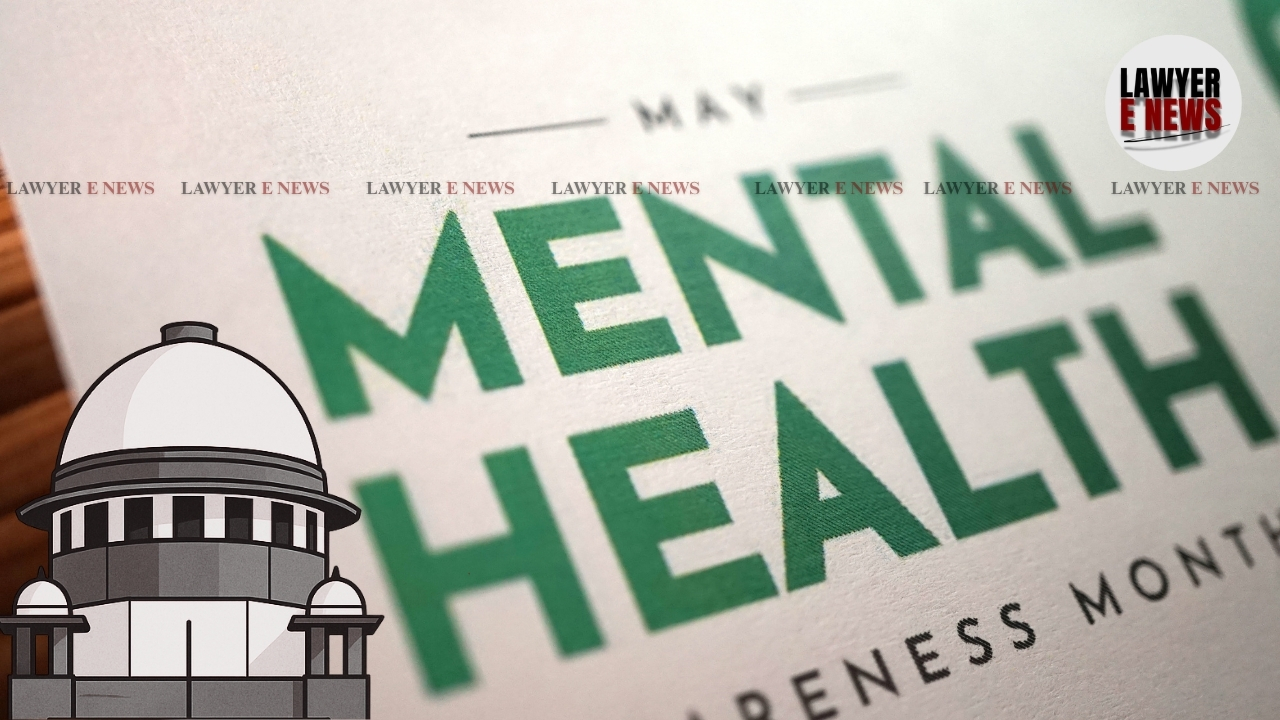
“Exceptional Circumstances Warrant Central Investigation — Local Police Failed to Reconcile Conflicting CCTV, Withheld Forensic Reports, and Allowed Destruction of Crucial Viscera Evidence”, - Supreme Court Declares Right to Mental Health Part of Article 21, Mandates National Protocol to Prevent Student Suicides in the Absence of Legislation.
Supreme Court of India delivered a groundbreaking judgment transferring the investigation into the death of a 17-year-old NEET aspirant from Visakhapatnam to the Central Bureau of Investigation (CBI), after finding the local investigation "manifestly deficient" and "structurally compromised."
Calling student suicides “a public health emergency and systemic failure,” the Court emphasized that “mental health is not charity, it is a constitutional and international obligation flowing from the right to life and dignity under Article 21.” Acting under Articles 32 and 141 of the Constitution, the Bench comprising Justices Vikram Nath and Sandeep Mehta issued binding interim guidelines applicable to all educational institutions across India for the protection of student mental health.
“This Court Cannot Be a Spectator to the Loss of Young Lives”: Death of a NEET Aspirant Exposes Systemic Negligence
The appeal arose from the tragic death of the appellant’s daughter, Ms. X, who fell from the third floor of her hostel on July 14, 2023, in Visakhapatnam, where she had enrolled in Aakash Byju’s Institute and was staying at Sadhana Ladies Hostel. Though initially conscious, she was later found on ventilator support and died the next day. The circumstances of her treatment, CCTV evidence, and forensic lapses led the father to suspect foul play and approach the Andhra Pradesh High Court, which rejected his plea for a CBI probe on jurisdictional grounds.
In overturning that decision, the Supreme Court observed: “This Court is of the considered view that the investigation into the unnatural death of Ms. X has to be entrusted to the CBI... Such a transfer is necessary not only to ensure a comprehensive and impartial investigation but also to restore public confidence.” [Para 23]
“A Suicide Theory Built on Post-Facto Narratives Cannot Trump Forensic Irregularities”: Court Slams Local Police for Hasty Conclusions and Investigative Gaps
Rejecting the respondents’ claim that the deceased was mentally distressed and committed suicide, the Court pointed out:
“The original and consistent version disclosed to the appellant, both by Aakash Institute’s personnel and local police, was that the appellant’s daughter had fallen from the terrace. At no point was the suicide theory mentioned in real-time. It was only in hindsight that respondents sought to paint her as mentally perturbed.” [Para 21.1]
The Court noted glaring contradictions in CCTV footage, highlighting that:
“The hostel footage shows a girl going upstairs at 10:25 pm in salwar and T-shirt; the adjacent building’s footage at 10:46 pm shows a girl in blue half-pants. No attempt was made to verify identity, conduct forensic comparison, or obtain witness statements.” [Para 21.2]
Further, the medical records revealed shocking discrepancies. The girl was initially conscious with a Glasgow Coma Scale score of 10/15, yet no statement was recorded by the police. She was put on a ventilator without consent, and eventually passed away.
“If the deceased was indeed conscious, there was sufficient time and opportunity to record her statement, which would have been crucial in uncovering the circumstances. The failure to do so reflects not only gross medical negligence but also a possible suppression of key evidence.” [Para 21.3]
“Conflict of Interest Is Not a Technicality — It Destroys Investigative Credibility”: Court Deplores Role of Single Doctor as Autopsy Surgeon, Analyst, and Inquiry Committee Member
Perhaps the most damning part of the judgment came when the Court condemned the tripartite role of one Dr. P. Venkataramana Rao, who functioned as the autopsy surgeon, chemical analyst, and member of the post-incident medical inquiry committee:
“Each of these roles, by the very nature of their functions, requires institutional independence, objectivity, and professional detachment. There appears to be no justification for inclusion of the autopsy surgeon in all these roles, which creates a great deal of doubt in the mind of the Court.” [Para 21.4]
Additionally, the premature destruction of the deceased’s viscera — a critical forensic sample — was termed a “gross dereliction of duty”, particularly since it was ordered for DNA testing by the High Court.
“By failing to preserve this material before completing the DNA match, the RFSL and IO undermined the investigation’s integrity and foreclosed any possibility of conclusively establishing the cause of death.” [Para 21.5]
The Court was also troubled by the “suspicious smell” noted in the stomach contents of the deceased during autopsy, and the presence of semi-digested food despite claims of continuous ventilatory support for nearly 48 hours.
“Mental Health Is Not a Luxury—It Is a Legal Right”: Supreme Court Invokes Article 21 to Issue Binding Guidelines for Educational Institutions
Acknowledging the increasing student suicide epidemic, particularly in competitive hubs like Kota, Sikar, Hyderabad, and Delhi NCR, the Court held:
“Mental health is central to the right to life... It is not an aspirational ideal but a constitutional mandate enforceable under Article 21.” [Para 31]
Referring to the National Crime Records Bureau 2022 data, the Court noted that 13,044 student suicides were reported in 2022 — “each a life prematurely silenced by unbearable academic and psychological pressures.” [Para 9]
Relying on Vishaka v. State of Rajasthan as precedent, the Court issued nationwide binding interim guidelines under Article 141, noting:
“In the absence of specific legislation, we lay down a preventive, remedial, and supportive framework for mental health protection in all educational institutions.” [Para 35]
Key mandates include:
A uniform mental health policy in all institutions,
Appointment of trained counsellors,
Ban on batch segregation based on performance,
Mandatory helpline displays and staff sensitivity training,
Protection mechanisms for marginalised and vulnerable students,
Accountability for institutional negligence in self-harm cases.
The Court declared: “Where institutional neglect contributes to a student’s suicide, such failure shall be treated as institutional culpability, making the administration legally liable.” [Guideline VIII]
“Let No Child Fall Through the Cracks of Silence, Indifference, or Pressure”: Supreme Court’s Directions to Government and Institutions
The Court directed:
The CBI to complete its investigation and submit a report within four months under Section 193(2) of the BNSS, 2023;
The Union Government to file a compliance affidavit within 90 days, detailing steps taken for enforcement;
States and UTs to notify rules for coaching centre regulation within two months;
District Monitoring Committees to be constituted under District Magistrates.
“This is not a matter for passive observation. The Court cannot stand by as students are driven to despair by the absence of institutional empathy and protection.” [Para 36]
In one of the most significant decisions of recent years addressing both criminal justice and public health, the Supreme Court has turned a personal tragedy into a national reckoning. By ordering a CBI investigation and issuing binding suicide prevention protocols, the Court has not only upheld the fundamental rights of the deceased and her family but has also recognised the urgent need for structural reforms in India's educational ecosystem.
As the Court aptly said: “This judgment is not only legal but moral, societal, and institutional. Its purpose is to safeguard the soul of education and the dignity of every young life.”
Date of Decision: July 25, 2025