-
by sayum
23 August 2026 2:56 PM







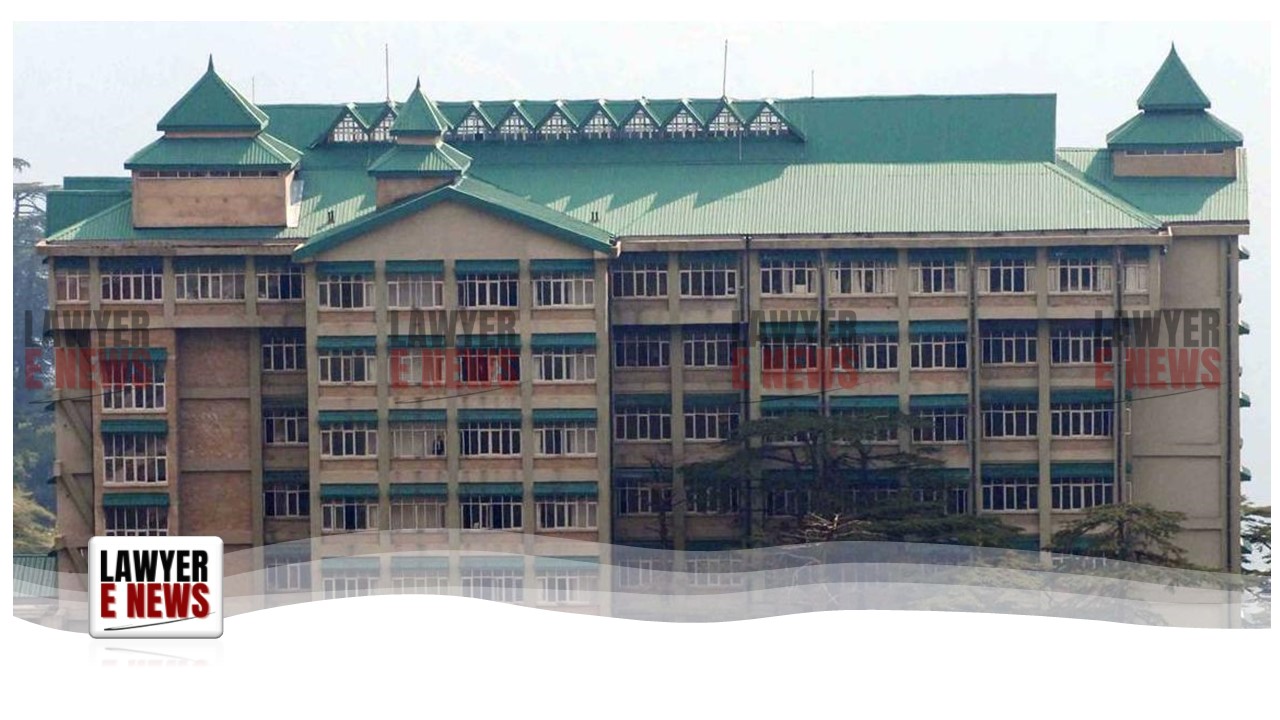
“Law Is Hard, But It Is the Law”, Himachal Pradesh High Court, in a significant ruling delivered by Hon’ble Mr. Justice Bipin Chander Negi in Achhroo Devi v. Yatish Chander, dismissed a civil miscellaneous application seeking condonation of a massive 853-day delay under Order IX Rule 9 read with Section 151 of the Code of Civil Procedure, 1908. The Court held that no “sufficient cause” was established for the prolonged inaction, thereby declining restoration of CMP(M) No. 695 of 2020, which stood dismissed for non-prosecution following the death of the original appellant and a failure to bring her legal representatives on record.
The judgment reiterates the binding nature of statutory limitation, reinforces the judicial expectation of litigants' diligence, and warns against the misuse of restoration provisions to reopen long-concluded disputes.
“Delay Must Be Backed by Explanation, Not Excuse” – Court Rejects Medical Grounds and Ignorance Plea
The application was filed by the daughter of late Smt. Achhroo Devi, who was not only the legal heir but had also acted as her mother's Power of Attorney holder during the trial and first appeal. The original appeal (CMP(M) No. 695 of 2020), seeking condonation of delay in filing a Regular Second Appeal, had itself been delayed by over 21 months and was ultimately dismissed on July 15, 2022, for want of prosecution. Notably, the applicant had failed to respond to multiple notices for bringing legal heirs on record after the appellant’s demise.
Rejecting the claim that she was unaware of the proceedings or medically incapacitated, the Court noted:
“From a perusal of the record, it is evident that despite repeated communications made by the counsel, no legal representative had come forward to impart instructions. The applicant in the case at hand was the Power of Attorney holder of late Smt. Achharoo Devi… The applicant can’t be heard to say that she was not aware of the present proceedings.”
The Court found the supporting medical documentation “sporadic” and “intermittent,” adding that it “does not reflect hospitalization, only depicts sporadic visits to the hospital for treatment.” Importantly, the bench clarified that the issue was not medical condition alone, but prolonged negligence without any bona fide attempt at revival.
The Court engaged in a detailed examination of precedents and statutory interpretation of limitation law. It cited the Supreme Court’s landmark ruling in Basawaraj v. Land Acquisition Officer, (2013) 14 SCC 81, reiterating:
“It is a settled legal proposition that law of limitation may harshly affect a particular party but it has to be applied with all its rigour when the statute so prescribes… A result flowing from a statutory provision is never an evil.”
The judgment also drew strength from Thirunagalingam v. Lingeswaran, SLP (C) No.17575/2023, where the Apex Court ruled:
“Delay should not be condoned merely as an act of generosity… The pursuit of substantial justice must not come at the cost of causing prejudice to the opposing party.”
Further bolstering its reasoning, the Court cited Sheo Raj Singh v. Union of India, (2023) 10 SCC 531, emphasizing the distinction between “explanation” and “excuse”:
“Calling something as just an ‘excuse’ would imply that the explanation proffered is believed not to be true… There is a distinction which, though fine, is real.”
The Court also referenced Katari Suryanarayana v. Koppisetti Subba Rao, (2009) 11 SCC 183 to underline that:
“Want of ‘diligence’ or ‘inaction’ can be attributed to an appellant only when something required to be done by him is not done.”
“Litigation Must End at Some Point” – Court Emphasizes Finality and Public Policy
Delivering a stern message on the need for certainty in legal proceedings, the Court observed:“Much time has elapsed since the decision of the First Appellate Court. Issues settled and decided by Courts should not be sought to be disturbed after passage of sufficient time as parties must be allowed to live in peace and certainty.”
The Court invoked the doctrine of “dura lex sed lex” – the law is harsh, but it is the law – and stressed that public policy demands finality in litigation. The preservation of judicial time and protection of the opposing party from indefinite uncertainty were cited as key considerations.
The High Court refused to extend discretionary relief under Section 151 CPC, reiterating that statutory deadlines cannot be bypassed through vague pleas of ignorance or weak medical justifications. Holding the restoration plea as devoid of merit, the Court refused to condone the inordinate 853-day delay, thereby bringing an end to the proceedings.
This judgment stands as a clear message to litigants and legal representatives that procedural complacency and unexplained dormancy will not be rewarded by the courts. The ruling is also a reaffirmation of the principle that legal proceedings must not only be fair but also finite.
Date of Decision: 31.12.2025