-
by sayum
23 August 2026 2:56 PM







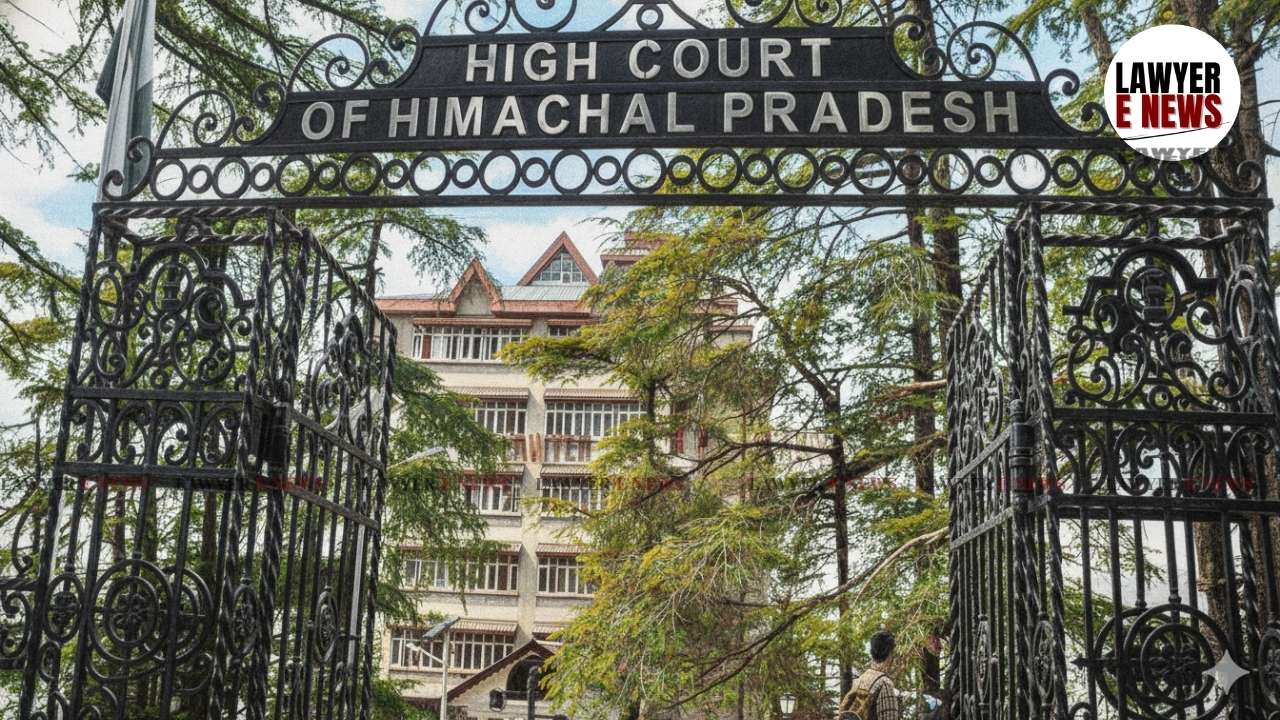
"If Two Views Are Reasonable, Acquittal Must Stand", On January 1, 2026, the Himachal Pradesh High Court dismissed a criminal appeal filed by the State challenging the acquittal of a bus driver, Ravi Prakash, accused of rash and negligent driving that allegedly caused injuries to a motorcyclist and his pillion rider. In State of Himachal Pradesh v. Ravi Prakash, the Single Bench of Justice Rakesh Kainthla reaffirmed the established legal principle that appellate interference in an acquittal is warranted only when the trial court’s view is patently perverse or based on a misreading of vital evidence.
The case revolved around alleged offences under Sections 279, 337, and 338 of the Indian Penal Code, 1860 and Section 187 of the Motor Vehicles Act, 1988. The State had sought reversal of the acquittal delivered by the Judicial Magistrate, First Class-II, Dehra, on June 12, 2014, asserting that the accused’s negligence was sufficiently proven by eyewitness testimony.
However, the High Court found that the trial court's evaluation of contradictory statements and lack of corroborative physical evidence was justified, and thus, upheld the acquittal.
Trial Court's View on Evidence Not "Perverse", Merely Another Possibility Doesn't Warrant Reversal: High Court
At the heart of the High Court’s judgment lies its endorsement of judicial restraint in disturbing acquittals. Referring extensively to Surendra Singh v. State of Uttarakhand [(2025) 5 SCC 433] and P. Somaraju v. State of A.P. [2025 SCC OnLine SC 2291], Justice Kainthla emphasized that “if two reasonable views are possible on the basis of the record, the acquittal should not be disturbed.”
He cited the Supreme Court’s caution that reversal of an acquittal requires satisfaction of a high threshold—perversity, omission to consider material evidence, or manifest miscarriage of justice. “It is a settled legal position that the interference with the finding of acquittal... would be warranted only if the judgment of acquittal suffers from patent perversity... and no two reasonable views are possible and only the view consistent with the guilt of the accused is possible,” noted the Court, quoting Surendra Singh.
Contradictions in Eyewitness Testimony and Site Plan Undermine Prosecution's Case
The High Court carefully dissected the evidence led by the prosecution and affirmed the trial court’s reasoning. The informant, Pradeep Kumar (PW1), and his wife Kamlesh Kumari (PW2), who was riding pillion, offered inconsistent accounts of how the accident occurred. While both asserted that a bus struck their motorcycle, their narratives diverged on crucial aspects such as the place of impact and positioning of the vehicles.
Pradeep Kumar claimed that the motorcycle was on the unmetalled left portion of the road, and the bus came from the opposite side. Kamlesh, however, stated that the motorcycle hit the rear of the bus. These statements were not only internally inconsistent but also contradicted the official site plan (Ex. PW9/D), which placed the point of impact on the metalled portion of the road.
This contradiction, the Court held, "materially affects credibility and fails to establish negligence beyond reasonable doubt."
Further, the mechanical inspection report (Ex. PW3/A) revealed damage to the headlight area of the bus, not the rear, refuting Kamlesh’s version and reinforcing doubts about the prosecution’s narrative.
Scientific and Documentary Evidence Prevail Over Ocular Inconsistencies
The Court underscored the significance of site inspection and mechanical reports, noting, “the learned Trial Court had rightly disbelieved the testimonies of these witnesses that the accident had occurred on the unmetalled portion of the road.” In doing so, the Court relied on the principle that objective evidence can override inconsistent oral testimony.
Justice Kainthla also dismissed the relevance of PW6 Rajinder Kumar’s testimony, who transported the injured to the hospital, noting that “he admitted in his cross-examination that the accident had not occurred in his presence. Therefore, he is not an eyewitness to the accident, and no advantage can be derived from his testimony.”
Presumption of Innocence Deepened Post-Acquittal
One of the key judicial sentiments expressed in the decision is the reinforced presumption of innocence once an accused is acquitted. “This was a reasonable view that could have been taken based on the evidence led before the learned Trial Court, and this Court will not interfere with the reasonable view of the learned Trial Court, even if another view is possible,” observed the Bench, drawing strength from the jurisprudence around double presumption of innocence post-acquittal.
No Grounds for Appellate Interference Found: Appeal Dismissed
Finding no compelling reason to dislodge the trial court’s appreciation of evidence, the High Court dismissed the appeal and affirmed the acquittal of the accused. However, in light of Section 437-A CrPC and its equivalent Section 481 of the Bharatiya Nagarik Suraksha Sanhita, 2023, the Court directed the accused to furnish a personal bond of ₹25,000/- with one surety, to remain effective for six months in the event of a potential SLP before the Supreme Court.
The judgment reiterates long-standing appellate norms and signals judicial caution in reversing acquittals without satisfying a strict standard of perversity or legal error.
Date of Decision: 01 January 2026