-
by sayum
26 August 2026 9:49 AM







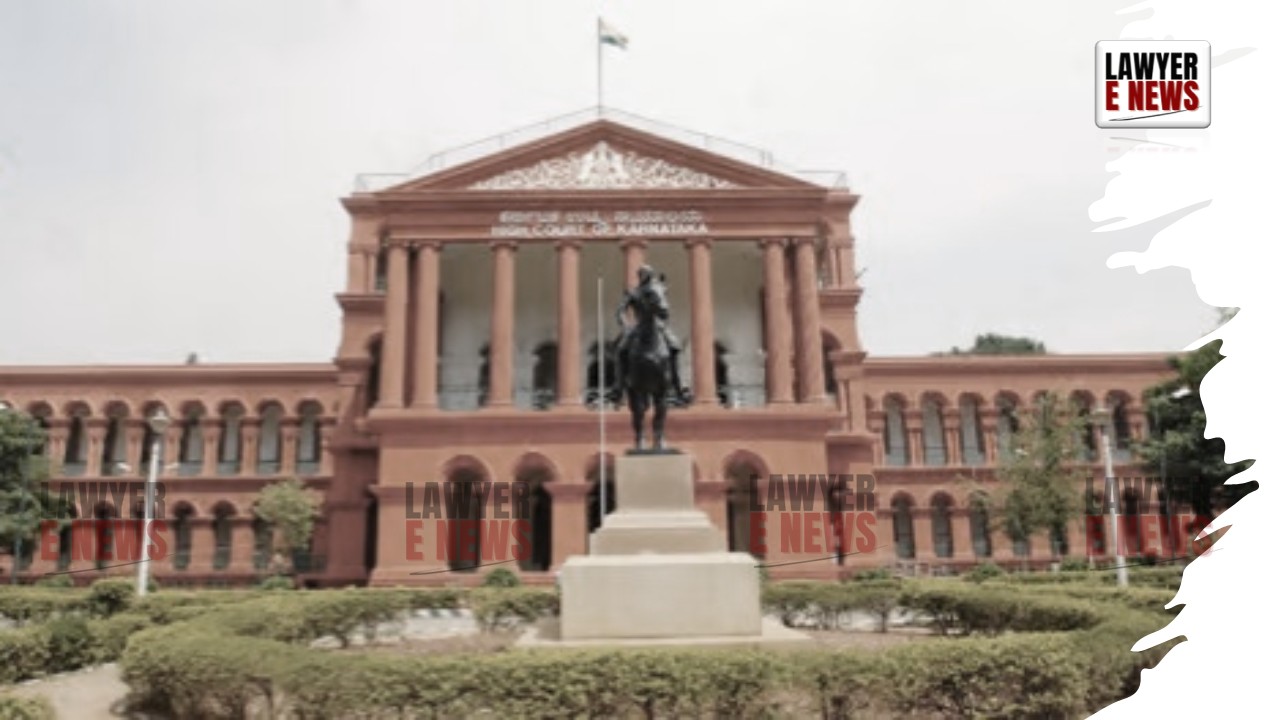
"Bidder Alone Bears the Risk of Submission Failure—No Procedural Impropriety If System Records Incomplete Bids as 'DRAFT'" – In a critical ruling that reiterates the strict procedural compliance mandated in public procurement, the Karnataka High Court dismissed two writ petitions filed by a Grade-I contractor who challenged his exclusion from a government tender process after his re-submitted bids were marked as incomplete (DRAFT) on the official portal. The Court, in its decision authored by Justice B.M. Shyam Prasad, held that there was no violation of Rule 19 of the Karnataka Transparency in Public Procurement Rules, 2000 (KTPP Rules) and that the failure to upload corrected bids within the extended deadline was solely attributable to the petitioner.
The petitions—W.P. No. 12722/2025 and W.P. No. 12725/2025—filed by Sri K.B. Kumar, related to lift irrigation projects at Devanuru Village and Kesthuru Koppalu in Karnataka, where the contractor alleged procedural impropriety and technical failure in the Karnataka Public Procurement Portal (KPPP), leading to wrongful exclusion of his bids.
"Status of 'DRAFT' Accurately Reflected Incomplete Bids—No Procedural Lapse Under Rule 19"
Central to the dispute was the petitioner's claim that his bid corrections could not be uploaded on 30.09.2024, the last date for submission, and that his bids were not shown as 'DRAFTS' as required under Rule 19. However, the Court found that the portal did display the petitioner’s bids as DRAFTS, pursuant to his own cancellation of earlier submissions on the same day at 15:13 and 15:16 hours, respectively.
The Court held:
“When the petitioner cancelled the bids submitted on 27.09.2024 on 30.09.2024, he rendered those bids incomplete, which are displayed as DRAFTS on the portal. These continued to be in DRAFT status at 17:30 hours—the submission deadline—because the petitioner did not re-submit them.”
Accordingly, the Court ruled that there was no procedural violation under Rule 19, which merely mandates that incomplete bids must be displayed as 'DRAFT' and complete bids as 'RECEIVED'.
"Bidder Must Bear the Consequences of Non-Submission—Onus Lies Under Rule 15(4)(b)"
Justice Shyam Prasad further invoked Rule 15(4)(b) of the KTPP Rules, which casts an unequivocal obligation on bidders to ensure submission within the time prescribed. The Court noted that the petitioner’s cancellation of his revised bids less than three hours before the cut-off time left him insufficient margin to correct and re-upload, and this delay could not be attributed to the authorities.
“The statute enjoins the petitioner with the responsibility to ensure that his tender is submitted within the last date/time specified. The petitioner has failed in this obligation. The onus in law is on the petitioner, and he has failed.”
The Court concluded that incomplete bids cannot be taken up for evaluation, and the authorities were justified in excluding them from the tender process.
Earlier Petitions Had No Bearing—Fresh Cause Based on New Facts
Although the petitioner had earlier challenged the corrigendum dated 25.09.2024, which extended bid submission deadlines and modified eligibility criteria, those writ petitions (W.P. Nos. 27111/2024 and 27103/2024) were dismissed on 22.04.2025. The present petitions were filed based on a subsequent exclusion from the tender process, which, the Court held, constituted a distinct cause of action.
Addressing the issue of locus standi, the Court observed:“The controversy as to whether the petitioner’s final bids were successfully submitted was not addressed in the earlier writ petitions. Therefore, this Court cannot conclude that the petitioner lacks locus or has contrived a cause of action.”
However, the petitioner ultimately failed to establish that any Rule 19 violation occurred, or that he was prejudiced by any procedural impropriety on part of the respondents.
No Relief for Self-Inflicted Delay—Court Cites Apex Court on Limits of Judicial Review
The Court also referred to the recent Supreme Court decision in Subodh Kumar Singh Rathod v. CEO and Others, (2024 SCC OnLine SC 1682), affirming that judicial review in tender matters can be invoked only where procedural impropriety, arbitrariness, or favouritism is established. But, as the High Court noted: “There is no deviation from the statutorily prescribed procedure to justify that there is procedural impropriety. The petitioner’s own failure to upload the corrected bids on time stands established.”
The Court reiterated that judicial review cannot substitute administrative discretion, especially in public procurement, where fairness, transparency, and adherence to timelines are paramount.
Petitions Dismissed – No Violation of Rule 19 or Right to Participate in Tender
In a detailed and unequivocal ruling, the Karnataka High Court held that:
The petitioner’s failure to re-submit corrected bids before the deadline was a self-inflicted lapse;
There was no procedural impropriety under Rule 19 of the KTPP Rules;
The status of the bids as 'DRAFT' was in line with the prescribed norms;
The on-screen failure to reflect a final submission did not arise from any systemic error, but from the petitioner's own actions.
“In view of the above, the petitions are rejected.” concluded Justice Shyam Prasad, dismissing both writ petitions without costs.
Date of Decision: 16 December 2025