-
by sayum
26 August 2026 1:47 PM







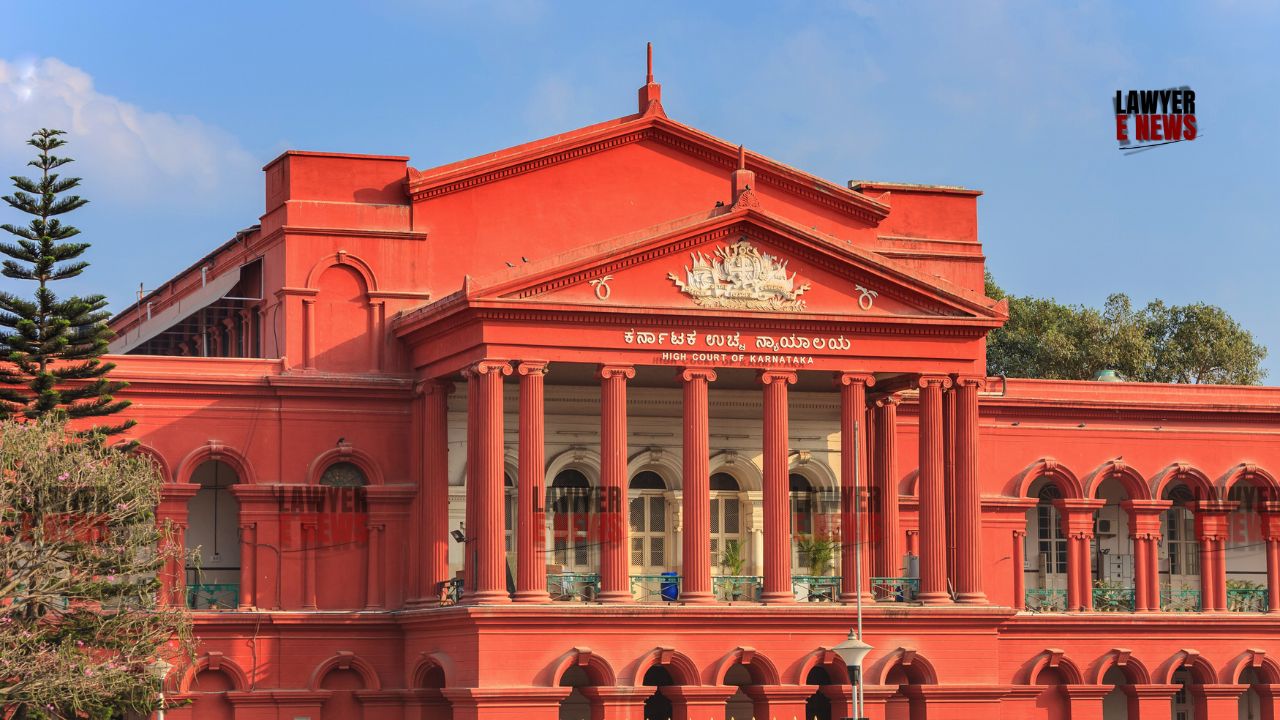
“Second Appeal Is Not a Third Trial”, High Court of Karnataka at Bengaluru, speaking through Justice H.P. Sandesh, delivered a reasoned and reportable judgment in Regular Second Appeal, decisively reiterating the limited scope of interference under Section 100 of the Code of Civil Procedure, 1908.
The Court dismissed the second appeal and affirmed the decree of permanent injunction granted by the First Appellate Court, holding that documentary evidence conclusively established the plaintiff’s possession over the vacant site as on the date of filing of the suit, and that the defendant’s plea of adverse possession was unsupported by proof.
“Reappreciation of Evidence Is Impermissible Unless Findings Are Perverse”
The litigation arose from a suit for permanent injunction concerning a vacant site bearing Sl. No.242, Property No.105/7 at Nelavagilu Village Grama Panchayath, Shikaripura Taluk, claimed by the plaintiff as ancestral property devolving upon him through family settlement.
The plaintiff asserted ownership and possession based on mutation entries, panchayath tax registers, tax paid receipts, and revenue records, contending that the defendant attempted to encroach upon the site on 28.07.2013.
The defendant resisted the suit by denying the plaintiff’s possession, asserting long-standing occupation, construction of a cattle shed, and claiming adverse possession for over 25 years.
The Trial Court dismissed the suit, citing discrepancies in measurements and alleged weaknesses in pleadings. However, the First Appellate Court reversed the decision, reappreciated evidence, and granted a decree of permanent injunction in favour of the plaintiff.
“Documentary Evidence Speaks Louder Than Interested Oral Testimony”
Legal Issues and Court’s Observations
Justice H.P. Sandesh framed the controversy within the narrow confines of Section 100 CPC, emphasising that a second appeal can succeed only if a substantial question of law arises, and not merely because an alternative view is possible.
The Court underscored that in a suit for injunction simpliciter, the decisive factor is possession on the date of suit, observing:
“When the suit is filed for the relief of permanent injunction, the Court has to take note that as on the date of filing of the suit, who is in possession of the property.”
On facts, the Court noted that all material documents — RTCs, tax assessment registers, tax paid receipts and panchayath records — stood in the plaintiff’s name, including receipts for years immediately preceding and including the year of the suit.
In contrast, the defendant admitted non-payment of tax and failed to produce any documentary evidence substantiating his claim of possession.
“Mere Assertion of Long Possession Does Not Constitute Adverse Possession”
Plea of Adverse Possession Rejected
Rejecting the defence of adverse possession, the Court held that:
“Though the defendant claims that he has perfected title by adverse possession, in order to substantiate the same, nothing is placed on record.”
The judgment reiterated that hostile, continuous, exclusive and uninterrupted possession must be strictly proved, and that bare oral assertions, unsupported by records, are legally insufficient.
The Court also took note that defence witnesses were interested witnesses, one of whom admitted that he was brought to court by the defendant himself, further weakening the defence version.
“Minor Discrepancy in Measurement Is Not Fatal When Identity Is Admitted”
Measurement Discrepancy Explained
A key argument in the second appeal concerned the discrepancy between the suit schedule measurement (15 x 180 feet) and the tax assessment register (15 x 143 feet).
Justice Sandesh acknowledged the discrepancy but held it to be minor and non-fatal, observing that:
“Identity of the property is not in dispute and location is admitted by parties.”
The Court agreed with the First Appellate Court that such a discrepancy does not defeat an injunction suit when possession and identity are otherwise clearly established.
“Section 100 CPC Does Not Permit a Second Guess on Facts”
Scope of Second Appeal Clarified
Affirming the approach of the First Appellate Court, the High Court held that:
“Reappreciation of evidence is not permissible unless the findings are perverse or based on no evidence.”
Finding that the appellate court had carefully analysed oral and documentary evidence, the High Court concluded that no substantial question of law arose for consideration.
Both substantial questions framed at admission were answered in the negative.
The Karnataka High Court’s judgment reinforces settled principles that injunction suits turn on possession, documentary evidence prevails over uncorroborated oral claims, and Section 100 CPC is not a forum for factual re-trials.
By dismissing the second appeal, the Court has sent a clear message that litigants cannot use second appeals to unsettle well-reasoned appellate findings merely by pointing out minor inconsistencies.
The Regular Second Appeal was dismissed, and the judgment and decree dated 06.08.2021 in R.A. No.27/2020 granting permanent injunction were confirmed.
Date of Decision: 19 December 2025