-
by sayum
29 August 2026 3:15 PM







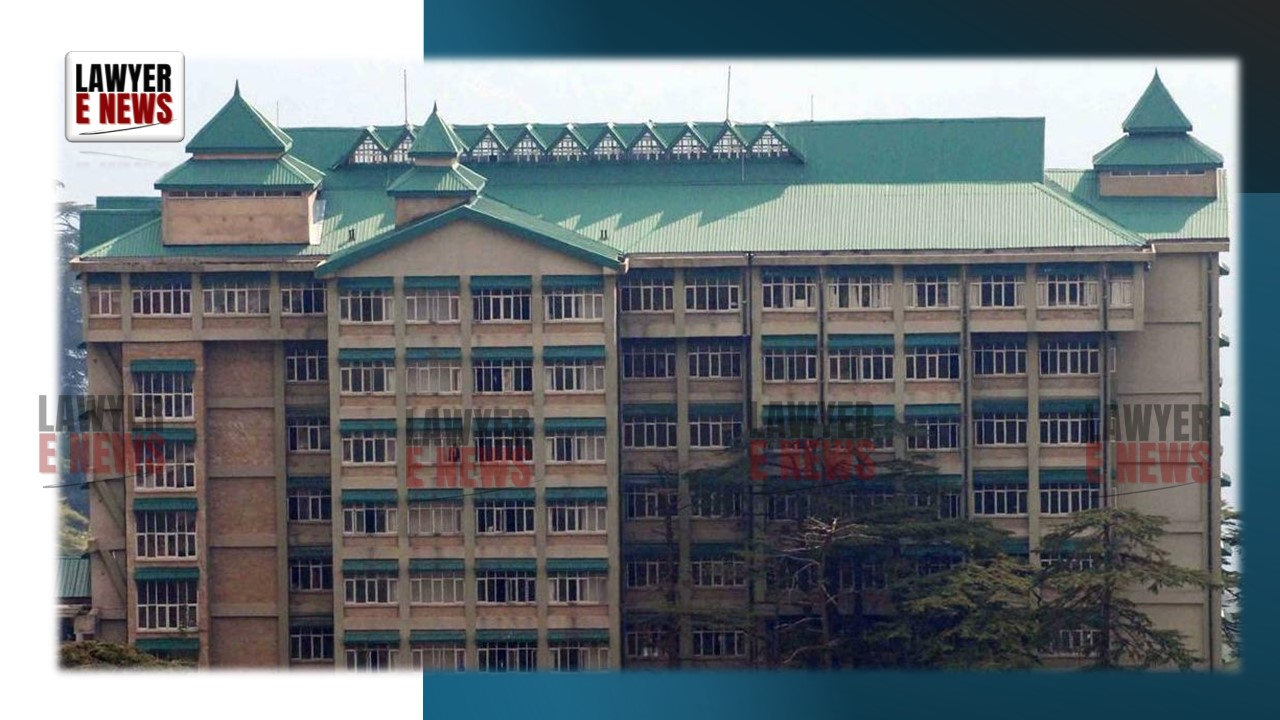
Himachal Pradesh High Court upheld the conviction and sentence of an accused found in possession of 810 grams of charas under Section 20(b)(ii)(B) of the NDPS Act, 1985.
Justice Rakesh Kainthla dismissed the appeal, rejecting challenges based on hostile independent witnesses, alleged contradictions, non-production of the sealing device, and purported breaks in the chain of custody. The Court reaffirmed that credible and consistent police testimony, duly corroborated by chain-of-custody evidence, is sufficient to sustain conviction.
The case arose from a 02 October 2016 police operation at Saula near Saroba Link Road, where a patrol team, including ASI Hem Raj (PW13), spotted the accused running suspiciously. After apprehension, the accused was searched in the presence of two independent witnesses, Chet Ram (PW1) and Bhup Singh (PW2), and found carrying a T-shirt containing a polythene pouch with black spherical substances later confirmed as charas weighing 810 grams.
The substance was seized, sealed with six impressions of seal “A”, and necessary NCB-I forms were completed. The seal after use was handed to an independent witness. The case property underwent resealing at multiple stages, judicial verification, and eventual forensic analysis at SFSL Junga, confirming the contraband as cannabis extract containing 28.83% resin.
The trial court convicted the accused on 23 November 2023 and sentenced him to five years rigorous imprisonment and ₹50,000 fine (two months simple imprisonment in default).
Effect of Hostile Independent Witnesses
Both independent witnesses denied witnessing the recovery but admitted their signatures on the seizure memo.
Citing Hanif Khan v. CBN (2020) and Sat Paul v. Delhi Administration (1976), the Court reiterated that:
“Mere hostility does not wash away testimony; dependable portions corroborated by other reliable evidence can be relied upon.”
The Court found that even though PW1 and PW2 turned hostile, their admitted presence and signatures supported the recovery process when read with consistent police testimony.
Credibility of Police Witnesses
The Court rejected the argument that police testimony was inherently unreliable:
“The presumption that official acts are regularly performed applies to police officers as well. Their testimony, if cogent and credible, can form the sole basis of conviction.”
Reliance was placed on Karamjit Singh v. State (2003), Budh Ram v. State of H.P. (2020), and Sathyan v. State of Kerala (2023).
Contradictions in Testimony
The alleged contradictions were held to be minor and attributable to time lapse—statements were recorded years after the incident.
The Court followed Goverdhan v. State of Chhattisgarh (2025) to hold that only material contradictions affecting the core issue can weaken prosecution.
Non-Production of Seal
The defence argued that the sealing device was not produced in court. The Court, relying on Fredrick George v. State of H.P. (2002) and Varinder Kumar v. State of H.P. (2019), held that:
“There is no mandatory requirement to produce the physical seal; intact seals with matching specimen impressions are sufficient.”
The FSL report confirmed that seals were intact and tallied with specimen seals, establishing an unbroken chain of custody.
Chain of Custody & Link Evidence
The Court meticulously traced the journey of the case property from recovery to forensic examination, noting judicial resealing, intact seals at each stage, and the absence of any tampering.
Cases like Surinder Kumar v. State of Punjab (2020) and Baljit Sharma v. State of H.P. (2007) were cited to affirm that intact seals conclusively establish integrity.
Sentence Adequacy
Justice Kainthla observed that five years RI for 810 g charas appeared inadequate considering proportionality principles—possession of 1 kg can attract 10 years—but no enhancement was possible absent a State appeal.
The High Court dismissed the appeal, confirming both conviction and sentence, holding that:
Date of Decision: 08 August 2025