
-
by sayum
29 August 2026 3:15 PM







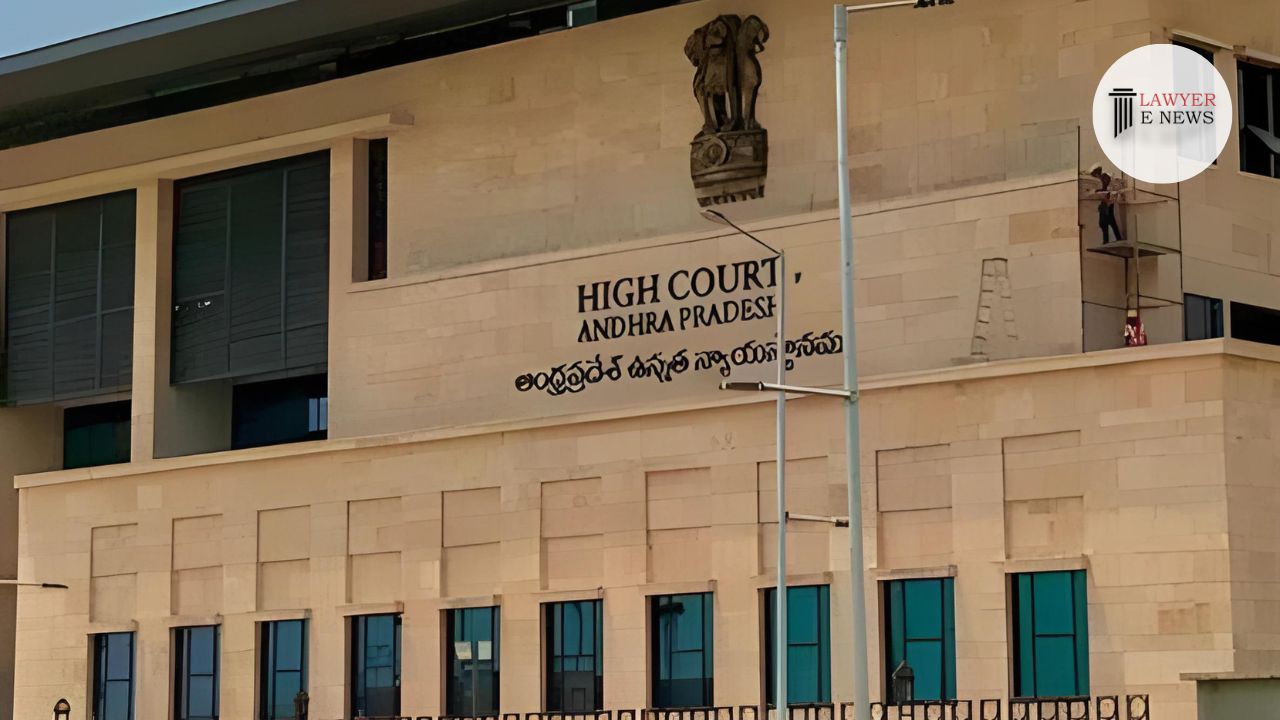
“The contention that the father played fraud with the minors in O.S.No.296 of 1975 is of no avail and is unbelievable.” – High Court of Andhra Pradesh at Amaravati, per Justice Venuthurumalli Gopala Krishna Rao, delivered a decisive ruling. The Court dismissed an appeal challenging a 1976 ex-parte specific performance decree, holding that allegations of fraud and gross negligence of the guardian were unfounded. The judgment brings closure to a 26-year-old appeal and effectively seals the fate of a legal battle spanning nearly half a century.
The dispute stems from an agreement of sale dated 14.03.1971 for Ac.29.10 cents of land for ₹40,000. The plaintiff’s grandfather allegedly received ₹20,000 upfront and delivered possession, later agreeing to adjust the income from the land towards the balance. Upon his death on 26.08.1975, the purchaser sued for specific performance in O.S. No.296 of 1975 before the Subordinate Judge, Vijayawada.
The defendants included one major son and two minor sons of the deceased testator. Their father, Lakshmi Narasimha Sastry, was appointed guardian of the minors under Order XXXII Rule 3 CPC. A common advocate filed Vakalat for all defendants. When they remained absent, the Court decreed the suit ex-parte on 10.03.1976. Thereafter, the decree-holder alienated portions of the land.
Nearly a decade later, in 1985, the youngest son (the present appellant) filed O.S. No.165/1985 seeking a declaration that the 1976 decree was void on grounds of fraud, misrepresentation, and gross negligence by the guardian, as well as recovery of possession. The trial court dismissed the suit on 17.12.1998, leading to the present appeal.
The Appellant’s Case: Fraud & Guardian’s Negligence
The appellant contended that the Will of 1964 expressly disqualified his father from acting as guardian. Yet, summons were served on him, and the Court appointed him as guardian for the minors. He argued that this amounted to fraudulent suppression of material facts and gross negligence, since the guardian remained ex-parte. The appellant further claimed that the balance consideration of ₹2,648.25 was never deposited by the decree-holder, rendering the decree inexecutable .
Respondent’s Stand: Binding Agreement & Set-Off Memo
The decree-holder rebutted these claims, pointing out that the grandfather himself admitted the agreement of sale and receipt of advance in replies to notices before his death. He argued that the minor heirs had no greater rights than their testator, who was already bound to convey the land. As to the balance amount, the decree-holder filed a memo on 03.04.1976 (Ex.B.6) seeking set-off of ₹2,648.25 against costs awarded in the decree. This was later upheld in C.R.P. No.1070/1989 by the High Court, treating it as sufficient compliance .
The Court meticulously examined whether the decree was vitiated by fraud or negligence.
On the allegation of negligence, the Court noted:
“Neither his father nor his mother raised any objection for appointing the father as a guardian… It is quite clear that except self-testimony of the plaintiff, no other evidence is adduced to prove the alleged fraud” .
On fraud, Justice Rao held:
“The allegation of fraud must be clearly and specifically pleaded and proved by unimpeachable cogent evidence. In the present case, the pre-requisites to prove fraud are missing even in the plaintiff’s own evidence” .
On the balance consideration issue, the Court reiterated that the earlier revision (C.R.P. No.1070/1989) had already settled the matter, observing:
“The memo filed by the plaintiff to set off the amount due towards costs can be treated as sufficient compliance of the decree” .
Rejecting all grounds of challenge, the Court concluded:
“The plaintiff failed to prove that there was gross negligence on the part of his father in O.S.No.296 of 1975… The contention of fraud is unbelievable… The view taken by the trial Court does not call for any interference and this Appeal is hereby dismissed” .
The appeal was thus dismissed, with each party bearing its own costs. Miscellaneous petitions connected to the appeal also stood closed.
This ruling underscores that mere bald allegations of fraud or negligence cannot undo long-standing decrees, especially when the parties themselves (including majors) acquiesced in earlier proceedings. The High Court gave weight to contemporaneous admissions by the testator, the proper appointment of a guardian, and the finality of earlier orders on balance consideration. After nearly five decades of litigation, the Court’s emphatic message was clear: “Fraud not proved, guardian duly appointed, and decree stands.”
Date of Decision: 20 August 2025