-
by sayum
29 August 2026 3:15 PM







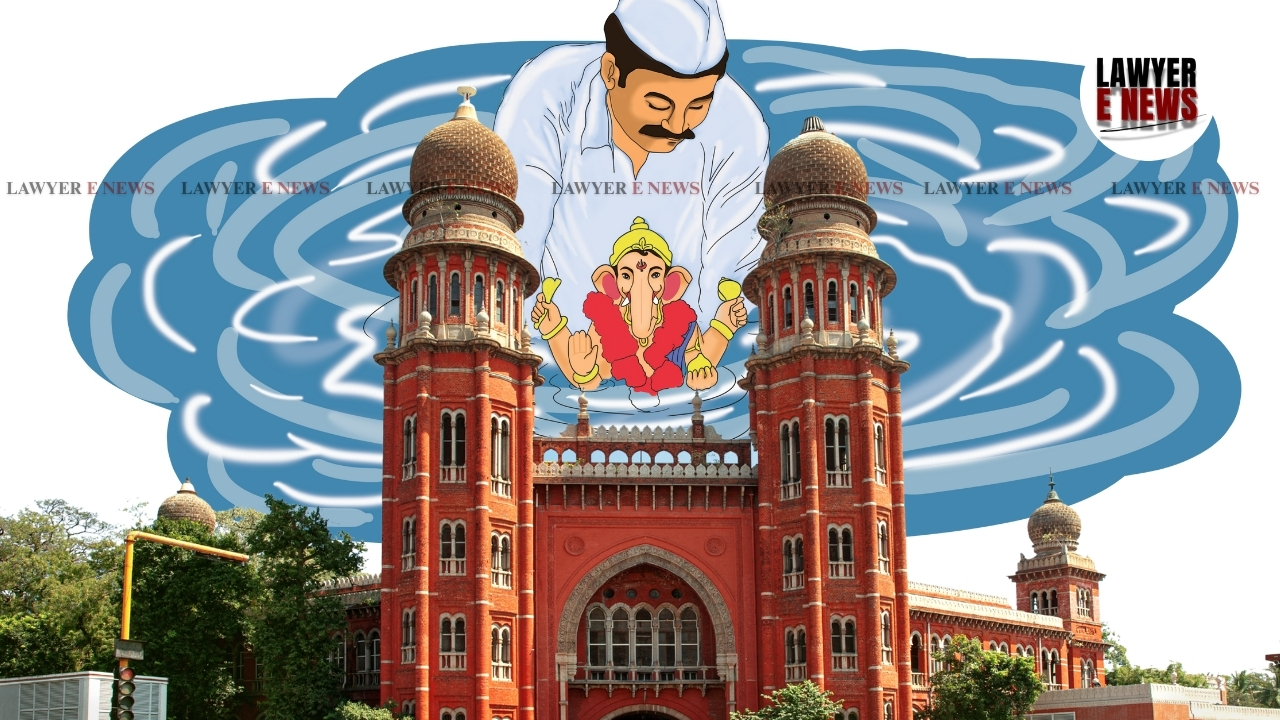
“Right to Worship Is Sacred, But Not Absolute” — In a landmark ruling Madurai Bench of the Madras High Court, while addressing a batch of petitions concerning the installation and immersion of Vinayagar idols, reaffirmed the fundamental right to worship under Article 25 of the Constitution but categorically held that “freedom of religion cannot override environmental laws or public order.”
The Court declared, “Worship, both individual and collective, is not a matter of State concession but a matter of constitutional recognition,” but cautioned that this right “must be exercised with responsibility and foresight.” It drew a sharp line between genuine devotion and actions that disrupt public peace or degrade natural resources.
“PoP Is Not an Offering, It’s a Violation” — Idol Immersion Must Follow CPCB and TNPCB Guidelines
Addressing the serious issue of environmental damage caused by idol immersions, the Court emphasized that “the immersion of Plaster of Paris idols causes grave harm to water bodies” and ruled that “only idols certified as eco-friendly—clay-based and painted with natural dyes—may be immersed in natural water bodies.” All others, the Court held, “must be immersed in artificial ponds specifically created for this purpose.”
Citing the 2020 guidelines of the Central Pollution Control Board, the Court observed, “The use of toxic chemical dyes, synthetic paints, enamel paints, and non-biodegradable materials such as plastics and thermocol is strictly banned.” It condemned the immersion of idols containing banned materials as a violation not just of pollution control regulations, but of the constitutional duty to protect the environment under Article 48-A and Article 51A(g).
“Idol Installations Driven by Ego, Not Devotion, Will Find No Judicial Shelter”
Justice Pugalendhi was unsparing in calling out the motives behind many of the petitions. “Most of the present requests appear to be driven by ego clashes and a desire to assert monetary influence, rather than genuine religious intent,” he wrote. “God is not a tool for rivalry; He is a symbol of unity, peace, and spiritual elevation.”
The Court remarked with disapproval, “Vinayagar temples at street corners remain neglected throughout the year, but elaborate efforts are made to install giant idols during the festival.” It urged devotees to reflect on this paradox and recognize that “true devotion lies not in grandeur but in consistent reverence.”
“You Cannot Claim Worship and Violate the Law Simultaneously” — Court Quashes Orders by Incompetent Authorities
In several cases, the Court struck down rejection orders issued by unauthorized police officials. It ruled that “only Assistant Commissioners of Police in city limits and Revenue Divisional Officers/Sub-Collectors in rural areas are competent to grant or reject such permissions under G.O.Ms.No.598 dated 09.08.2018.”
The Court made it clear: “Rejection orders passed by Station House Officers are illegal and without jurisdiction.” Petitioners affected by such orders were permitted to file fresh applications before the correct authorities.
“Religious Equality Is Not Discretionary” — Arbitrary Grant of Permissions Violates the Principle of Fairness
Calling out selective permissions granted to some groups while denying others similarly situated, the Court held that “discrimination in granting permission, especially in matters involving religious expression, can lead to unnecessary friction and undermine public trust.” The message was clear: “Either all similarly placed applicants must be permitted, or none.”
The Court observed that such arbitrary behavior violated the principle of equality and was incompatible with constitutional guarantees. It directed authorities to treat all applicants fairly and apply rules uniformly.
“No Worship Without Compliance” — Form-I and NOCs Are Mandatory
Many petitions were dismissed or closed for procedural non-compliance. The Court highlighted that several representations were not submitted in the prescribed Form-I, as required under the Government Order, and noted, “bald political representations, some even on party letterheads, seeking bulk permissions without basic disclosures, cannot be entertained.”
The Court advised, “Those seeking permission must follow due process. Permission is not a birthright; it comes with statutory obligations.”
“No Immersion Without Environmental Certification”
The Court underscored that idol immersion is a regulated activity, and that “no permission for immersion shall be granted unless the petitioners obtain a certificate from the Pollution Control Board, confirming that the idol is free from banned pollutants and harmful substances.”
It declared, “Devotion to God cannot be allowed to result in disturbance to man or destruction of nature,” and reiterated that “organisers must obtain a certificate from the competent authority confirming that the idol is free from restricted materials such as plaster of Paris, chemical paints or other non-biodegradable substances.”
“Celebrate Together, Not Apart” — Court Advocates Unity in Worship
Refusing to allow religious celebrations to become contests of pride, the Court directed, “Petitioners are advised to participate in already permitted processions instead of creating rivalry. True worship is in unity, not competition.”
It found that many applications were not made in good faith, stating, “Some applications were driven more by one-upmanship than by spiritual devotion.”
“Environmental Duty Is Not Optional, It’s Constitutional”
The Court ordered strict compliance with all environmental guidelines and regulations. It declared that “pollution boards must conduct water quality tests before, during, and after immersion,” and insisted that “only certified eco-friendly idols may be immersed in natural water bodies.”
Quoting the National Green Tribunal’s Hariharan case, the Court endorsed the “polluter pays” principle and encouraged the State to collect immersion fees based on idol size to fund post-immersion cleanup efforts.
“Delay Defeats Devotion and Due Process” — Eleventh Hour Petitions Not Entertained
The Court repeatedly expressed dismay over the last-minute nature of the applications and responses. “Almost all applications were filed at the last minute, and the officials responded equally late,” it said, noting that this denied the Court an opportunity to properly adjudicate many petitions.
Yet, in a measured approach, the Court directed authorities to consider some pending applications, “provided they are filed in proper format and comply with environmental and administrative requirements.”
Decision Date: 26 August 2025