-
by sayum
05 August 2026 3:07 PM







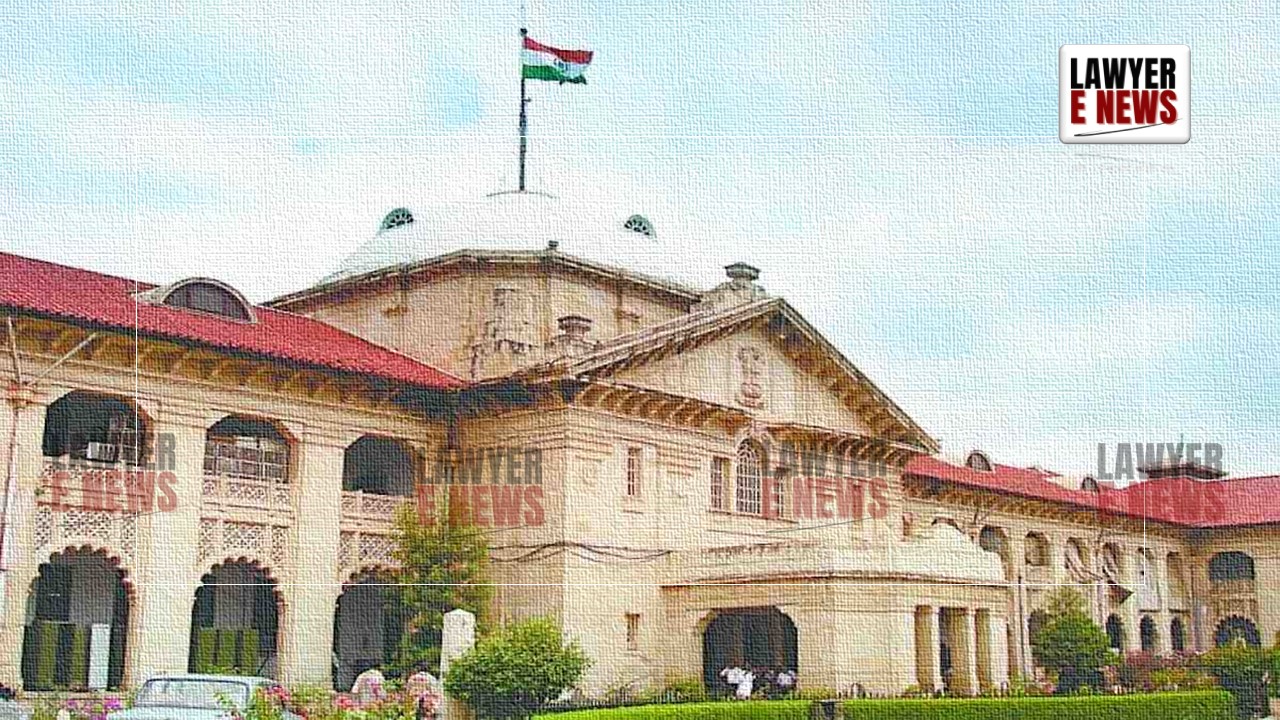
Absorption Rights Extinguished by 2009 Act; ‘Sleeping Over Rights Fatal to Claims”, Allahabad High Court, through Justice Saurabh Shyam Shamshery, delivered a landmark ruling, decisively dismissing claims of retrenched employees of the Uttar Pradesh Cement Corporation for absorption into government service. Referring to the statutory framework and binding judicial precedents, the Court held that the petitioners’ claims stood extinguished by the Uttar Pradesh Absorption of Retrenched Employees of Government or Public Corporations in Government Service (Rescission of Rules) Act, 2009.
Delivering a clear message on judicial discipline and statutory finality, the Court observed, “The petitioners who remained silent for nearly two decades, without pursuing any remedy, cannot be allowed to resurrect claims extinguished by law, merely because some others litigated successfully.”
The case originated from the long-standing grievances of employees retrenched after the winding up of the U.P. Cement Corporation in 1999. The petitioners sought absorption into government service under the Uttar Pradesh Absorption of Retrenched Employees Rules, 1991, claiming parity with other employees who had been absorbed following the Supreme Court’s judgment in Sunil Kumar Verma vs. State of U.P., (2016) 1 SCC 397.
The Court recounted how these petitioners had initially approached the Court in 1998 when they were advised to submit representations for consideration. Despite this direction, the Court noted, “The petitioners remained in a state of inertia for nineteen long years, showing no meaningful participation in any proceedings before the High Court or the Supreme Court.”
Justice Shamshery meticulously addressed the central legal question: whether these belated claimants, who neither pursued their remedies nor participated in the earlier rounds of litigation, could claim absorption under the 1991 Rules after they were rescinded.
The Court decisively answered in the negative, observing, “Sunil Kumar Verma’s case was confined to the appellants therein and is not a declaration of law in rem that binds the State to extend benefits universally to all similarly circumstanced employees.”
The High Court invoked Section 3 of the 2009 Act which explicitly states that, “The Absorption Rules… shall be rescinded and be deemed to have been rescinded on May 9, 1991.” The Court emphasized that this statutory rescission permanently extinguished any claim to absorption for employees not absorbed before 8th April 2003.
Rejecting the petitioners' attempt to claim under the Sunil Kumar Verma precedent, the Court quoted, “It is not open for fence-sitters who remained in comfortable silence, awakening only after seeing a successful verdict obtained by others after sustained litigation of thirteen years, to now claim the same benefits.”
The Court’s Interpretation of Sunil Kumar Verma Judgment:
The High Court clarified the limited applicability of the Supreme Court’s decision, noting, “The Supreme Court extended benefits exclusively to the appellants before it, without any expression to generalize the relief.”
Referring to the language of the judgment, the High Court highlighted, “In the absence of any direction to apply the judgment to non-parties, this Court cannot stretch the applicability to those who stood as silent spectators while the battle was fought by others.”
Dismissal of Reliance on Shiv Jag Sharma Case:
The petitioners had placed significant reliance on another judgment of the Allahabad High Court in State of U.P. vs. Shiv Jag Sharma (2023), where pensionary benefits were granted to certain absorbed employees of U.P. Rajya Cement Nigam Ltd. However, the Court categorically distinguished it, stating, “The Shiv Jag Sharma case pertained exclusively to already absorbed employees seeking pension benefits; it has no bearing on claims of unabsorbed employees whose rights were extinguished.”
The Court added, “This attempt to latch onto disconnected precedents only reflects a desperate clutching at straws by petitioners who have no legal foothold left after the 2009 Act.”
Binding Nature of Division Bench Precedents:
The Court also placed reliance on an authoritative Division Bench ruling in State of U.P. vs. Shambhu Nath Srivastava (2019), which rejected similar claims. Justice Shamshery observed, “The judgment in Shambhu Nath Srivastava squarely covers the case at hand, having considered the effect of the 2009 Rescission Act and distinguishing the Sunil Kumar Verma judgment.”
He further noted, “This Court finds no persuasive ground to depart from the settled position reaffirmed by coordinate Benches.”
Delay and Laches Proved Fatal:
Critically, the Court condemned the inordinate delay of the petitioners, who failed to act upon their claims for nearly two decades. The Court observed, “The petitioners remained mute spectators, displaying no diligence, and the law does not reward such indolence.”
In a stinging observation, the Court held, “Law does not protect those who sleep over their rights; the doctrine of laches bars claims of petitioners who woke up from their long slumber only after witnessing others’ success.”
In summation, the Allahabad High Court ruled, “The claim of the petitioners for absorption stands terminated under the binding force of the Rescission Act, 2009, and no fundamental right survives.” The Court also added that, “At best, the only benefit petitioners could possibly claim is relaxation in age limit for direct recruitment under Section 3(2)(c) of the 2009 Act, but no claim for absorption remains.”
Accordingly, the Court dismissed all 145 writ petitions with a firm pronouncement that, “Judicial discipline and legislative clarity prevent this Court from granting any relief to the petitioners who allowed their claims to be washed away by time.”
Date of Decision: 21 July 2025