
-
by sayum
29 August 2026 3:15 PM







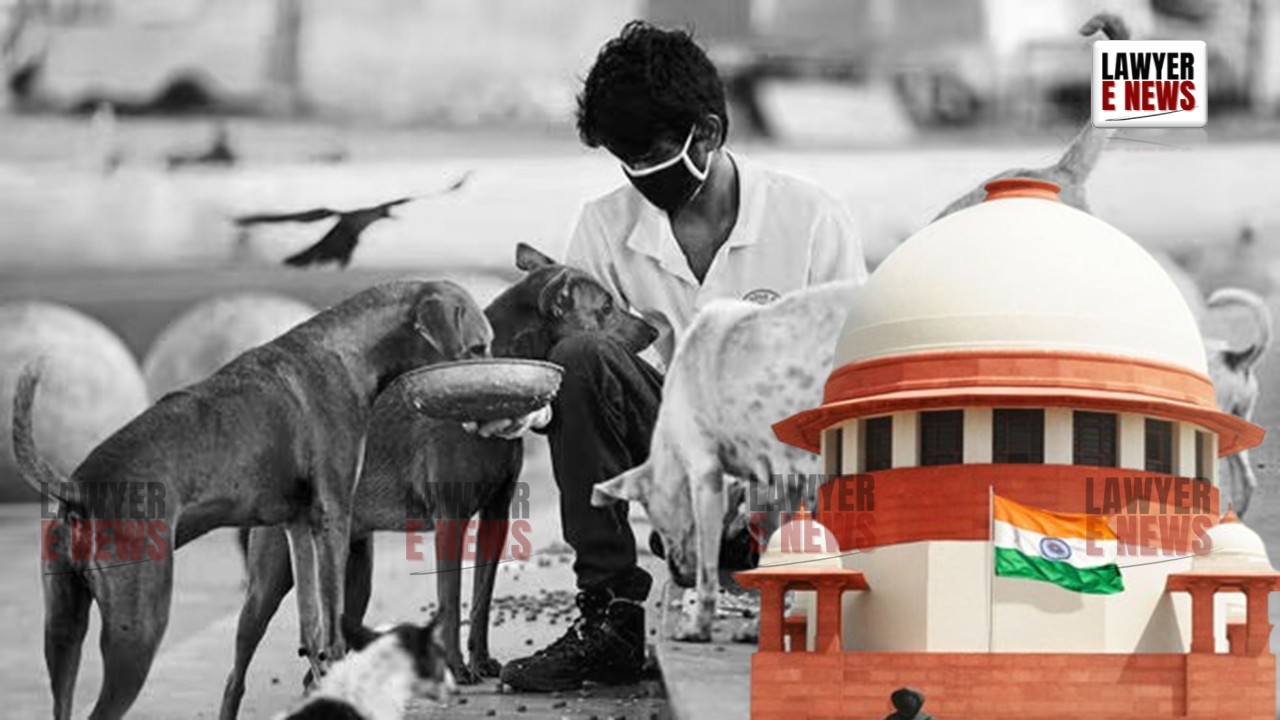
“Right to Life of Citizens Cannot be Compromised by Packs of Rabid Strays”— On 22 August 2025, a three-Judge Bench of the Supreme Court comprising Justices Vikram Nath, Sandeep Mehta, and N.V. Anjaria issued a landmark order in In Re: “City Hounded by Strays, Kids Pay Price”, Suo Motu Writ Petition (Civil) No. 5 of 2025. The case arose after the Court took cognizance of a news report of a six-year-old girl dying of rabies in Delhi following a dog attack.
In strong words, the Court declared that the safety and security of citizens, especially children and the elderly, is paramount under Article 21, and modified earlier directions that required all stray dogs to be permanently impounded. Instead, the Court adopted a balanced approach, allowing sterilised and vaccinated dogs to return to their original locations, but mandating separate shelters for rabid or aggressive dogs, and dedicated feeding zones across municipal wards.
“We make it clear that there is not even the slightest doubt in our minds that the intent behind the order is salutary… However, there are certain vital factors that call for a balancing exercise so that the order can be taken to its logical conclusion while keeping its ambit within the contour of the legal framework.”
The Court’s suo motu action began on 28 July 2025, based on the Times of India report “City hounded by strays, kids pay price: Girl (6) dies of rabies after dog attack”. On 11 August 2025, a two-Judge Bench directed authorities in Delhi, NOIDA, Ghaziabad, Faridabad, and Gurugram to round up stray dogs, sterilise, vaccinate, and permanently confine them in shelters/pounds, prohibiting their release back on streets.
Animal welfare organisations and individuals opposed these directions, arguing that they violated Rule 11(19) of the Animal Birth Control (ABC) Rules, 2023, which mandates that sterilised and vaccinated stray dogs must be released back into the same locality. They warned that municipal bodies lacked infrastructure for lakhs of dogs, creating the danger of illegal culling.
On the other hand, the Solicitor General Tushar Mehta, defending the order, highlighted staggering statistics: over 37 lakh dog bites in 2024, many resulting in rabies deaths, with children and the elderly unable to access streets and parks due to fear of stray dog attacks.
Balancing Article 21 Rights of Citizens and ABC Rules
The Supreme Court acknowledged that sterilisation under the ABC Rules has been effective in reducing stray populations in cities like Dehradun and Lucknow, but also noted the practical impossibility of immediately sheltering all dogs in Delhi-NCR.
The Court found the earlier order’s blanket prohibition on release to be “too harsh”:
“The mandate to keep all the stray dogs… in shelters would require logistics of gargantuan proportions. A blanket direction without evaluating infrastructure may lead to a catch-22 situation because such directions may be impossible to comply with.”
On the ABC Rule 11(19) requirement to return dogs to their locality, the Court recognised its scientific and compassionate purpose:
“The picked-up stray dogs after immunisation and sterilisation are relocated to the same environment where they were living earlier, which is a compassionate treatment.”
Modified Directions of the Court
The Bench issued a comprehensive framework, modifying its earlier order:
Sterilised, dewormed, and vaccinated stray dogs must be released back into the same locality.
Rabid or aggressive dogs must be sterilised, immunised, and kept in separate shelters; they cannot be released on streets.
Municipal authorities must immediately create designated feeding spaces in each ward, with clear boards. Feeding strays on roads is prohibited, and violators may face legal action.
Helplines must be set up in every municipal body to report violations.
Animal lovers and NGOs who approached the Court must deposit ₹25,000 (individuals) and ₹2,00,000 (NGOs) to help create infrastructure; only then may they continue in the case.
Adoption of strays by animal lovers is encouraged, with responsibility to prevent their return to streets.
Compliance affidavits from municipal bodies must disclose infrastructure—shelters, veterinarians, staff, and transport.
Importantly, the Court expanded the scope nationwide, impleading all States and Union Territories and ordering transfer of similar pending cases from High Courts to itself.
This ruling marks a turning point in India’s stray dog jurisprudence, where the Supreme Court has drawn a fine balance between human safety and animal welfare. It reiterated that while rabies and dog-bite deaths threaten citizens’ Article 21 rights, compassion and scientific sterilisation cannot be abandoned.
“Feeding dogs on streets is no longer permissible. Citizens’ right to safe movement and children’s right to life cannot be compromised.”
With this judgment, the Court has set the stage for a national policy shift, compelling States to adopt structured, humane, and accountable measures to manage stray dog populations.
Date of Decision: 22 August 2025