-
by sayum
30 August 2026 4:28 AM







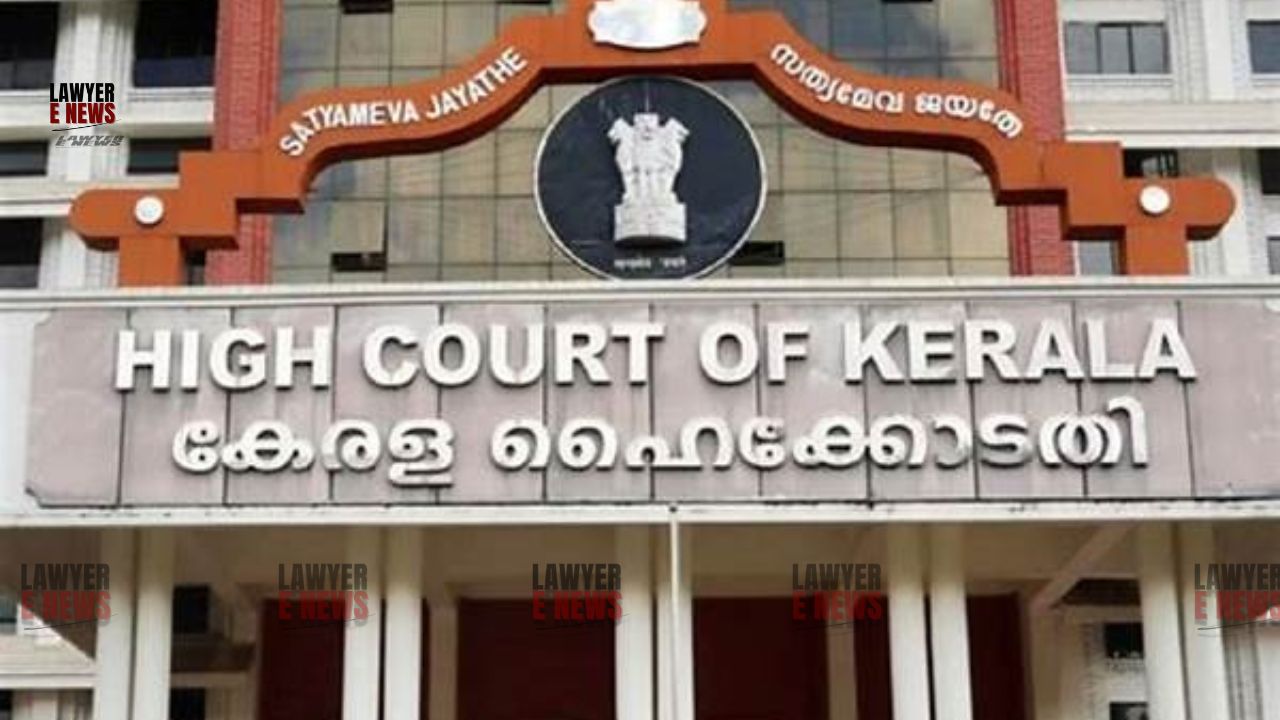
“In Welfare Laws, Preponderance of Probability Is Enough—Strict Rules of Evidence Don’t Apply,” In a judgment Kerala High Court upheld the finding of an employer-employee relationship and the occurrence of an accident during the course of employment under the Employees' Compensation Act, 1923, but set aside the compensation quantum due to lack of proper reasoning and ordered fresh adjudication.
The appeal arose from the decision of the Commissioner for Employee’s Compensation, Alappuzha, in ECC No. 213 of 2014, awarding compensation to the respondent Manoharan, who sustained injuries while working as a toddy tapper.
“Employer-Employee Relationship Established—Dispute About Accident Location Is Irrelevant in Face of Admission,” Declares Court
The primary contention raised by the appellant-employer, George Mathew, was that the respondent did not fall from a palm tree during toddy tapping but rather from a jackfruit tree while plucking fruit, arguing that the injury was outside the course of employment. The High Court dismissed this argument, declaring:
“The Opposite Party has admitted the employment of the Applicant as a toddy tapper. The presence of a palm tree in the property where the accident occurred is proved. There is no case that the Applicant was engaged in any other job. Hence, his presence there probabilizes that it was for toddy tapping, and the accident occurred during the course of employment.”
“Strict Rules of Pleading and Evidence Are Not Applicable in Welfare Legislations Like Employee’s Compensation,” Rules Court
In rejecting the appellant’s demand for strict evidentiary standards, the Court reiterated the settled principle:
“Labour welfare legislation cannot be strangulated by rigid rules of pleadings and evidence. What is required is a holistic appreciation based on the preponderance of probabilities, not proof beyond reasonable doubt.”
Quoting precedent, the Court relied heavily on the Supreme Court judgment in Fulmati Dhramdev Yadav v. New India Assurance Co. Ltd. [(2023) 4 KLT 1174 (SC)], emphasizing that:
“In matters under the Employees’ Compensation Act, the Commissioner is the last authority on facts, and appellate interference is limited to substantial questions of law.”
“Absence of Wound Certificate Is Not Fatal—Adverse Inference Cannot Be Drawn When Document Is Destroyed By Hospital,” Observes Court
One of the main grounds of challenge was the non-production of the Wound Certificate, which had been directed by the High Court in an earlier remand. The appellant argued that without this, the respondent’s case should fail.
The Court rejected this contention, noting: “The Applicant made reasonable efforts to summon the Wound Certificate, but it was destroyed by the hospital. No prudent person would expect that the records would be destroyed within such a short period after the remand. The absence of the Wound Certificate cannot lead to an adverse inference against the Applicant.”
“Whether the Tree Was Licensed Is Irrelevant—Accident During Assigned Work Remains Compensable,” Clarifies Court
The employer further argued that the palm tree in question was not licensed under the Kerala Tree Tax Rules, hence the tapping was unauthorized and outside the course of employment.
The Court rejected this, ruling: “The question of whether the palm tree was licensed or not does not arise from the pleadings. The employer did not have a case before the Commissioner that the Applicant was tapping an unlicensed tree. His specific defence was that the fall was from a jackfruit tree. The issue is not about licensing but whether the accident occurred during employment duties.”
On Quantum: “Commissioner’s Award Without Reasoning Is Legally Unsustainable”
While upholding the finding on the occurrence of the accident, the Court strongly criticized the Commissioner for “blindly awarding the same compensation as the earlier set-aside order without any fresh adjudication or reasoning.”
The judgment reads:
“When an earlier order is set aside, all findings go. The Commissioner is bound to consider afresh the quantification of compensation with due reasoning. The present order does not even specify the heads under which amounts were awarded. Such an approach is unsustainable.”
Court Answers Substantial Questions of Law:
On the question of whether the Commissioner committed any perversity in appreciating evidence on the occurrence of the accident, the Court answered:
“No. There is no perversity. The finding that the accident occurred in the course of employment stands.”
On whether the Commissioner erred in mechanically awarding the same compensation as the earlier set-aside order, the Court ruled:
“Yes. The Commissioner erred by failing to adjudicate the quantum afresh. The award is set aside for the limited purpose of proper quantification with supporting reasons.”
The Court ordered: “The finding that the accident occurred in the course of employment is upheld. However, the award is set aside to the limited extent of quantification. The matter is remanded back to the Commissioner for the purpose of fresh computation of compensation under appropriate heads with detailed reasoning.”
It further directed the parties to appear before the Commissioner at the next Camp Sitting at Ernakulam in July 2025.
This judgment once again reiterates the benevolent nature of labour welfare legislation, emphasizing that “when employment is admitted, and the work activity is linked to the accident site, the benefit of doubt must favour the workman.”
At the same time, it sends a strong message that “quantification of compensation cannot be a mechanical exercise devoid of application of mind.”
Date of Decision: 13th June 2025