-
by sayum
26 October 2026 4:04 PM







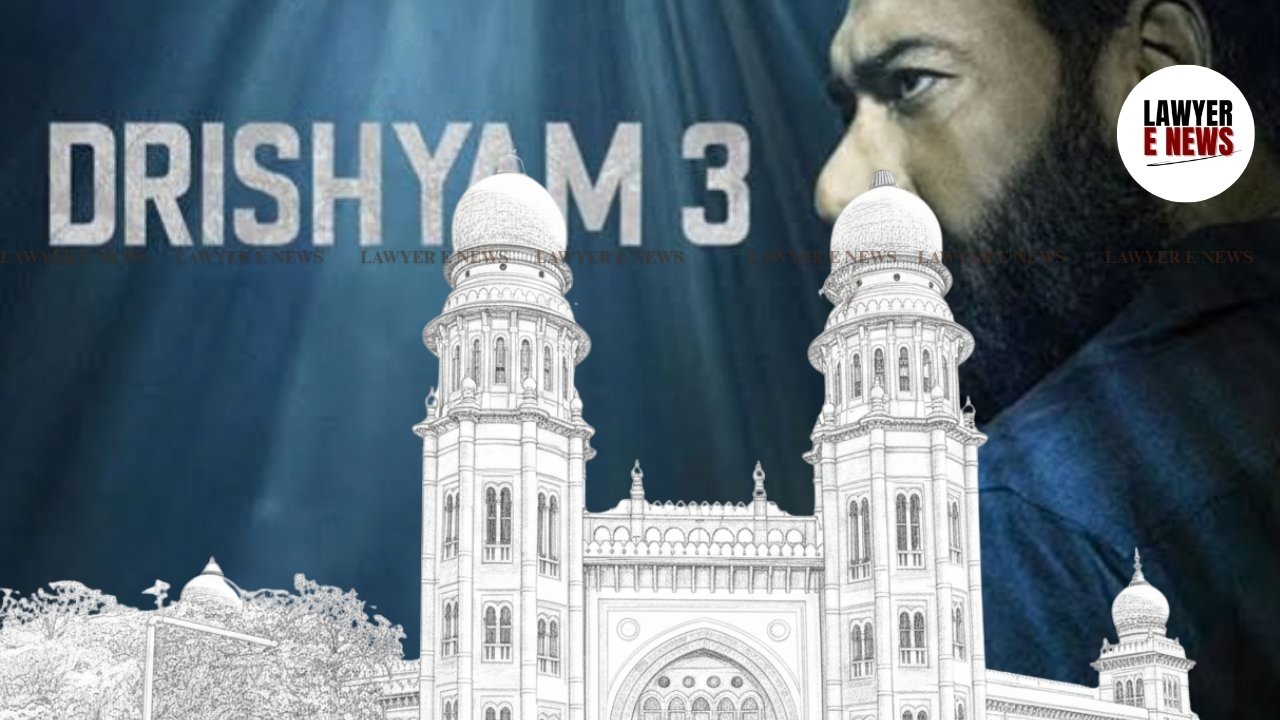
"Before granting such relief, the applicant must place before this Court clear material establishing a subsisting enforceable right which is threatened with imminent infringement." Madras High Court, in a ruling dated 01 October 2026, held that an interim injunction under Section 9 of the Arbitration and Conciliation Act, 1996, cannot be granted to restrain the commercial exploitation of a cinematograph film unless the applicant produces clear material establishing a subsisting and enforceable copyright.
A bench of Mrs. Justice K. Govindarajan Thilakavadi observed that in the face of disputed contractual claims and subsequent assignment deeds, a party cannot seek a sweeping restraint order without prima facie demonstrating an unclouded title to the rights asserted.
The applicant, Rajkumar Theatres Pvt. Ltd., claimed joint ownership of remake rights for the "Drishyam" film franchise in Hindi and North Indian languages, based on agreements dating back to 2013 and 2014. The applicant alleged that the respondents were infringing these rights by producing and releasing a Hindi remake of "Drishyam 3" without their consent. The respondents countered that the applicant had previously assigned these derivative and sequel rights under subsequent settlement agreements, thereby losing the locus to restrain the current production.
The court was primarily called upon to determine whether the applicant had established a prima facie case of copyright infringement sufficient to warrant an interim injunction under Section 9 of the Arbitration and Conciliation Act. Furthermore, the court examined whether the alleged subsisting rights of the applicant could be enforced in the face of conflicting assignment documents and subsequent settlement agreements relied upon by the respondents.
Nature of Section 9 Jurisdiction
The court underscored that the power to grant interim protection is not automatic. While the applicant invoked Section 62 of the Copyright Act, 1957, in conjunction with Section 9 of the Arbitration Act, the bench clarified that such jurisdiction is circumscribed by the necessity of proving a clear, enforceable right. The court emphasized that the requested relief—a worldwide injunction—would carry severe commercial consequences for third parties.
Requirement of Clear Evidence
The bench noted that the material placed before the court was insufficient to prove that the applicant retained an exclusive or joint copyright over the Hindi remake rights of "Drishyam 3." Given the complexity of the competing claims, the court held that the existence of the applicant's rights remained a matter for substantive adjudication rather than interlocutory determination.
"The material presently placed before this Court does not, at this interlocutory stage, establish with sufficient clarity that the applicant continues to possess an exclusive or joint copy right in the Hindi remake rights of 'Drishyam 3', particularly in view of the subsequent assignment and settlement documents relied upon the respondents."
Adjudication of Contractual Disputes
The court further observed that the core of the dispute lay in the interpretation of various agreements and the conduct of the parties over several years. Whether the initial 2013 rights survived the later 2014 assignment and the 2022 settlement agreements requires a deeper examination of evidence. Consequently, the court found it improper to grant an injunction based on assertions that are "seriously disputed."
"Having regard to the nature of the competing contractual and copy right claims, and the fact that the applicant’s asserted rights themselves are seriously disputed on the basis of subsequent documents, this Court is not persuaded that the applicant has, at this stage, established the necessary foundation for the grant of sweeping restraint."
The High Court dismissed the application, finding that the applicant failed to establish the foundational requirements for interim injunctive relief. The court reiterated that in commercial disputes involving intellectual property, the balance of convenience and the presence of a clear prima facie case are mandatory thresholds that the applicant failed to meet.
Date of Decision: 01 October 2026