-
by sayum
26 October 2026 4:04 PM







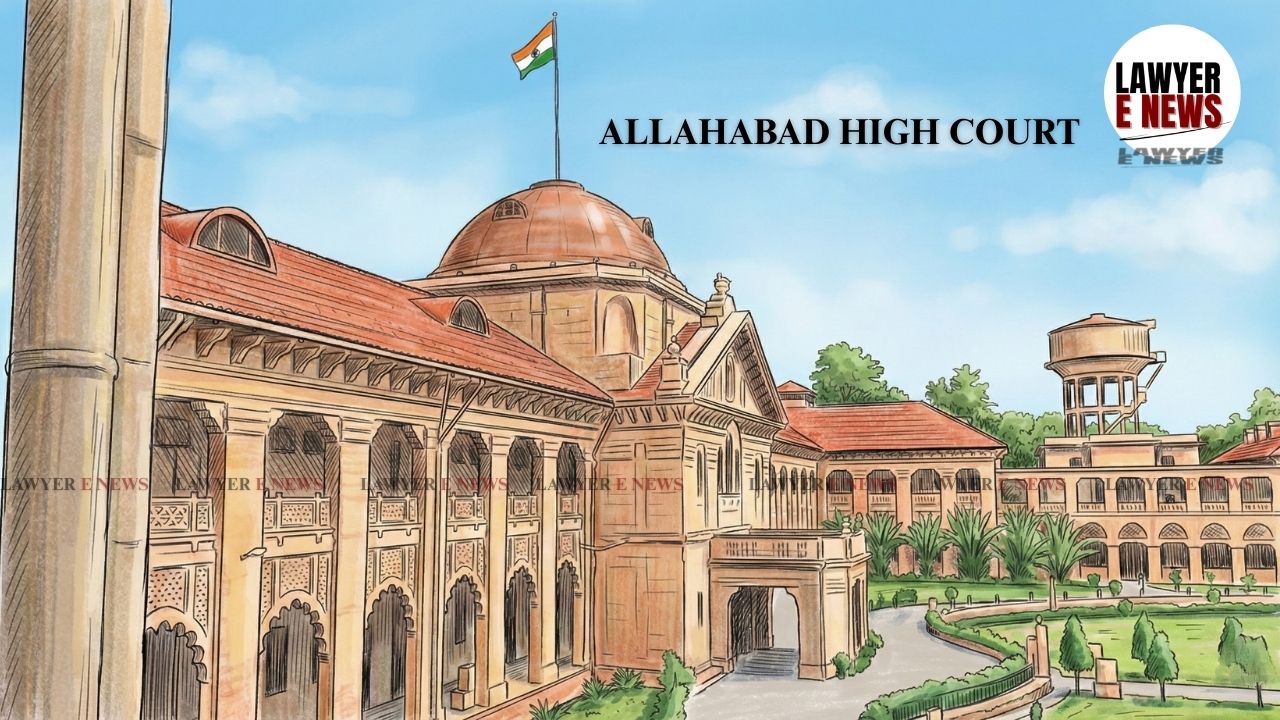
"The appellate court is duty-bound to examine whether the compensation awarded conforms to the statutory mandate and, if found deficient, the court is duty-bound to enhance the same so as to ensure that the claimants receive ‘just compensation’ as per law." Allahabad High Court has reaffirmed that appellate courts possess the inherent power and duty to enhance compensation in motor accident claims, even in the absence of a cross-appeal or cross-objection filed by the claimants.
A bench of Justice Prashant Kumar observed that the objective of the Motor Vehicles Act, 1988 is to provide "just and fair" compensation, and courts should not allow technical procedural hurdles to impede this mandate.
Court Rejects Hyper-Technical Approach
The appeal arose from an order of the Motor Accident Claims Tribunal, Faizabad, which had awarded Rs. 7,20,000 to the family of one Sabhajeet Tadmali, who died in a 2017 road accident. The Insurance Company challenged the award, arguing that the offending vehicle was stolen, the driver’s name on the license had a minor discrepancy, and the deceased’s age was incorrectly assessed. The claimants, though not having filed a formal cross-appeal, sought enhancement during the hearing, citing that the Tribunal had failed to apply the minimum wage notification and the guidelines laid down in National Insurance Co. Ltd. v. Pranay Sethi.
No Legal Embargo On Enhancement
Addressing the maintainability of the claimants' request, the Court relied on Order XLI Rule 33 of the Code of Civil Procedure (CPC). Justice Prashant Kumar held that the provision enables the appellate court to pass any order which ought to have been passed, provided the parties are before the court and the question arises from the judgment. "The appellate courts are empowered to make whatever order it thinks fit and proper to do complete justice, not only between the appellant and the respondent but also between one respondent and another respondent," the Court noted.
Court Clarifies Scope Of Power Under Order XLI Rule 33 CPC
The bench emphasized that when an Insurance Company assails an award on the ground of quantum, the entire issue of compensation is set at large. The Court noted that in such a scenario, the appellate court is duty-bound to ascertain if the awarded sum is truly "just compensation." Relying on the Supreme Court’s observations in Surekha v. Santosh and Ranjana Prakash v. Divl. Manager, the High Court ruled that a "hyper-technical approach" would defeat the purpose of the beneficial legislation.
Aadhaar Card Not Conclusive Proof Of Age
Regarding the Insurance Company's contention that the deceased’s age was higher based on his Aadhaar card, the Court rejected it as conclusive proof. Citing Saroj & Ors. v. IFFCO-TOKIO General Insurance Co., the Court held that an Aadhaar card serves as proof of identity but is not a valid document for establishing date of birth in motor accident compensation claims. The Court instead relied on the family register, concluding that the Tribunal had rightly adopted the multiplier of 13 for the age bracket of 45–50 years.
Minimum Wages As Yardstick For Notional Income
The Court further enhanced the monthly income of the deceased from Rs. 5,000 to Rs. 7,400.46, aligning it with the minimum wage notification for unskilled labor issued by the Uttar Pradesh Labour Commissioner at the time of the accident. While referencing Chandra @ Chanda v. Mukesh Kumar Yadav, the Court held that in the absence of salary certificates, minimum wage notifications serve as a legitimate yardstick to ensure compensation is not "totally detached from reality."
Consortium And Conventional Heads Revised
Applying the principles from Pranay Sethi, Magma General Insurance, and New India Assurance Co. Ltd. v. Somwati, the Court modified the conventional heads. It explicitly clarified that "loss of love and affection" is no longer a separate head of compensation and is subsumed within "loss of consortium." The Court awarded Rs. 48,400 each to the wife and two children as filial and parental consortium, noting that every claimant is entitled to a separate amount under this head. The total compensation was consequently increased from Rs. 7,20,000 to Rs. 11,43,565.
Date of Decision: 23 September 2026