-
by sayum
30 August 2026 4:28 AM







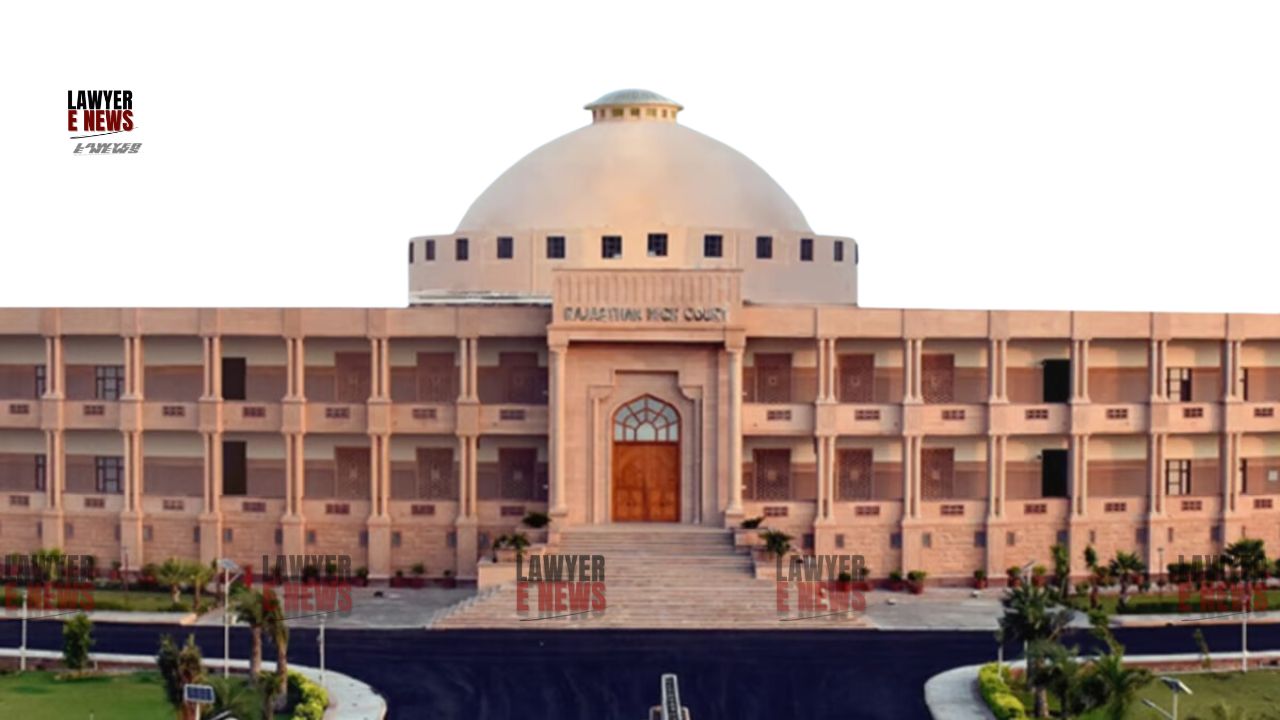
“Detention of Vehicles Achieves Nothing—Interim Release with Safeguards Is Lawful and Sensible”, Delivering a significant ruling the Rajasthan High Court at Jodhpur, in a judgment authored by Justice Kuldeep Mathur, upheld the validity of orders passed by the District Collector, Banswara, allowing interim release of vehicles seized in cases involving alleged illegal transportation of bovine animals.
The Court held that the Collector is a competent quasi-judicial authority under Section 6-A of the Rajasthan Bovine Animal (Prohibition of Slaughter and Regulation of Temporary Migration or Export) Act, 1995, and does not require prior confiscation proceedings to exercise jurisdiction for releasing vehicles on supurdginama.
Observing that “detention of vehicles serves no practical purpose and causes economic loss to both private parties and the State, the Court ruled that the interim release of seized vehicles was both legal and justified.
The petitions were filed by Lok Priya Panchal and others, challenging the orders of the District Collector, Banswara, who had directed the release of vehicles that were seized by police in connection with FIRs registered under the 1995 Bovine Act and the Prevention of Cruelty to Animals Act, 1960.
The petitioners argued that such orders could only be passed by the Magistrate and that the Collector acted beyond his jurisdiction, especially in the absence of any prior confiscation proceedings. They further invoked the Cruelty to Animals (Care and Maintenance of Case Property Animals) Rules, 2016, to argue that a holistic view should have been taken given the dual application of statutes.
On the other hand, the State contended that the Collector was the statutorily designated competent authority under Section 6-A, and that the law empowered him to take interim decisions on the custody or release of vehicles used in the commission of offences under the Act.
The Collector’s Jurisdiction Is Statutory and Exclusive
Rejecting the petitioners' objections, the Court delivered a categorical pronouncement:
“The District Collector, acting under Section 6-A of the 1995 Act, functions as a quasi-judicial authority. His powers are distinct from those exercised by Magistrates under the Criminal Procedure Code.”
Justice Kuldeep Mathur drew extensively from the precedent laid down by a co-ordinate bench in Rameshwar v. State of Rajasthan, 2024 (3) Cr.L.R. (RAJ) 1196, which had clarified that proceedings under Section 6-A are not criminal in nature but quasi-judicial, and run parallel to any ongoing criminal trial.
The Court held: “Confiscation proceedings are not a prerequisite for release of vehicles on interim custody. Such release can be ordered with proper safeguards, including undertakings and financial securities, to ensure appearance and compliance.”
Further reiterating the law, the Court quoted from the Rameshwar judgment: “The detention of a vehicle for a prolonged period results in its deterioration. Interim release is therefore not only lawful but economically and administratively prudent.”
The Court observed that Section 6-A(3) of the Act was unequivocal in stating that no other authority, including courts, shall exercise jurisdiction once seizure is made under the Bovine Act.
“Notwithstanding anything contained in any law for the time being in force, any Court, Tribunal or other authority shall not have jurisdiction to make order with regard to the possession, delivery, disposal or release of such means of conveyance.”
No Overlap with Magistrate’s Powers Under Prevention of Cruelty to Animals Act
The Court also dealt with the petitioners' contention that since FIRs were also registered under the 1960 Prevention of Cruelty to Animals Act, only a Magistrate had authority to deal with the case property.
Justice Kuldeep Mathur clarified that no orders had been passed by the Magistrate under the 2016 Rules, and therefore, the District Collector’s jurisdiction remained unimpaired.
“In the absence of any order by the Magistrate, the Collector—being the competent authority under the Bovine Act—was well within his rights to pass interim orders regarding possession or release.”
The Court acknowledged the possibility of concurrent jurisdiction under different statutes but emphasised that each must be respected within its own legislative framework.
Furnishing Undertakings: A Sensible Safeguard
In allowing the Collector’s orders to stand, the Court directed the petitioners to submit written undertakings before the Collector stating that they:
Shall produce the vehicles whenever required during trial, and
Shall not create any third-party rights in the vehicles until the conclusion of proceedings.
The Court noted that this arrangement offered a balanced solution, protecting public interest while preventing unnecessary economic loss or degradation of property.
No Appeal Under Section 6-A, But Legislative Reform Recommended
While dismissing the petitions, the Court expressed concern that Section 6-A lacks any appellate or revisional remedy, despite dealing with matters involving seizure, penalty, and property rights.
Justice Mathur echoed the recommendation of the coordinate bench in Rameshwar:
“The State Legislature ought to consider introducing a right of appeal or revision against orders passed under Section 6-A, similar to provisions found in the Rajasthan Excise Act or under Section 7(3) of the Bovine Act itself.”
The High Court’s ruling underscores that District Collectors are not mere administrators, but statutory quasi-judicial authorities with exclusive jurisdiction under Section 6-A of the Bovine Act, 1995.
“It is a mistake to assume that Magistrates alone control every aspect of case property in criminal cases. Where statutes confer exclusive powers to other authorities, such powers must be respected and given full legal effect.”
This judgment provides much-needed clarity on a recurring issue in bovine transportation cases and safeguards against bureaucratic overlap, while also urging the government to fill legislative gaps to ensure appellate review in future.
Date of Decision: 06 August 2025