-
by sayum
28 August 2026 10:07 AM







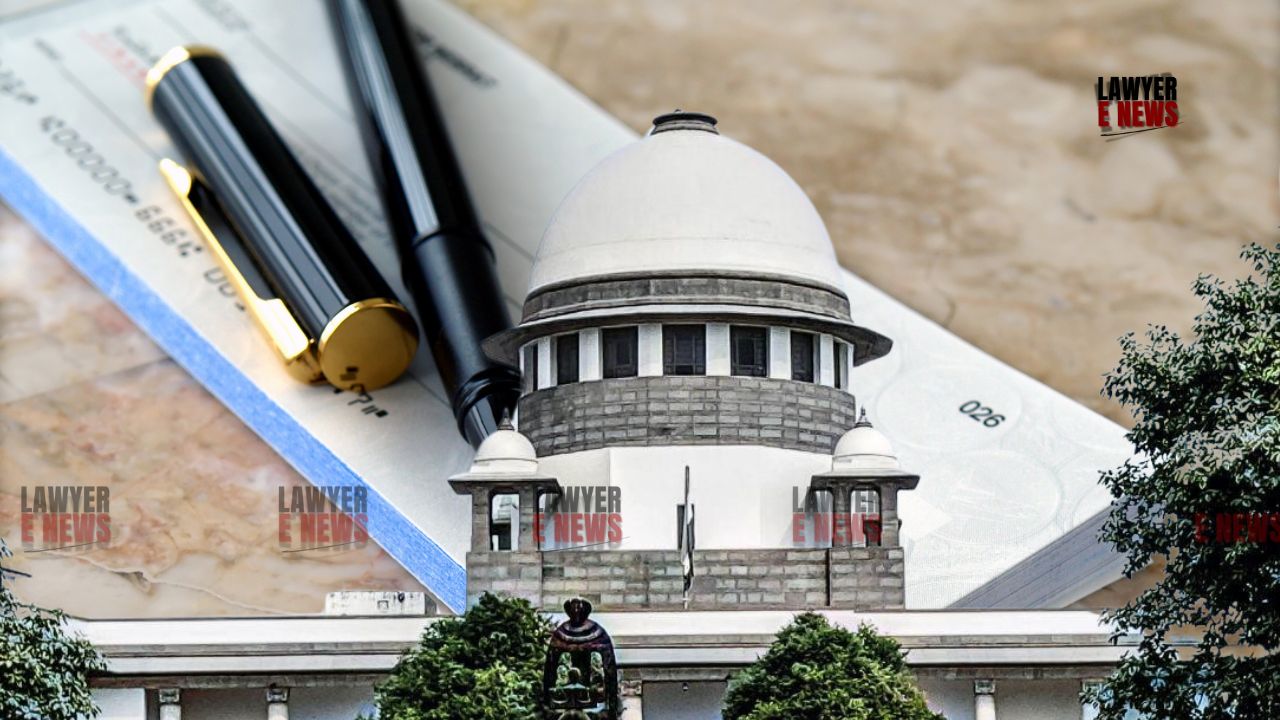
“Once the Complainant Accepts the Full and Final Settlement, Section 138 NI Act Cannot Hold Water”, Supreme Court of India setting aside the concurrent conviction of the appellant under Section 138 of the Negotiable Instruments Act, 1881, on the basis of a compromise deed entered into by the parties after dismissal of a criminal revision petition. The bench comprising Justices Aravind Kumar and Sandeep Mehta held that once a complainant voluntarily accepts a settlement in full satisfaction, proceedings under Section 138 NI Act become legally untenable.
The case arose from a complaint filed by respondent no. 1 (Harpal Singh) under Section 138 of the NI Act, alleging that the appellant, Gian Chand Garg, had borrowed ₹5,00,000 and issued a cheque towards repayment, which was dishonoured with the endorsement "funds insufficient." A legal notice followed, and upon failure to receive the amount, a criminal complaint was filed.
The Judicial Magistrate First Class convicted the appellant on April 21, 2010, sentencing him to six months' simple imprisonment and a fine of ₹1,000. This conviction was upheld first by the Additional Sessions Judge and subsequently by the Punjab and Haryana High Court on March 27, 2025, in CRR No. 2563 of 2010.
After the High Court’s decision, the parties entered into a settlement dated April 6, 2025, pursuant to which the complainant agreed not to oppose any application filed by the appellant to seek modification or acquittal. However, when the appellant approached the High Court for modification of its earlier order, the same was dismissed on the ground of non-maintainability.
The Supreme Court considered the key question: Can a conviction under Section 138 NI Act be quashed after a voluntary post-conviction compromise between the complainant and the accused?
The Court emphasized that Section 138 is “primarily a civil wrong made compoundable” under Section 147 of the NI Act, especially after the 2002 amendment. Relying on a consistent line of precedents, the Court laid down the following guiding principles:
On Nature of Offence under Section 138
Quoting its earlier decisions, the Court noted: “Dishonour of cheque causes incalculable loss, injury and inconvenience to the payee… however, the nature of offence under Section 138 primarily related to a civil wrong and the 2002 amendment specifically made it compoundable” — Meters and Instruments Pvt. Ltd. v. Kanchan Mehta (2018) 1 SCC 560
It further reinforced the analogy laid down in P. Mohanraj v. Shah Brothers (2021) 6 SCC 258: “Section 138 NI Act is a Civil Sheep in Criminal Wolf’s Clothing.”
This reflects that the proceedings under this provision are quasi-criminal, introduced to bolster confidence in commercial transactions, but remain fundamentally of civil nature.
On Effect of Settlement
The Court relied on M/s Gimpex Pvt. Ltd. v. Manoj Goel (2021) SCC OnLine SC 925:
“Once parties voluntarily enter into such an agreement and agree to abide by the consequence of non-compliance, they cannot be allowed to reverse the effects of the agreement by pursuing both the original complaint and subsequent complaint arising from such non-compliance.”
And reiterated the decision in B.V. Seshaiah v. State of Telangana (2023):
“When parties compound the offence to save themselves from litigation, the law allows them to do so. The courts cannot override such compounding and impose their will.”
The Court noted that the compromise deed dated April 6, 2025, and the supporting affidavit filed by the complainant confirmed receipt of the following payments:
Two demand drafts of ₹2.5 lakhs each dated 04.04.2025 and 11.02.2025
Three cheques of ₹1 lakh each dated 10.05.2025, 10.06.2025, and 10.07.2025
The Court observed:
“Once the complainant has signed the compromise deed accepting the amount in full and final settlement of the default sum, the proceedings under Section 138 of the NI Act cannot hold water…”
Hence, the Court quashed the conviction and sentence imposed by the lower courts and allowed the appeal.
The Supreme Court, reaffirming the principle of decriminalization through compounding under Section 138 of the NI Act, emphasized that voluntary and complete settlement between the complainant and accused extinguishes the criminal liability, even after a conviction.
This ruling bolsters the objective of promoting settlement in cheque dishonour cases and deterring unnecessary litigation when disputes are resolved amicably.
Date of Decision: August 11, 2025