-
by sayum
09 August 2026 1:53 PM







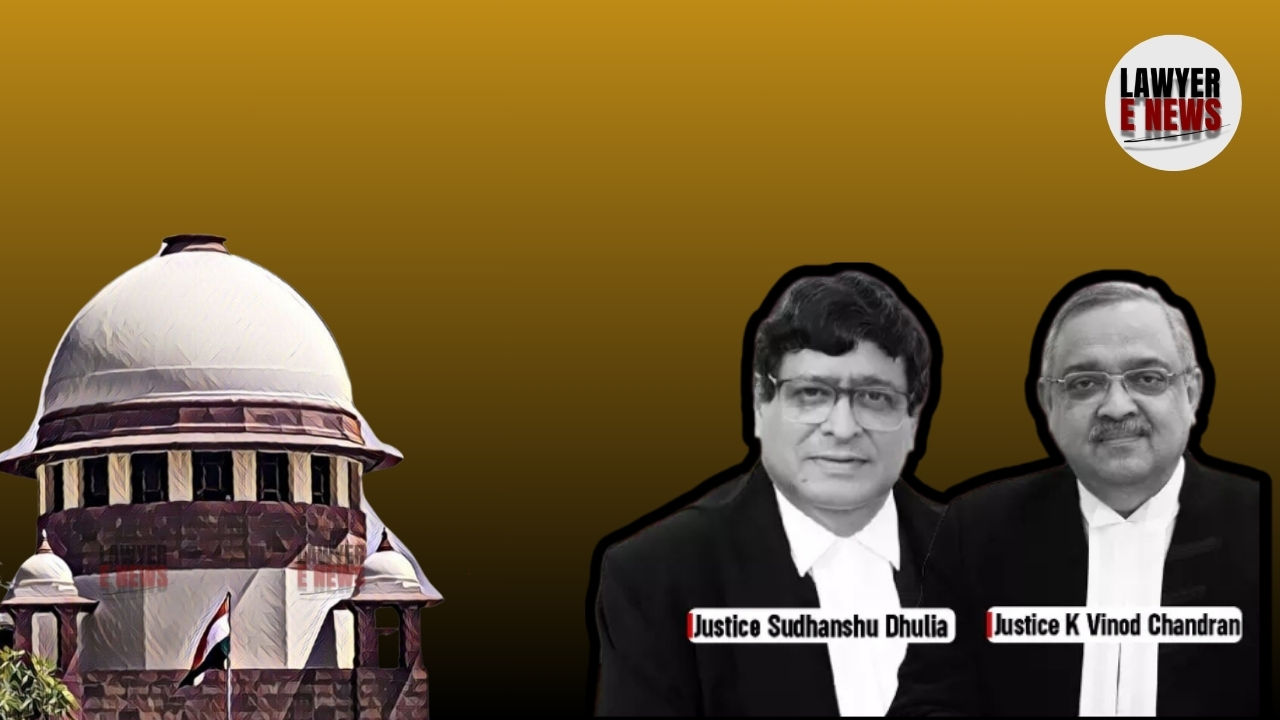
“Mere delay in registering FIR cannot demolish a rightful claim when the accident is contemporaneously recorded and supported by eyewitness testimony”— In a strong affirmation of claimants’ rights under the Motor Vehicles Act, the Supreme Court of India restored compensation to the widow and three minor children of a deceased peon . A Bench comprising Justice Sudhanshu Dhulia and Justice K. Vinod Chandran set aside the High Court’s judgment which had denied compensation citing delayed FIR and inconsistencies in the eyewitness account. The Supreme Court reinstated the Tribunal’s award of ₹46,29,152/- under Section 166 of the Motor Vehicles Act, 1988, directing expeditious payment to the bereaved family.
The deceased, a peon employed in a local school, met with a fatal road accident on his way home after his motorcycle collided with a high-speed vehicle. His widow and three minor children filed a compensation claim under Section 166 of the Motor Vehicles Act, seeking ₹53,79,820/-. The Motor Accident Claims Tribunal, after considering the evidence, granted ₹46,29,152/- as compensation for loss of dependency.
The insurance company, however, contested the Tribunal’s award before the High Court, mainly arguing that the offending vehicle was falsely implicated due to a delay of three months in lodging the FIR. The High Court accepted these arguments, set aside the Tribunal’s award, and denied compensation altogether.
Aggrieved, the widow and her minor children approached the Supreme Court seeking restoration of their rightful compensation.
The principal legal issues before the Court revolved around the effect of delay in FIR registration, credibility of eyewitness testimony marred by minor inconsistencies, and overall proof of involvement of the offending vehicle in the fatal accident.
“Delay in FIR by itself is not a ground to deny rightful compensation” — Supreme Court
The Supreme Court pointedly disagreed with the High Court’s adverse inference drawn from the delayed FIR. The Bench highlighted that a Murg report was filed on the same day of the accident, immediately upon the deceased’s admission to the hospital. The Court underscored,
“The mere fact that PW-2, the eyewitness, did not approach the police cannot be a reason to find the delay in FIR to be suspicious.”
The Court emphasized that an investigation was promptly initiated following the Murg report and the FIR was eventually registered after verification, thus rendering the delay non-fatal to the claim.
“Eyewitness testimony cannot be rejected for trivial mistakes regarding vehicle details” — Supreme Court
The High Court had disbelieved the sole eyewitness, PW-2, due to minor inconsistencies about the colour and type of the number plate. The Supreme Court strongly disapproved of this reasoning, observing,
“The High Court, on an appeal by the insurance company, picked holes in the deposition of the eyewitness; according to us without just cause.”
The Court clarified that peripheral errors in vehicle description, such as misremembering the colour of the number plate, are natural in human recollection and cannot invalidate the core testimony confirming the accident.
The Bench further noted that the insurance company failed to summon the investigating officer to dispute the findings, observing,
“We do not find any reason to disbelieve the FIR, especially since the insurance company did not make any attempt to examine the investigating officer before the Tribunal.”
“When the accident is proved through contemporaneous hospital report and credible eyewitness, compensation must follow” — Supreme Court
Referring to the documentary evidence in the form of the Murg report and unshaken eyewitness testimony, the Court firmly held that the insurance company’s objections were devoid of merit.
The Supreme Court set aside the High Court judgment in its entirety, reinstating the compensation granted by the Tribunal. It directed:
“The amounts, with interest, as awarded by the Tribunal shall be disbursed to the claimants within a period of two months, which shall be equally apportioned in the name of the wife and three minor children.”
Protecting the interests of minor children, the Court mandated,
“If any of the minor children have not attained majority, the amount shall be kept in a fixed deposit, the interest of which can be disbursed to the mother who is the guardian.”
The Court also issued a timeline for compliance, warning, “The insurance company shall deposit the amounts within the period stipulated before the Tribunal and the Tribunal shall apportion the amounts as directed.”
With this decision, the Supreme Court has reiterated the settled principle that procedural lapses like delay in FIR cannot nullify genuine compensation claims under the Motor Vehicles Act when credible evidence establishes the accident. The judgment is a firm stance against hyper-technicalities depriving dependents of their rightful dues.
Summarizing the essence of justice in accident claims, the Court declared,
“Compensation under the Motor Vehicles Act is intended to mitigate the irreparable loss of dependents, and cannot be denied on the basis of mere procedural technicalities or minor factual inconsistencies.”
This ruling provides renewed protection to accident victims and their families against unwarranted denial of compensation due to delayed procedural compliance or overly rigid judicial scrutiny.
Date of Decision: 14th July 2025