-
by sayum
09 August 2026 11:43 AM







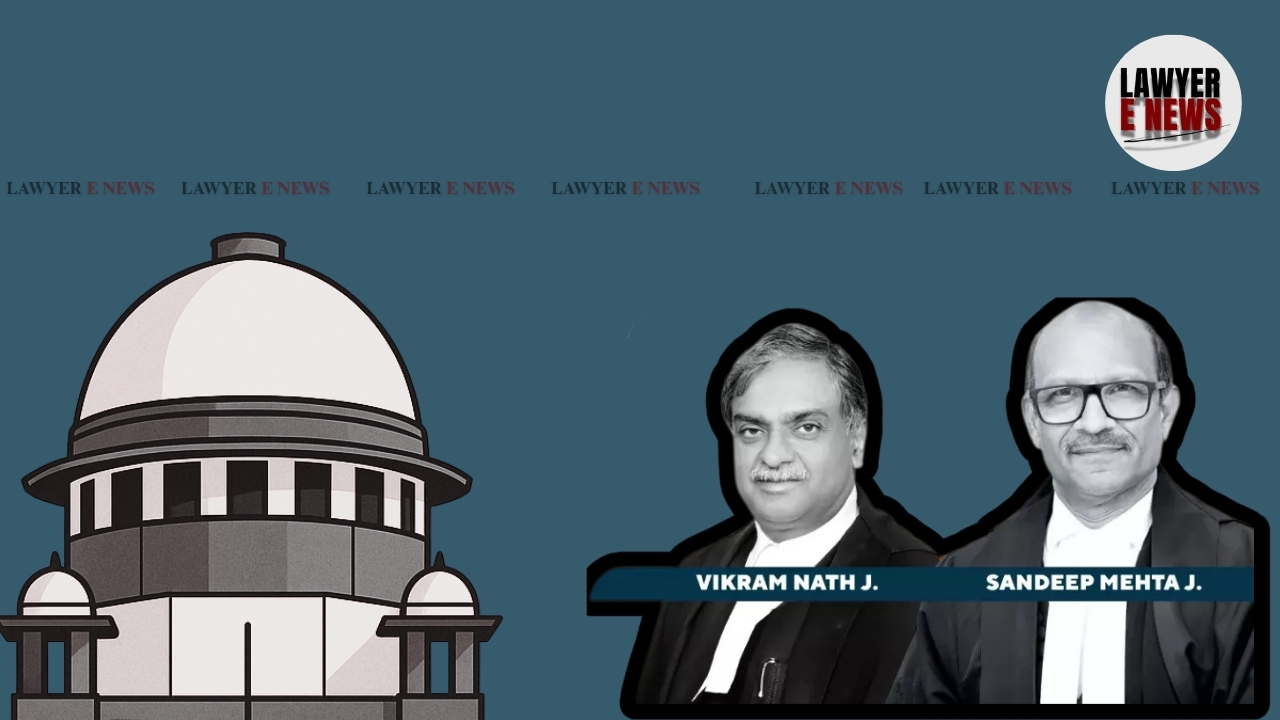
In a scathing judgment delivered on 21st July 2025, the Supreme Court of India cancelled the bail granted to a Superintendent of a women’s protection home accused of sexually exploiting female inmates under her care. The Court found serious procedural violations in the bail order granted by the Patna High Court and expressed severe disapproval of how the criminal justice system ignored the victim’s fundamental rights. In the case of Victim ‘X’ versus State of Bihar and Another, the Bench of Justice Vikram Nath and Justice Sandeep Mehta categorically held that bail granted in violation of the statutory mandate of Section 15A(3) of the Scheduled Castes and Scheduled Tribes (Prevention of Atrocities) Act, 1989 is legally unsustainable. The Supreme Court declared, “Where the victim’s right to be heard is violated, the bail order stands vitiated on this ground alone.”
The Supreme Court was examining an appeal filed by the victim under Article 136 of the Constitution of India challenging the order dated 18th January 2024, passed by the High Court of Patna. The High Court had granted bail to respondent no.2, the Superintendent of Uttar Raksha Grih, Gaighat, Patna, against whom shocking allegations of sexual exploitation, forced administration of intoxicants, and mental torture had been levelled by the victim and other inmates of the protection home. The FIR had been registered under serious charges including Sections 376, 328, 341, 342, 120B of the Indian Penal Code, Sections 3 and 4 of the Immoral Traffic (Prevention) Act, and Sections 3(1)(w) and 3(2)(va) of the SC/ST Act. The Supreme Court noted that these allegations were corroborated by statements of several inmates recorded under Section 164 of the Code of Criminal Procedure, 1973.
Tracing the background of the case, the Supreme Court observed that the present proceedings stemmed from the High Court’s suo motu cognizance of a newspaper report revealing the horrific ordeal of female inmates. Despite the gravity of the charges, the Patna High Court allowed bail to respondent no.2 without issuing any notice to the victim or affording her an opportunity of hearing, in gross violation of Section 15A(3) of the SC/ST Act. The Special Court under SC/ST Act, Patna, had earlier rejected the bail application on 10th July 2023 after examining the material on record, which included statements of victims, charge-sheet and medical evidence. The accused was nonetheless granted bail by the High Court in a perfunctory one-line order stating, “There is no specific allegation against the appellant.”
The Supreme Court criticised the High Court’s approach and found its order to be manifestly erroneous and unreasoned. Justice Sandeep Mehta, delivering the verdict, recorded that the accused, who was in a position of authority, grossly abused her power by exposing helpless women to sexual exploitation rather than protecting them. The Court described the incident as one where “the custodian turned into a perpetrator of the gravest kind of exploitation.” The Court condemned the fact that after being granted bail, respondent no.2 was reinstated in service and shockingly, was again placed in charge of another women’s protection home. This, according to the Court, was a glaring example of systemic failure where administrative authorities facilitated continuance of an accused in positions of power despite being charged with heinous crimes.
The Supreme Court expressed alarm at the State’s lack of sensitivity and recorded that despite repeated queries, the State’s counsel was unable to justify how an accused in such a grave case was reinstated in service. The Court found that the continued liberty of respondent no.2 posed a serious threat to the fair trial and safety of witnesses, especially the victim inmates, who were already receiving threats. The Supreme Court unequivocally stated, “It is a case where the protector has become the violator; bail to such an accused shocks the conscience of the Court.”
In its detailed reasoning, the Court cited the precedent in Shabeen Ahmad v. State of Uttar Pradesh and Anr., and the principles in Ajwar v. Waseem, where it was reiterated that while bail once granted should not ordinarily be cancelled, it must be revoked where the liberty of an accused endangers justice or when the order granting bail is perverse or without proper reasoning. The Court quoted with approval, “An unreasoned or perverse bail order is always open to judicial correction, particularly in cases involving social crimes where public faith in the judicial process is at stake.”
The Supreme Court took strong exception to the violation of Section 15A(3) of the SC/ST Act which mandates prior notice to the victim before bail is considered in such cases. The Court said, “On this count alone, the bail order deserves to be quashed as the victim’s legal right to be heard was completely ignored.” In addition, the Court remarked that the nature of allegations, which involve breach of public trust, custodial violence, and sexual exploitation, demanded the highest judicial scrutiny and ruled that no accused in such circumstances deserves to remain on bail unless exceptional circumstances exist, which were absent in the present case.
The Court finally allowed the appeal filed by the victim, set aside the High Court’s order dated 18th January 2024, and cancelled the bail granted to respondent no.2. The accused has been directed to surrender within four weeks, failing which the Trial Court has been directed to take her into custody. The Court further directed that adequate protection must be granted to the victims and witnesses during the trial.
The judgment serves as a stern reminder of the judiciary’s commitment to safeguard the rights of the most vulnerable sections of society and to correct arbitrary and unjustified bail orders which may weaken the confidence of the public in the rule of law. The Supreme Court underlined that the criminal justice system cannot be allowed to fail victims who are already subjected to brutal abuse under institutional care.
Date of Decision: 21st July 2025