-
by sayum
29 August 2026 3:15 PM







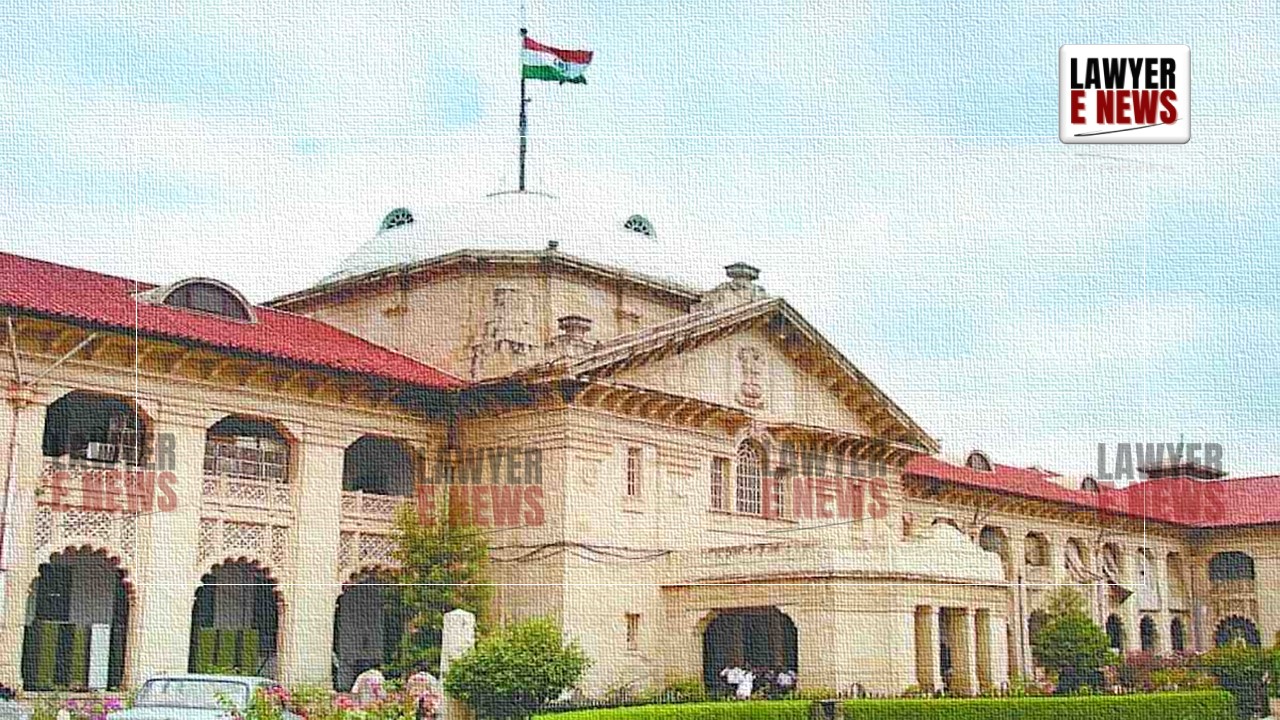
“Civil Disputes Can't Be Painted With Criminal Colour Just to Harass Opponents”, In a strongly worded and legally significant ruling Allahabad High Court (Lucknow Bench) delivered a stern warning against the misuse of criminal law to settle old civil land disputes. Justice Rajnish Kumar held that the criminal complaint filed nine months after the incident was not only retaliatory in nature but a blatant abuse of legal process, intended to harass the accused who had already lodged an FIR the very next day of the occurrence.
Calling out the mala fide intent behind the complaint, the Court observed:
“The complaint appears to have been filed in a counterblast to the FIR... and to give colour of criminal to a civil dispute... which is nothing but an abuse of process of law.”
The dispute arose from an incident dated April 10, 2018, concerning ownership and possession of land bearing Khata No. 4999 in Amethi district. On the following day, April 11, 2018, Sarfaraj, a man reportedly over 88 years of age at the time, filed an FIR under Sections 504 and 506 IPC against Mohd. Ismayl Khan and others, alleging they trespassed on his land, threatened him, and attempted to cultivate it forcibly.
Despite this prompt legal action, Ismayl Khan, who is an advocate by profession, filed a complaint under Sections 147, 427, 504, and 506 IPC on January 4, 2019, nearly nine months later, alleging a similar but inverted version of the same incident. He claimed that Sarfaraj and others trespassed on his land, ploughed his crop of urad, abused him, and threatened him.
The Magistrate, without examining the contradictions and inconsistencies, passed a summoning order on April 13, 2021, which was upheld by both Revisional Courts. Challenging these orders, the accused filed the present 482 CrPC application.
The High Court dismantled the foundation of the complaint with surgical precision, observing that it was not a bona fide attempt to seek justice, but a calculated legal tactic to retaliate against the FIR lodged by Sarfaraj.
Justice Rajnish Kumar noted: “The complaint was filed after about 9 months of the incident… if a person suffered a loss of ₹50,000 due to destruction of crops, he would not keep mum for such a long time, especially when the other party had already lodged a prompt FIR.”
The Court took note of glaring contradictions in the statements under Sections 200 and 202 CrPC, as well as internal inconsistencies within the complaint itself. The complainant initially claimed physical assault, but during deposition, admitted that no one had beaten him and he had only been verbally threatened. The names of the accused fluctuated across statements, and no specific roles were assigned to any accused.
“No specific role has been assigned to anybody… it has also not been disclosed as to who was driving the tractor, or who carried lathi, danda or gun. The allegations are vague and appear concocted.”
Crucially, the Court acknowledged that the core dispute was civil in nature, involving long-standing litigation over land ownership, and that attempts to criminalize civil disagreements erode the sanctity of both civil and criminal jurisprudence.
“A civil dispute... has been given the colour of criminal case... by making vague allegations and without any substantive material. This is a classic case of malicious prosecution.”
Summoning Orders Must Not Be Casual
Referring to the Supreme Court’s judgment in Rikhab Birani v. State of U.P. (2025), the High Court emphasized that summoning orders must reflect conscious judicial application of mind. It stated: “The summoning order should not be passed lightly or as a matter of course. The Magistrate is duty-bound to examine whether the complaint discloses the ingredients of the alleged offence.”
Justice Rajnish Kumar reminded that the mere existence of a complaint does not justify summoning the accused, especially when prima facie material is absent, and facts suggest ulterior motives.
He further observed: “The learned Magistrate has passed the summoning order without considering the contents of the complaint, statements, and whether the alleged offences are prima facie made out or not.”
The Court evaluated each of the invoked sections—147 (rioting), 427 (mischief), 504 (intentional insult), and 506 (criminal intimidation)—and concluded that none were attracted on facts. There were no injuries, no evidence of force or violence, and no specific threats capable of constituting criminal intimidation or provocation.
Referring to Fiona Shrikhande v. State of Maharashtra, the Court reiterated: “Mere abuse, discourtesy, rudeness or insolence may not amount to an intentional insult... unless it has the necessary element of being likely to provoke the person insulted to breach the peace.”
And on criminal intimidation, the Court cited Mohd. Wajid v. State of U.P. to hold: “Before an offence of criminal intimidation is made out, it must be established that the accused had an intention to cause alarm to the complainant.”
None of these essential ingredients, the Court held, were present.
Allowing the application under Section 482 CrPC, the High Court quashed the summoning order dated April 13, 2021, along with subsequent orders dated April 18, 2022 and July 30, 2022, and the entire proceedings in Complaint Case No. 9/2019.
Calling it a textbook case of malicious prosecution, the Court concluded:
“The impugned orders... are nothing but abuse of process of court... The criminal justice system must not be misused to settle private scores in civil matters.”
Date of Decision: August 19, 2025