-
by sayum
11 August 2026 2:00 PM







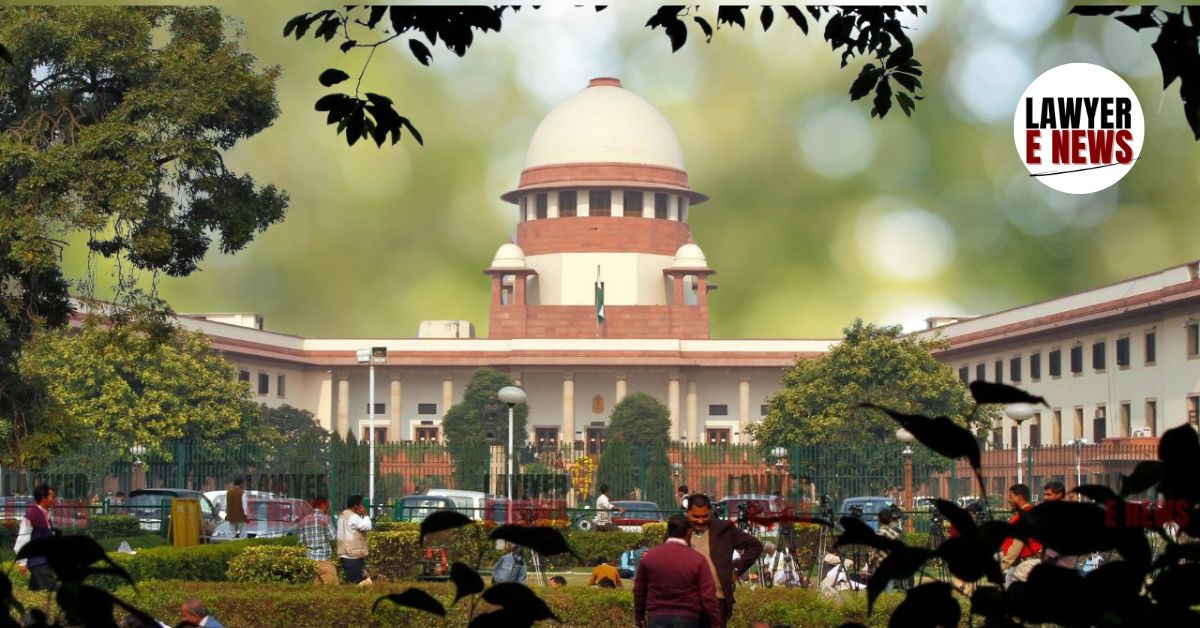
“What the Court under Section 34 cannot do directly, it also cannot do indirectly… the modification of an award is outside the statutory scheme of the Arbitration Act” - In a decisive pronouncement Supreme Court of India restored a major arbitral award that had been partially set aside by the Delhi High Court. The Court held in unequivocal terms that courts exercising jurisdiction under Sections 34 and 37 of the Arbitration and Conciliation Act, 1996 have no power to modify or uphold awards in parts. The bench stated, “It is well settled that a court exercising jurisdiction under Section 34 cannot modify or vary an arbitral award — it can only set aside or uphold it,” and ruled that the Delhi High Court had acted in excess of its jurisdiction by severing and nullifying portions of an otherwise reasoned and enforceable award.
The case arises from a real estate development venture in Gurgaon, where Puri Construction Pvt. Ltd. (PCL) had entered into a Development Agreement dated March 10, 1998, with Larsen & Toubro Ltd. (L&T). Disputes emerged after PCL terminated the contract, citing L&T’s breach of obligations—specifically, its failure to commence construction, pay External Development Charges (EDC), and fulfill its responsibility toward ITCREF, a prior stakeholder in the project. PCL claimed L&T abandoned the project and sought significant damages before an arbitral tribunal.
In an arbitral award dated December 28, 2002, the tribunal awarded over ₹115 crores to PCL under various heads, including ₹35 crores in damages, ₹75 crores in lieu of title deed obligations, ₹5 crores in compensation for failure to return licenses and permits, and ₹30 lakhs as costs. L&T’s counterclaims were rejected. The award was challenged under Section 34 by L&T, and a Single Judge of the Delhi High Court set aside several monetary components of the award. On appeal, the Division Bench upheld findings of breach and coercion against L&T but attempted to sever the monetary reliefs from the rest of the award—inviting the Supreme Court's scrutiny.
The Supreme Court firmly ruled that a court under Section 34 has no power to modify or revise an arbitral award, referring extensively to prior decisions including Project Director, NHAI v. M. Hakeem, McDermott International Inc. v. Burn Standard Co. Ltd., and Dakshin Haryana Bijli Vitran Nigam Ltd. v. Navigant Technologies (P) Ltd.
The Court held, “What the court under Section 34 cannot do directly, it also cannot do indirectly. The approach of the Division Bench in severing the monetary reliefs while sustaining findings of breach is alien to the structure of the Arbitration Act.”
It further declared, “There is no provision in the Arbitration Act empowering courts to modify or vary an award. The only recourse is to uphold or set aside the award.”
The Court noted that the arbitral tribunal had comprehensively addressed the facts, evidence, and obligations under the Development, Supplementary, and Tripartite Agreements. It had rightly concluded that the Supplementary Agreement was vitiated by coercion, and that L&T had abandoned the project, committed breaches, and failed to fulfill statutory and contractual obligations.
Referring to L&T’s own internal communications, refusal to pay EDC, and its abrupt withdrawal from the project site, the Tribunal found economic duress had undermined subsequent agreements and that L&T’s conduct had directly caused loss to PCL.
The bench emphasized, “The quantified damages were not fanciful but logically flowed from the findings of breach. The tribunal based its computation on L&T’s own projected profits in the counterclaim. There was clear evidence and reasoning.”
The Supreme Court restored the arbitral award in its entirety, setting aside the Delhi High Court’s judgment. It upheld the full award of damages and costs granted to PCL, stating:
“If the Court accepts the Tribunal’s findings on coercion, breach and abandonment, it cannot in the same breath reject the consequential reliefs arising from those findings. The arbitral award stands reinstated.”
The Court reaffirmed that arbitral autonomy and minimal judicial interference remain the cornerstones of arbitration law in India. This decision reinforces that courts must not intrude into the merits of an arbitral award beyond what is narrowly permitted under Section 34, and cannot become a court of appeal over arbitrators.
Date of Decision: April 21, 2025