-
by sayum
25 August 2026 4:05 AM







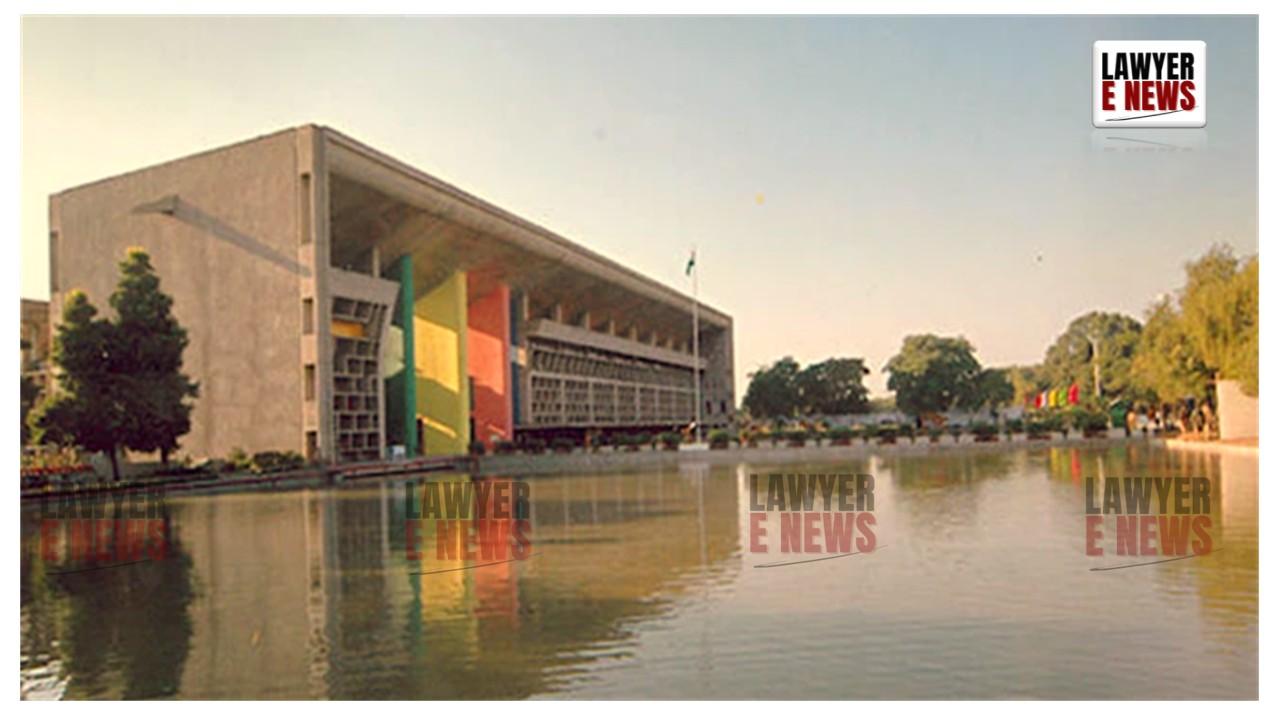
“Imposing Punitive Costs Without Affording Opportunity Violates Procedural Fairness” - Punjab & Haryana High Court, in a significant ruling in CACP No. 43 of 2024, quashed a contempt court order imposing ₹50,000 as costs on government officials for alleged non-compliance with a prior judicial directive concerning regularization of employment. The Bench of Justice Sureshwar Thakur and Justice Kirti Singh ruled that the contempt court acted prematurely and without adhering to mandatory procedural safeguards, stating that "contempt jurisdiction must not be exercised arbitrarily or without first affording the contemnors an opportunity to explain their position."
The case arose from a contempt petition alleging willful non-compliance with a March 2024 order in a writ petition, but the High Court held that imposing coercive costs at the outset was a violation of due process. The judgment reaffirms that contempt jurisdiction must only be invoked sparingly and within the bounds of procedural and substantive fairness.
The respondent, Sushil Kumar, had sought the regularization of his services as a part-time water carrier through CWP No. 17778 of 2018, challenging a previous denial of his claim. On March 20, 2024, the High Court had directed the state to consider the respondent's claim in line with its prior decision in Ashish Sharma v. State of Haryana.
Alleging non-compliance with this directive, the respondent initiated contempt proceedings in COCP No. 4247 of 2024, prompting the contempt court to issue an order on November 21, 2024, directing the appellants (government officials) to file a compliance report within a stipulated time. Failure to comply, the court warned, would result in costs of ₹50,000 being imposed personally on the officers. This punitive order, issued without framing formal charges or allowing an opportunity for explanation, led the appellants to challenge it in CACP No. 43 of 2024.
The appellants argued that the contempt court exceeded its jurisdiction, particularly since they were in the process of filing a Special Leave Petition (SLP) before the Supreme Court against the original writ order. They contended that "coercive action to impose costs on the first date of hearing violated procedural fairness and amounted to a miscarriage of justice."
"Contempt Power Must Be Exercised Sparingly and with Great Caution"
The Court emphasized that contempt jurisdiction is an extraordinary power to ensure the dignity of the court and the enforcement of its orders, but it "must not be exercised in a manner that substitutes itself for the execution of orders or remedies available in law." The Bench quoted from the landmark case of State of J&K v. Mohd. Yaqoob Khan, observing that:
"Where appellate or corrective remedies are being pursued, contempt jurisdiction must be exercised with restraint, and punitive action must await the final outcome of such proceedings."
The Court noted that the appellants had already filed an LPA (Letters Patent Appeal) against the March 2024 order, and the contempt court should have deferred its action until the appeal was resolved. Instead, the contempt court acted prematurely by imposing costs without even framing charges or allowing the appellants to defend themselves.
"Imposing Costs Without Following Rules Violates Principles of Fair Procedure"
The High Court underscored the procedural safeguards enshrined in Rule 10 of the Punjab & Haryana High Court Contempt of Court Rules, 1974, which mandate that alleged contemnors must be given an opportunity to file replies on affidavit and contest the charges. The Court observed:
"Without framing a charge or considering any explanation offered by the appellants, the contempt court acted arbitrarily in imposing costs of ₹50,000. Such a course of action not only violates procedural fairness but also undermines the rule of law."
The judgment cited Sudhir Vasudeva v. M. George Ravishekaran (2014), where the Supreme Court held:
"The power to punish for contempt is drastic and must be exercised with utmost care and caution. Courts must ensure that procedural safeguards are strictly followed before holding anyone guilty of contempt."
"Contempt Proceedings Cannot Be a Substitute for Execution of Orders"
The Bench made it clear that contempt jurisdiction should not be misused as a mechanism to enforce orders, especially when alternative legal remedies such as execution are available. Relying on the decision in R.N. Dey v. Bhagyabati Pramanik (2000), the Court held:
"The weapon of contempt is not to be wielded in abundance or misused to coerce compliance. It is primarily intended to uphold the dignity and authority of the court, not to substitute execution proceedings."
The Court also found that the contempt court had effectively acted as an execution court, disregarding the pending appellate proceedings and violating established judicial principles.
"Appeal Against Contempt Order is Maintainable Under Section 19 of the Contempt of Courts Act"
The High Court addressed the maintainability of the appeal under Section 19 of the Contempt of Courts Act, 1971, which allows appeals against orders "inextricably connected with the imposition of punishment for contempt." The Court observed:
"Even though the contempt court did not explicitly impose punishment, the order to pay costs of ₹50,000 was incidental to and connected with punitive action. As such, the appeal is maintainable under Section 19."
Citing Midnapore Peoples’ Coop. Bank Ltd. v. Chunilal Nanda (2006), the Court reiterated:
"Any direction or decision incidental to the imposition of punishment for contempt is appealable. Procedural lapses in the exercise of contempt jurisdiction cannot go uncorrected."
The High Court allowed the appeal, quashed the contempt court’s order dated November 21, 2024, and discharged the appellants from the contempt proceedings. The Bench also reserved liberty for the respondent to file a fresh contempt petition if the final decision in the LPA remains unimplemented.
The judgment emphasized that: "The majesty of law is best upheld by ensuring fairness and adherence to due process, not by arbitrary or premature punitive action."
The Punjab & Haryana High Court's decision is a resounding affirmation of the principles of procedural fairness and judicial restraint in the exercise of contempt jurisdiction. By quashing the arbitrary imposition of costs, the Court has sent a strong message that contempt proceedings must strictly adhere to procedural rules and must not be misused to bypass execution mechanisms or appellate remedies.
This ruling serves as a critical precedent, reinforcing that the extraordinary power to punish for contempt must always be exercised with caution, fairness, and respect for the rule of law.
Date of Decision: January 16, 2025